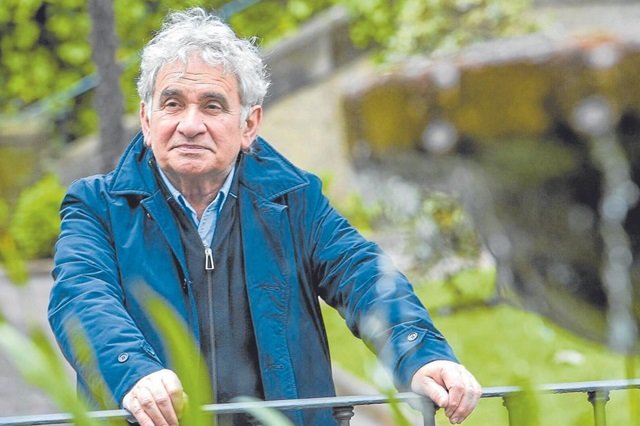
Bernardo Atxaga’s new novel begins with a seemingly mundane fact about death: graves do not necessarily remain occupied forever. Walking through the cemetery in Zestoa, Gipuzkoa, the birthplace of legendary Basque boxer Urtain, the 75-year-old writer asked a local man where the boxer was buried. The man, who had been Urtain’s schoolmate, told him that the cemetery was the right place but that the boxer’s remains had been removed 25 years after his burial. The discovery became the starting point for Golondrinas, published in Spanish by Alfaguara and in Basque, the language in which Atxaga is one of its leading literary figures, by Pamiela under the title Enarak. Atxaga translated the Spanish edition himself.
As reported by EL PAÍS, the novel takes the burial of José Manuel Íbar Azpiazu, known as Urtain after the farmhouse where he grew up, and turns it into the beginning of three interconnected stories. Urtain achieved enormous sporting and popular success before taking his own life in Madrid in 1992. His story has subsequently become a recurring subject in Basque and Spanish culture, including the 2010 theatre production Urtain by Animalario, written by Juan Cavestany, Juan Bas’s 2004 novel La cuenta atrás, and the 2024 essay Urtain. Retrato de una época, which examined the boxer’s cultural legacy.
For Atxaga, Urtain’s story represents more than the rise and fall of a famous sportsman. “Urtain era un príncipe del deporte rural, era el más fuerte del País Vasco, y muy ágil,” he says. Urtain had cut trees, lifted stones and dragged stones with oxen before becoming a boxer and dealing with the weight of fame. He was received by the dictator Francisco Franco after winning the European championship. Atxaga describes him as “un hombre extraordinario”, but sees his journey as that of a man who left one world for another and could not return. Asked where Urtain emigrated, the writer gives a characteristically compressed answer: “Al boxeo.”
That idea of departure and failed return shapes the novel. Urtain is buried in the cemetery of Arroa Goia, where numerous rural sportsmen and boxers, including Pedro Carrasco, attended his funeral. Twenty-five years later, his remains are removed and another character, Guillermo el Tirolés, takes the same grave. Guillermo had attended Urtain’s burial. A third character, Pedro, witnesses the removal of the boxer’s remains and later occupies the same grave himself, with his burial taking place another 25 years later, in 2042. Three burials therefore take place in the same space, each separated by a quarter of a century, linking different lives and deaths.
The narrative is accompanied by four “military angels” who are, in reality, demons from Lucifer’s legions. Characters with names such as Semiyazza and Azazel, inspired by John Milton’s Paradise Lost, provide a running commentary on the events. Their supernatural nature gives Atxaga considerable freedom to move between the comic and the sinister. They use deliberately abrasive language, describe colours by Pantone numbers and punctuate their observations with strange exclamations. The result is a form of dark humour that the writer regards as an important means of revealing reality. “A veces el humor cruel desvela una realidad,” he says.
Humour has long been central to Atxaga’s work, although he argues that it remains insufficiently respected in literature. “Eso es porque hay mucho cura sin sotana,” he says, linking literary attitudes to questions of class and arguing that institutions of literary culture have too often dismissed traditional and popular forms. His exposure to English-language culture, including rock music and the poetry of W.H. Auden, changed his view. In Golondrinas, detective fiction, fantasy, darkness, absurdity and poetry coexist with autobiographical and historical elements. Atxaga rejects rigid literary categories: “La literatura no es como una vaca en la que puedes decir esto es la rabadilla, esto los cuartos traseros… Toda clasificación es impropia.”
The novel also allows Atxaga to revisit the rural world of his childhood and its gradual displacement by urban life. Urtain’s movement from rural sport to professional boxing becomes, in the writer’s interpretation, a possible metaphor for the abandonment of rural communities. Atxaga recalls his own childhood in a rural village, followed by adolescence in an industrial town and studies in Barcelona, describing those experiences as something preserved “como en una caja”. Asked whether this reflects nostalgia, he says he has resisted expressing it because nostalgia has a poor reputation. At 75, however, he says he is less concerned with such reservations. “Yo creo que hoy en día la gente se siente abrumada, y muchas actitudes políticas tienen que ver con eso,” he says. For him, resistance can be found in poetry.
Atxaga has suggested that Golondrinas could be his final novel because writing one leaves him exhausted. The process, he explains, involves repeated rewriting rather than romantic inspiration. “Como hacen los pintores, escribo, doy un paso atrás para mirar, y vuelvo a escribir, una y otra vez, le doy muchísimas vueltas.” Yet after finishing each book and declaring that he will never do it again, the attraction of literature returns. His latest novel begins with remains being removed from a grave after 25 years; its title points instead towards the creatures he has watched for years circling his garage and filling his notebooks with observations: the swallows.