Kamjong District has emerged as one of the principal theatres of the expanding Naga-Kuki confrontation in Manipur in 2026. Located along the India-Myanmar border and predominantly inhabited by Tangkhul Naga communities, the district has witnessed cross-border attacks, civilian killings, abductions, village arson, clashes between armed formations and the use of increasingly sophisticated weapons. The violence differs in important respects from the predominantly Meitei-Kuki conflict that defined much of Manipur’s post-May 2023 security crisis. In Kamjong, the principal fault line has increasingly involved Naga and Kuki armed groups, with Myanmar-based formations playing a significant role.
The latest incident underscores the deterioration. On September 24, 2026, four Tangkhul Naga civilians were reportedly killed near Pilong village, close to Border Pillars 91-93 along the India-Myanmar border. The deceased were identified as Phami Jajo, Betterson Jajo, Vareishim Jajo and Ningthem Kashak. A fifth civilian, Akhan Kaping, reportedly escaped and subsequently informed villagers and authorities. Police registered a suo motu case and suspected the involvement of Myanmar-based Kuki National Army-Burma (KNA-B) militants who had entered the area from across the border. The Working Committee of the Tangkhul Naga Long (TNL) specifically alleged that KNA-B cadres and armed Kuki elements backed by Myanmar-based People’s Defence Force (PDF) groups carried out the attack.
The September 24 killings followed several months of violence along the district’s border belt. On May 7, 2026, suspected KNA-B cadres and Village Volunteers Eastern Zone (VVEZ) reportedly attacked Tangkhul Naga settlements near Namlee, Wanglee and Choro. Local accounts reported houses being burned and residents fleeing into surrounding forests. Assam Rifles subsequently conducted operations in the area and, on May 9, rescued a Tangkhul Naga woman, Olina Ningshen, who had reportedly been abducted from Namlee during the attacks. Assam Rifles stated that the woman had been abducted by KNA-B and VVEZ and was released south of Z Choro under the supervision of security and intelligence personnel.
The May attacks also indicated a possible change in militant tactics. Local reports alleged that suspected KNA-B militants used drones during attacks on the Namlee Market and Choro village, where several houses were reportedly set ablaze. The reported use of drones is significant because it indicates that armed groups operating in the remote hill areas are capable of employing technology beyond conventional small-arms attacks. SATP had earlier noted the increasing use of sophisticated tactics, including drone attacks, in Manipur’s evolving conflict environment.
Violence has not been confined to attacks on Naga settlements. On June 11, 2026, two Kuki civilians were killed and another two were injured in a pre-dawn attack at Kultuh village under the Chassad Police Station. At least 15 houses were reportedly burned. The deceased were identified as Letminlun Haokip, Head Deacon of the village Church, and Lunminthang Haokip, Chairman of the Church Youth Committee. The Naga Village Guard (NVG) Eastern Command blamed KNA-B for the attack, while the Eastern Kuki Chiefs’ Association (EKCA) alleged the involvement of the Eastern Flank of the Myanmar-based National Socialist Council of Nagalim-Isak-Muivah (NSCN-IM) and the Shanni National Army (SNA). No outfit had claimed responsibility at the time of writing, highlighting the difficulty of establishing responsibility in the border areas.
The Kamjong district has consequently become an arena in which competing armed organisations accuse one another of attacks, while civilian communities remain exposed. On April 13, 2026, four suspected KNA-B cadres were reportedly killed in a clash with NSCN-IM cadres along the Indo-Myanmar border, between Ashang Khullen in Kamjong and Phaiyang village in Myanmar. The firefight reportedly lasted about an hour, and four AK-series rifles were recovered from the deceased. The incident demonstrated that the border is not merely a transit route for armed groups but also a contested operational space in which rival formations confront one another directly.
The confrontation intensified again on April 24, 2026. The National Socialist Council of Nagaland/Government of the People’s Republic of Nagaland (NSCN/GPRN)-Aleng faction claimed that its armed wing had killed five KNA-B cadres in Kamjong District. The outfit said the operation was conducted in retaliation for an earlier attack near T.M. Kasom in Ukhrul District, and alleged that more than 20 KNA-B cadres were camping near the international border. The claim was not independently verified and there was no official confirmation from security agencies. Nevertheless, the episode illustrated the increasingly retaliatory nature of armed confrontations between Naga and Kuki formations operating around the border.
The district has also witnessed violence within the Naga insurgent landscape. On March 28, 2026, at least four cadres of the Naga Army, Eastern Flank of NSCN-IM, were killed in a suspected intra-factional ambush at Hongbei village junction under the Kasom Khullen Block. According to the Eastern Flank, the cadres were returning from duty near the Indo-Myanmar border when they were intercepted by another NSCN-IM-linked group. Two cadres escaped. Following the incident, an angry mob reportedly set fire to the NSCN-IM Wung Tangkhul Region office in Ukhrul District.
According to partial data compiled by the South Asia Terrorism Portal (SATP), Kamjong recorded 19 insurgency-related fatalities in 2026 – 13 terrorists and six civilians – in five separate incidents; in 2025, 24 fatalities (all terrorists) were recorded in a single incident. No insurgency-related fatalities were recorded in 2024. Since 2000, Kamjong has recorded a total of 53 insurgency-related fatalities – 42 terrorists, eight civilians and three Security Force (SF) personnel – in 12 separate incidents (data till September 27, 2026.)
The border’s strategic significance is reinforced by the quantity of arms and explosives recovered from Kamjong. On April 11, 2026, SFs recovered two AK-47 rifles with magazines, a .22 rifle, 16 mortar bombs, six rocket-propelled grenade (RPG) rounds, five grenades, 461 rounds of ammunition of different calibres and 14 12-bore cartridges, from the Border Pillar 115 area under the Chassad Police Station. The recovery points to the availability of substantial quantities of military-grade weaponry in the border belt.
The security challenge also extends to infrastructure. On July 22, 2026, suspected militants destroyed a Bailey bridge over the Namban Lok River between Phange and Chatric villages using what was suspected to be an explosive device. The bridge was reportedly the only road connection linking several villages in the Sahamphung area with essential services, markets and agricultural land. A Telecom Department vehicle was also set ablaze. No outfit claimed responsibility.
Significantly, in view of the prevailing security scenario, the Centre extended the Armed Forces (Special Powers) Act (AFSPA) in Manipur for another six months, effective from October 1, 2026. The “disturbed area” declaration will continue across the State, excluding areas under 13 police stations in five districts, reflecting the continued deployment of security forces amid persistent armed violence.
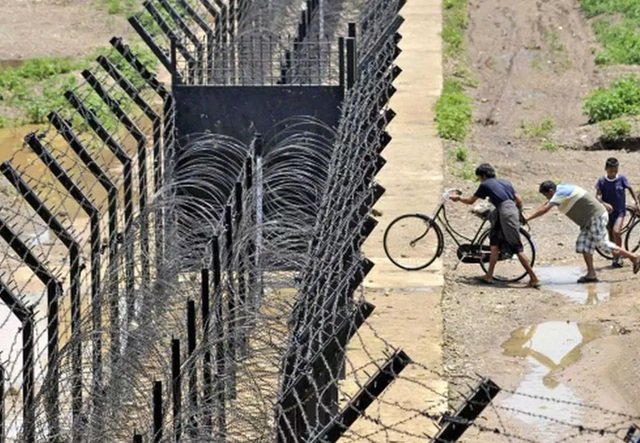
Kamjong’s geography is central to the security problem. The district contains extensive forested and hilly terrain and stretches along the international boundary with Myanmar. Remote settlements, limited road connectivity and the proximity of armed formations operating from across the border create conditions conducive to infiltration, concealment and movement. The May attacks demonstrated the vulnerability of villages located close to the frontier, while the September killings near Border Pillars 91-93 again highlighted the difficulty of protecting isolated settlements.
The role of Myanmar-based armed organisations adds another layer to the conflict. KNA-B has been repeatedly accused by Naga organisations and security sources of crossing into Manipur to conduct operations against Naga settlements. At the same time, Kuki organisations have accused Naga formations, including NSCN-IM-linked groups, of attacking Kuki villages. These competing allegations make attribution particularly difficult. The June 11 Kultuh attack is illustrative: different community-based organisations attributed the incident to opposing armed formations. Consequently, while the presence and activities of armed groups are increasingly evident, responsibility for individual incidents must be established separately, rather than inferred from broader communal alignments.
The district’s present insecurity is also linked to developments in neighbouring Ukhrul. Several attacks against Naga civilians in Ukhrul in April 2026 were followed by armed confrontations involving KNA-B and Naga formations in Kamjong. This geographic overlap demonstrates how violence in one district can rapidly generate retaliatory activity in another. The April 24 KNA-B operation claimed by NSCN/GPRN-Aleng, for example, was explicitly presented by the outfit as retaliation for an earlier attack in Ukhrul. The pattern indicates that local incidents are increasingly being interpreted as part of a wider confrontation rather than isolated security events.
The January 27-30, 2025, clashes provide an indication of the district’s capacity for large-scale armed confrontation. During the fighting near Yaingoupk/Wangli village around Border Pillar 87, 24 militants were reportedly killed in clashes involving KNA-B and Manipur-based insurgent groups, including the People’s Liberation Army (PLA), Kanglei Yawol Kanna Lup (KYKL), United National Liberation Front-Koireng (UNLF-K) and Peoples Revolutionary Party of Kangleipak (PREPAK). 19 of those killed were identified as KNA-B cadres. The incident remains one of the most lethal militant confrontations recorded in the district and demonstrated the concentration of armed groups around the international border.
The September 24, killings thus represent more than another isolated episode of violence. They follow a sequence of cross-border attacks, abductions, village destruction, militant clashes and arms recoveries that has progressively transformed Kamjong into a major conflict theatre. The reported targeting of civilians at Pilong is particularly significant, because it occurred after months of attacks on border settlements and amid growing mutual accusations between Naga and Kuki organisations.
The immediate security challenge is to prevent further attacks on vulnerable border settlements while restricting the movement of armed groups across the international frontier. Strengthening intelligence networks, improving road connectivity, maintaining a visible security presence around exposed villages and protecting critical infrastructure are likely to remain central requirements. Equally important is preventing attacks by individual armed formations from developing into broader retaliatory mobilisation by entire communities.
The significance of the recent violence in Kamjong is further underscored by developments in neighbouring Naga-inhabited districts. On September 26, 2026, three Naga civilians, Rocky Mao, Kumar Poumai and Ashiho Sani (49), were killed and another injured after suspected Kuki Revolutionary Army (KRA) militants opened fire at Kalenjang village in Senapati District. The incident occurred two days after the killing of four Tangkhul Naga civilians at Pilong in Kamjong and amid heightened concern over attacks on Naga civilians in Manipur’s hill districts. The geographical spread of such incidents is significant because it indicates that insecurity is no longer confined to Kamjong’s international border belt. Rather, attacks involving Naga and Kuki populations are increasingly being reported across adjoining Naga-inhabited areas, potentially widening the scope of the emerging Naga-Kuki confrontation.
Kamjong’s significance consequently extends beyond its local geography. The district has become an interface between Myanmar-based armed organisations and competing Naga and Kuki formations within Manipur. The combination of cross-border militant activity, difficult terrain, civilian vulnerability, intra-Naga factionalism and expanding Naga-Kuki confrontation has produced a complex security environment. Unless the cycle of attacks and retaliation is contained, Kamjong is likely to remain one of the principal areas through which Manipur’s wider ethnic conflict intersects with the security consequences of the prolonged instability in Myanmar.