Air pollution carried by heat, wildfires and atmospheric currents has exposed an estimated 40% of the world’s population to extremely high levels of ground-level ozone during the first eight months of 2026, according to a new analysis by the Copernicus Atmosphere Monitoring Service (CAMS). The findings illustrate how pollution generated in one location can affect air quality hundreds or thousands of kilometres away, crossing national borders and, in some cases, oceans.
The report, Atmosphere Watch, draws on millions of observations from satellites, ground-based monitoring networks and aircraft incorporated into CAMS’s global atmospheric pollution prediction system. Its analysis of ozone and Saharan dust extends to 15 September. Ian Marnane, head of the Environment and Health Unit at the European Environment Agency, said air quality in cities, towns and countries “is not only influenced by local activities, but can be affected by pollution from neighbouring or quite distant countries”.
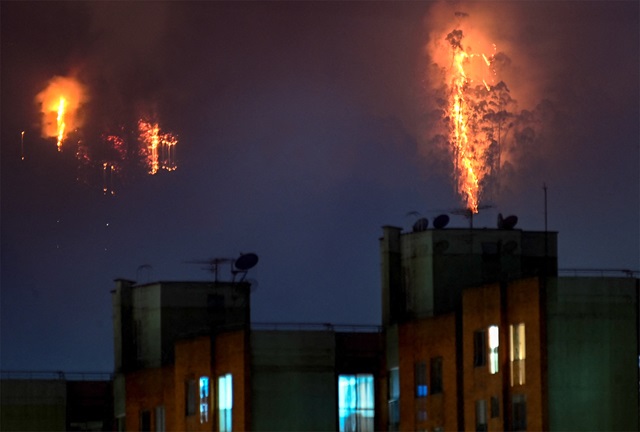
The effects have been visible across Europe. In August, smoke from the major fire in Niebla, in Spain’s Huelva province, contributed to a sharp deterioration in air quality in Seville. Days earlier, Madrid authorities advised residents to remain indoors because smoke from uncontrolled fires in the Sierra Oeste and Ávila province had reached the capital. The CAMS analysis also identifies major fires in France, Spain and Belgium as significant pollution events during 2026.
Ozone pollution has been particularly severe across Asia. CAMS reports that 60% of the continent’s population was exposed to extremely high ozone levels during the eight months examined. In industrialised and densely populated regions, those concentrations were accompanied by significant pollution from particulate matter, nitrogen dioxide and sulphur dioxide. Globally, only 5% of the population experienced good long-term ozone levels during 2026, while 15% experienced what the study classified as reasonable levels.
Europe has also experienced widespread exposure. About half of the European population was exposed to poor, very poor or extremely poor ozone levels during the year, according to the CAMS report. Italy, particularly northern Italy, Spain and Greece were among the countries most affected. In Spain, the Mediterranean coast and the Guadalquivir valley recorded particularly high concentrations. Laurence Rouil, director of CAMS, said the greater exposure in Mediterranean countries was expected because “the countries of the south, the Mediterranean ones, are more exposed to high concentrations of ozone due to sunlight and high temperatures”.
The formation of ground-level ozone is more complicated than a direct emission of the pollutant. It is a secondary pollutant produced through chemical reactions involving nitrogen oxides and volatile organic compounds in the presence of strong sunlight and high temperatures. Nitrogen dioxide can come from traffic and fossil fuels, while volatile organic compounds are emitted by industry, solvents, some household products and vegetation.
That chemistry helps explain what Rouil describes as the “ozone paradox”. European emissions of the chemical precursors responsible for ozone formation have declined clearly since 2005, yet ozone pollution has not fallen correspondingly. The compounds can be transported thousands of kilometres by atmospheric currents, while ozone itself can remain active for days and travel beyond national boundaries. Rouil said reducing precursor emissions remains necessary, but warned that “the responses in terms of concentration are not always proportional”.
The problem has intensified amid unusually high global temperatures in 2026, with heat since June further affected by a record-level El Niño event. CAMS said exposure to ground-level ozone during the first eight months was “extremely high and persistent” across Asia, while Europe and North America experienced several days of very high exposure during repeated summer heatwaves. Oceanía was the least affected continent.
Wildfires added another layer of transboundary pollution. Fires release fine particles, nitrogen oxides, volatile organic compounds and greenhouse gases. Although global emissions from biomass burning have declined over recent decades, the report says exposure to wildfire smoke is increasing because more extreme fires are occurring near populated areas. Smoke can turn a local fire into a regional or continental air-quality episode and can travel thousands of kilometres, including repeatedly between North America and Europe.
CAMS highlighted the scale of the 2026 European fires. On 22 July, major fires began in France’s Gironde and Landes regions while a large fire was also burning in Ávila, Spain. The French fires destroyed almost 50,000 hectares and forced 40,000 people to evacuate. In Spain, the Ávila fire was joined by another in Madrid, together burning more than 50,000 hectares, prompting 56,000 evacuations and the confinement of almost 30,000 people indoors. Madrid and Ávila recorded their highest wildfire carbon emissions since at least 2003, according to CAMS.
Dust provides another long-distance source of pollution. About 2 billion tonnes of sand and dust enter the atmosphere each year, forming what the report describes as a global “dust belt” stretching from China and the Gobi Desert through the Arabian Peninsula to the Sahara. Saharan dust is frequently transported across the Mediterranean into Europe or across the North Atlantic towards the Caribbean. Several major transport events occurred in February, particularly affecting Spain.
Among European cities with more than 250,000 inhabitants, 12 of the 20 recording the highest number of dust alerts in 2026 were Spanish. Las Palmas recorded 20 days and Santa Cruz de Tenerife 18, followed by Córdoba with 17, Palma de Mallorca and Seville with 15 each, and Málaga and Murcia with 14 each. The remaining cities on the list were Granada and Alicante with 11 days, and Valladolid, Valencia and Vigo with 10 each.