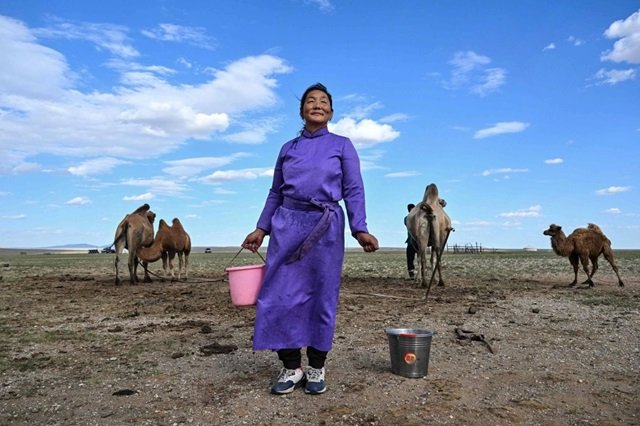
For Mongolian herder Ganchimeg, a GPS tracker recently helped avert the loss of her entire flock after hungry sheep strayed towards a salt lake in the Gobi Desert. With vegetation scarce, the animals moved dangerously close to brackish water, leaving her in what she described as “total panic”.
Her husband used the tracker to locate and intercept the sheep before they drank or entered the lake. “If we hadn’t used that GPS tracker, we might have lost our entire flock,” said Ganchimeg, a mother of four who, like many Mongolians, uses a single name.
The incident illustrates the growing risks facing Mongolia’s nomadic herders, who are exposed to increasingly severe weather while also dealing with desertification and overgrazing. Extreme cold snaps and droughts have compounded pressure on rangelands, threatening livestock and the livelihoods of communities that depend on them.
Bilgudei Gankhulug, a 26-year-old entrepreneur whose ancestors were nomadic herders, developed the Hunu app after the 2024 dzud, an extreme weather event in which temperatures fell as low as minus 45 degrees Celsius. “Over 8 million livestock died. I saw a lot of herders losing their income, losing their livelihoods in just the span of a few months,” he said.
Hunu, a name meaning “strong nomad”, combines livestock tracking with weather and environmental information. A solar-powered GPS device is attached to one animal in a group, allowing herders to monitor the movement of a flock or herd that generally remains together across Mongolia’s open steppe.
The application also provides an artificial intelligence-powered weather feature, including updates on dust storms and blizzards. Its maps provide information on snow depth, wind direction, soil moisture and drought, allowing herders to assess conditions when deciding where to move their animals.
The pressure on Mongolia’s grazing lands is extensive. About 80 per cent of the country consists of rangelands, according to Chimeddorj Buyanaa, Mongolia conservation director at the World Wildlife Fund. He said these areas were critical to local communities and the livelihoods of Mongolians. Overgrazing, he added, was also putting wildlife including snow leopards and saiga antelope at risk.
Authorities said in August that nearly 82 per cent of Mongolia’s territory was affected by desertification and land degradation. About one in four Mongolians are nomadic herders, while some families have left pastoral life and moved to cities. In Dundgovi province, Governor Munkhchuluun Samdannyam said the population had been declining continuously in recent years and that three-fifths of the provincial economy depended on livestock husbandry.
Munkhchuluun also said the effects extended beyond Mongolia, noting that dust storms could travel from the region to China, Korea, Japan and even the United States. Mongolia hosted COP17, talks on a global desertification treaty, last month, where countries agreed on financing for land restoration and drought resilience, although concerns remain about a major funding shortfall.
For some herders, however, international discussions remain distant from conditions on the ground. Bolormaa Erdenee, who raises about 400 livestock with her husband, said roads used by heavy mining trucks now crossed their usual summer grazing area, generating dust and disrupting their animals. Nearby nomadic households have already moved almost 200 kilometres in search of greener pastures.
Bilgudei said Hunu could eventually expand to other Central Asian countries, while pastoralists from Tanzania and Uruguay expressed interest after meeting him at COP17. “Our problems are pretty similar,” he said. He said traditional migration could itself help protect the environment and that it was important to “learn from the traditions … and combine it with the science and technology.”