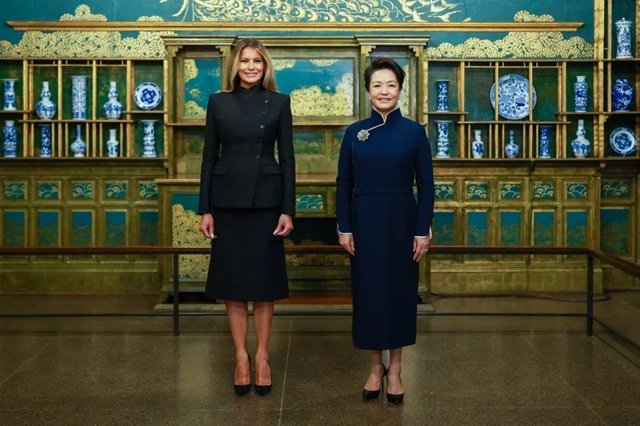
Melania Trump and China’s first lady Peng Liyuan spent 45 minutes touring the Smithsonian’s National Museum of Asian Art in Washington on Thursday, visiting Chinese artworks and the museum’s celebrated Peacock Room while their husbands held talks at the White House.
The visit was selected by the office of the US first lady, according to museum director Chase Robinson, but the institution’s longstanding links with China made it a fitting venue for the occasion. Robinson said the two women were “full of questions” during their tour, much of which focused on the Peacock Room, a celebrated interior shaped by Chinese and Japanese artistic influences.
“What better place to introduce the two first ladies to our museum on the occasion of high-level conversations and discussions between our two countries?” Robinson told the South China Morning Post.
The museum, more than a century old and located on Washington’s National Mall, holds tens of thousands of works from across Asia. Its Peacock Room was created by American artist James McNeill Whistler in 1876-77, combining blue, green and gold decoration inspired partly by Chinese porcelain and Japanese design. American collector Charles Freer purchased the room in 1904 and had it moved from London to the United States. It became a centrepiece of the Washington museum in 1923.
The tour included an 18th-century Chinese porcelain vase decorated with famille rose enamels, gold and iron red, as well as a Yuan dynasty scroll painting. Robinson said the museum has an exceptionally strong collection of Yuan and early Ming paintings, helping explain the choice of the works shown to the two first ladies.
He said both women appeared to enjoy the visit and were intrigued by the historical connections represented by the collection. “I think they were both intrigued by the scale of 19th-century interaction between China and the United States,” Robinson said.
The visit ended with a performance by students from Hope Chinese School, a Chinese immersion school. For the museum, the occasion also provided an opportunity to highlight its continuing cultural engagement with China. Robinson had recently returned from visits to Xian, Dunhuang and Beijing, while the museum maintains partnerships with the Palace Museum and other Chinese institutions and regularly sends staff to China. It also works with the Chinese embassy in Washington and the US State Department.
“Given those kinds of relationships, given the opportunity to celebrate US-China relations, this was an appropriate place,” Robinson said.
The museum runs regular Chinese cultural programmes, including a Lunar New Year celebration that can attract 15,000 to 16,000 people in a single afternoon. Robinson said he hoped the first ladies’ visit would similarly encourage public interest in the institution. “I hope [it will] inspire many more visits,” he said.
The cultural diplomacy of the day was accompanied by a more informal moment involving Xi Jinping and Donald Trump. During a White House tour, Xi laughed when Trump stopped at the “Presidential Walk of Fame” and pointed to a framed image representing an autopen in place of former president Joe Biden’s portrait.
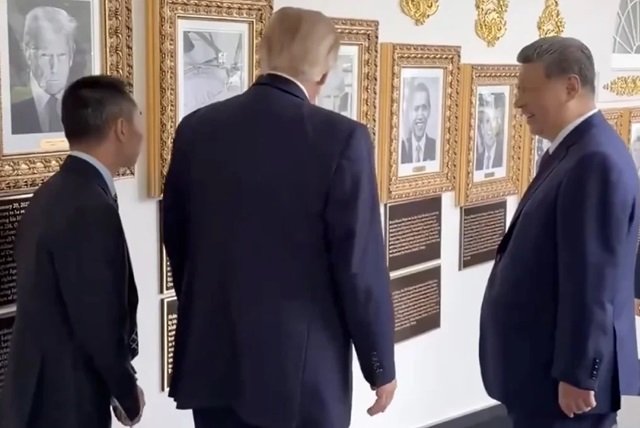
“This is the autopen … it’s Biden,” Trump said, according to a White House video. Xi responded with audible laughter as several people accompanying the leaders also appeared to laugh.
The episode contrasted with Xi’s generally restrained public demeanour during his first state visit to the United States in more than a decade. The visit was taking place amid continuing tensions between Washington and Beijing over technology and rare earths, while the two presidents sought to manage a broader relationship marked by competing strategic interests.
Trump’s comments appeared to refer sarcastically to Biden’s use of an autopen, an issue that has repeatedly featured in his criticism of his predecessor. The image has occupied the former president’s place in Trump’s “Presidential Walk of Fame” since September 2025. Trump has repeatedly criticised Biden’s use of aides and the autopen to sign official documents towards the end of his presidency, allegations disputed by Biden’s administration.
Trump also pointed to a framed photograph from his May meeting with Xi in Beijing and asked, “Who is that? I don’t recognise him.” Xi turned towards members of his delegation and appeared to laugh briefly again.
The informal exchanges came after years in which US-China relations deteriorated during Biden’s presidency. Disputes included recriminations over the origins of Covid-19, a major cross-Strait crisis following then-US House speaker Nancy Pelosi’s Taiwan visit in 2022, the 2023 “spy balloon” episode and a series of US technology and investment restrictions affecting China.
Biden held three formal in-person meetings with Xi after taking office in January 2021, all on the sidelines of multilateral gatherings such as the G20. No state visits were exchanged between Washington and Beijing during Biden’s presidency. Xi last visited the United States in November 2023 for the Asia-Pacific Economic Cooperation summit in San Francisco, where he met Biden. His previous state visit to Washington had been in September 2015, when then-US vice-president Biden and his wife Jill Biden welcomed Xi and Peng Liyuan at the airport.