by Our Correspondent in Washington DC
China has increasingly relied on people outside formal diplomatic structures to communicate with the United States, using academics, business leaders, students, cultural organisations and even sport to sustain channels of contact as strategic rivalry makes direct government-to-government engagement more difficult.
The approach was evident immediately before Chinese President Xi Jinping’s latest visit to Washington, when he replied to correspondence from dozens of students at 10 US universities, including Harvard, who had taken part in an exchange trip to China. According to China’s State Council, Xi urged the students to advance cooperation between the two countries.
The gesture fits a longstanding practice. Beijing has repeatedly used prominent individuals and organisations with links to both countries to convey its views to Washington. The method became particularly prominent during the trade war that began in 2018, when China placed considerable value on Henry Kissinger, the former US secretary of state and principal architect of the US rapprochement with China in the early 1970s. Kissinger held multiple meetings with Chinese officials and remained an important interlocutor until his death in 2023.
After Kissinger’s death, that intermediary role appeared to shift towards Graham Allison, the former dean of Harvard University’s Kennedy School of Government. Allison visited China in March and June, meeting senior officials including Wang Huning, the country’s fourth-ranking official. Allison is the author of The Thucydides Trap, which popularised the argument that conflict can become more likely when a rising power challenges an established hegemon. Xi referred to the concept during his talks with Trump.
Business has provided another channel. Days before Xi’s visit, Chinese Premier Li Qiang met a delegation from the US-China Business Council in Beijing. Founded in 1973 with support from the White House and the State and Commerce departments, the council has played a prominent role in the development of bilateral relations. Its members include Apple, Boeing and Nvidia, whose executives have maintained high-profile connections with China.
Nvidia chief executive Jensen Huang has repeatedly visited China and met senior Chinese officials. He also accompanied Trump during the US president’s May visit to Beijing. On Wednesday, Chinese state broadcaster CCTV released interviews in which Elon Musk, the US billionaire and Trump ally, described Xi as “a great leader”. China’s National Development and Reform Commission, meanwhile, invited the American Chamber of Commerce in China to a roundtable on September 10.
The effectiveness of such intermediaries remains open to debate, particularly over how much influence business executives, academics or other private figures can exercise in Washington. But China has a long history of using unofficial contacts to signal a willingness to improve relations. In 1970, Mao Zedong appeared with American writer Edgar Snow on the Tiananmen Rostrum, sending a signal to President Richard Nixon that Beijing was prepared to reopen communications. The subsequent “ping-pong diplomacy” helped normalise China-US relations.
Sport has since acquired a contemporary version of that role. Over the past two years, Chinese and American teenagers have taken part in multiple pickleball exchanges. At an event in May, China’s ambassador to Washington, Xie Feng, urged participants to “carry forward the spirit of ping-pong diplomacy” through the sport and “write new stories of China-US friendship with the passion of youth”.
People-to-people exchanges have become particularly important after years of pressure from Washington contributed to the large-scale closure of Confucius Institutes in the United States, restricting a channel that Beijing had long regarded as important for educational and cultural exchanges. Xi has responded by promoting new youth exchanges. In 2023, he invited 50,000 US youths to China over five years; Beijing later said that target had been reached two and a half years ahead of schedule. At the White House on Thursday, Xi announced plans to invite 100,000 young Americans to China over the next five years.
Historical memory has also been used as a diplomatic bridge. Beijing has repeatedly highlighted the Flying Tigers, the group of American volunteer pilots who fought Japanese forces in China and Burma during the Second World War. In September 2023, Xi replied to a letter from Jeffrey Greene, chairman of the Sino-American Aviation Heritage Foundation, and Flying Tigers veterans Harry Moyer and Mel McMullen, saying China and the US “should, and must, respect each other, coexist in peace and pursue win-win cooperation”. During his November 2023 US visit, Xi referred to the Flying Tigers and to friends he had made in Iowa during his first American visit in 1985. In February, he sent a reply letter and Chinese New Year card to long-time Iowa friends.
Another initiative, “Bond with Kuliang”, draws on historic links between residents of a mountain resort in Fujian province and American families who lived, worked or holidayed there from the late 19th century.
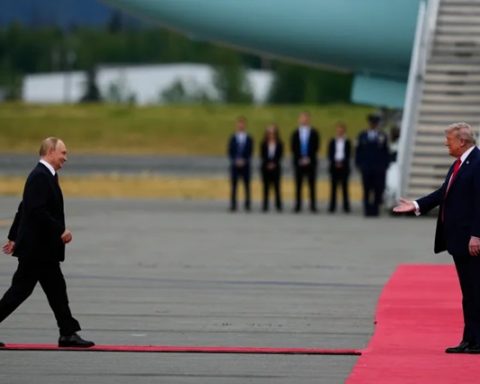
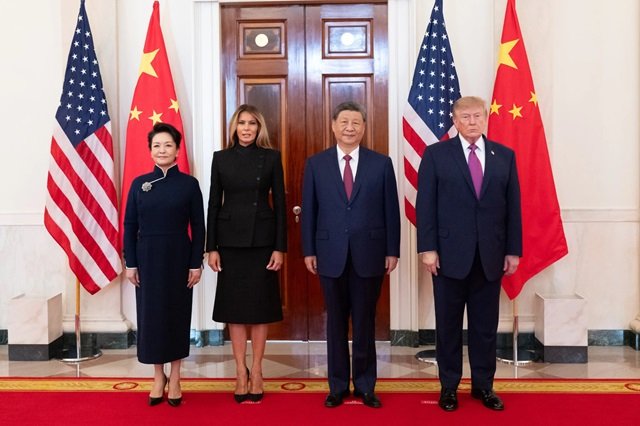
The latest presidential visit placed these unofficial channels alongside highly choreographed formal diplomacy. Trump greeted Xi at the White House after an unprecedented reception at Joint Base Andrews, followed by a military flyover involving a B-2 Spirit bomber and four F-22 Raptors. Both leaders invoked the Flying Tigers and common interests, while Xi said Chinese and Americans had “fought shoulder to shoulder against fascist aggression” during the Second World War.
At the state dinner that evening, the role of commercial ties was especially visible. Elon Musk, Jensen Huang, AMD chief executive Lisa Su and Apple board chairman Tim Cook sat at the main table with the presidents. Other prominent guests included OpenAI chief executive Sam Altman, Amazon chairman Jeff Bezos, Google chief executive Sundar Pichai, Micron Technology chief executive Sanjay Mehrotra, JPMorgan Chase chief executive Jamie Dimon, Citigroup chief executive Jane Fraser, Lockheed Martin chief executive James Taiclet and Pfizer chairman Albert Bourla. No Chinese business executives attended.
The dinner itself incorporated diplomatic symbolism. Guests drank California blanc de noir from the same vineyard that supplied wine for the 1972 “Toast to Peace” between Nixon and Chinese premier Zhou Enlai in Beijing. According to the office of US first lady Melania Trump, the menu combined American ingredients with subtle Chinese influences.
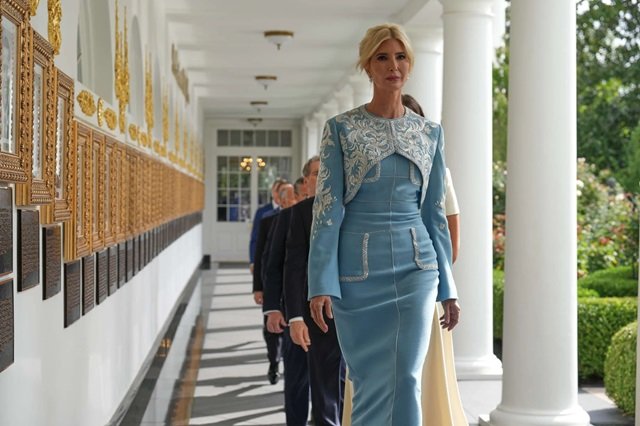
The ceremony also highlighted cultural connections. Ivanka Trump attended the White House welcome wearing a dress by Beijing-based Chinese designer Guo Pei, while her daughter Arabella Kushner wore a white dress by London-based Self-Portrait. Arabella had previously performed the Chinese ballad “Mo Li Hua” and recited Tang dynasty poetry in Chinese for Xi during his 2017 visit to the United States.
Ivanka Trump’s choice of designer echoed Peng Liyuan’s use of fashion as a form of cultural diplomacy, with the Chinese first lady known for promoting Chinese designers and traditional culture.