There are moments in the life of a nation when the constitutional curtain falls and the stage lights reveal the true protagonist. Pakistan has reached precisely such a moment. The country’s long romance with military dominance—an affair stretching across seven decades—has now matured into something more explicit, more brazen and more structurally permanent. With the extraordinary powers vested in Field Marshal Asim Munir, Pakistan has not merely drifted deeper into praetorianism; it has embraced it with legislative enthusiasm. What was once an army overshadowing the state has become an army absorbing it. The republic now wears epaulettes.
Praetorianism, in its classical definition, describes a condition in which the military does not simply guard the republic but supervises it, disciplines it and ultimately decides who may govern it. Pakistan has illustrated this principle with unwavering consistency. Ayub Khan’s coup in 1958 inaugurated the first era of military tutelage; Yahya Khan’s disastrous tenure culminated in the 1971 break-up of the country; Zia-ul-Haq’s Islamised authoritarianism in the 1980s reshaped the ideological foundations of the state; and Pervez Musharraf’s 1999 takeover reaffirmed the army’s primacy in national decision-making. Each episode underscored the same iron rule: civilian authority exists only at the pleasure of Rawalpindi. Yet none of these rulers—neither Zia with his ideological fervour nor Musharraf with his technocratic confidence—commanded the kind of legally sanctified, constitutionally embedded powers that Munir now wields while still in uniform.
It is in this continuum of militarised ascendancy that Munir’s latest elevation must be situated. Munir’s swift coronation as Field Marshal after the 96-hour Operation Sindoor—publicly repackaged by Pakistan as Operation Bunyan-un-Marsoos—illustrates the country’s peculiar relationship with its highest military honours. Nowhere else has the apex rank been awarded with such velocity. Yet Pakistan has seen this play before: Ayub Khan simply appointed himself Field Marshal, establishing a precedent in which the rank functions not as a testament to strategic brilliance but as a symbol of unchallenged authority.
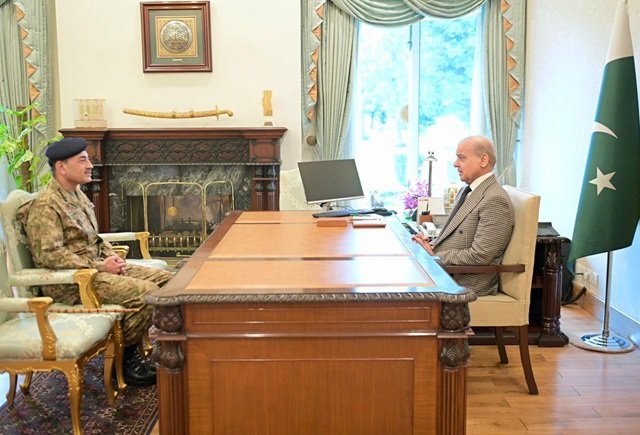
What followed was a spectacle worthy of a political-theatre state. The government orchestrated a lavish, triumphalist celebration of Munir’s coronation, led personally by the Prime Minister. State media ran wall-to-wall coverage; cabinet ministers delivered florid tributes; military bands paraded through Islamabad; and a choreographed ceremony at the Prime Minister’s Office presented Munir not merely as a soldier elevated but as a national saviour anointed. The symbolism was unmistakable: Pakistan was not honouring a military victory; it was consecrating a new locus of power. The civilian leadership did not merely endorse Munir’s rise—they performed it.
The Defence Forces of Pakistan Act, 2026, and the amendments to the National Command Authority Act have placed Munir at the summit of a unified command structure that subsumes the Army, Navy and Air Force under a single office. The Chairman Joint Chiefs of Staff Committee, once the symbolic apex of tri-service coordination, has been abolished. In its place stands the Chief of Defence Forces (CDF), a role Munir holds concurrently with that of Army Chief. This is not administrative tidying; it is the legal enthronement of military supremacy. Munir now exercises operational command over all armed forces, directs multi-domain integration and presides over strategic and national security matters across services. He is simultaneously the principal military adviser to the Prime Minister and the commander of the machinery that executes national security decisions. Advisory authority and executive power, fused in one uniformed figure, create a constitutional anomaly unprecedented in Pakistan’s history.
More unsettling still is Munir’s “hire, fire and retire” prerogative. The CDF may retire, release, discharge, retain or relax service limits for any personnel across the armed forces. He may accept or reject resignations, override retirement ages and reshape careers at will. Every military future in Pakistan now hangs by the thread of one man’s discretion. The legislation goes further: Munir’s Field Marshal rank is for life, with full benefits, and he enjoys immunity from prosecution—perpetually. The 27th Constitutional Amendment, retrospectively formalised by these laws, grants him a five-year extension until 2030 and embeds military authority into the constitutional marrow of the state. This is not merely praetorianism; it is praetorianism engraved in statute and sealed with parliamentary obedience.
For a nation already steeped in military dominance, the consequences are stark. Civilian authority has been reduced to ceremonial performance. The speed with which the laws were passed—approved by the Cabinet, rushed through the National Assembly in thirty breathless minutes and rubber-stamped by the President—reveals the extent of political capitulation. Even the Pakistan Peoples Party, which initially protested, ultimately voted in favour. Nobody makes Asim Munir wait.
It is here that Pakistan’s recent political history becomes inseparable from its military choreography. Imran Khan’s rise to power in 2018 was not the triumph of an insurgent democratic wave; it was the outcome of an elaborate facilitation by General Qamar Javed Bajwa, who saw in Khan a pliable civilian partner. Bajwa’s influence shaped electoral dynamics, political alliances and administrative outcomes, enabling Khan’s ascent. But when Khan began asserting the primacy of elected authority—challenging the military’s dominance in foreign policy, intelligence appointments and governance—his usefulness ended. Bajwa engineered his removal with the same precision with which he had orchestrated his rise. Khan’s fall in 2022, followed by his incarceration and political dismantling, was not a democratic correction; it was a military recalibration. Shehbaz Sharif’s return to power is widely understood as a Rawalpindi-approved arrangement. Pakistan’s political transitions are not democratic alternations; they are military decisions executed through civilian façades.
And here lies the heart of Pakistan’s tragedy. Ayesha Siddiqa’s concept of Milbus—the military’s vast economic, political and strategic interests—has become the country’s operating system. The army’s business empire, estimated by some analysts to exceed USD 20 billion in assets, spans real estate, construction, logistics, agriculture and consumer goods. Munir’s centralisation of command does not merely reinforce this structure; it deepens it. The army’s reach extends from real estate empires to business conglomerates, from foreign policy to internal policing, from media management to judicial influence. It is a military that owns land, corporations, narratives and courts. It is a military that manufactures political leaders and dismantles them. It is a military that decides which civilian will sit in the Prime Minister’s chair and how long he may remain there. Pakistan is not a democracy with a powerful army; it is an army with a democratic façade.
History offers a sober warning: Pakistani military rulers eventually succumb to paranoia. Ayub Khan, Zia-ul-Haq and Musharraf all tightened their grip as insecurity grew. Munir’s consolidation has come at “T-20 speed”, as analysts remark—multiple phases of self-aggrandisement within months. The latest laws, passed with stunning swiftness, reflect a leadership increasingly fearful of internal rivals. And paranoia at the summit of a nuclear-armed state is not a comforting prospect. Pakistan possesses an estimated 170–180 nuclear warheads; the centralisation of nuclear command oversight under positions dominated by the Army raises further concerns about strategic stability. In any India-Pakistan confrontation, decisions may be shaped not by elected leaders but by a single military mind.
Pakistan’s democratic institutions have long been fragile, but Munir’s sweeping powers strip away even the pretence. The Opposition’s walkout during the passage of the laws was symbolic; the real power centre lies in Rawalpindi, not Islamabad. Pakistan has entered a new phase of praetorianism—one not enforced by tanks on the streets but by clauses in the Constitution. Munir’s authority is not merely vast; it is permanent, legally protected and structurally embedded.
For a nation staggering under economic collapse, political fragmentation and rising extremism, the concentration of power in one unelected military office is not stability—it is a slow-burning national tragedy. Pakistan’s misfortune is not that it has a powerful army. It is that the army has a nation—and now, one man has the army.