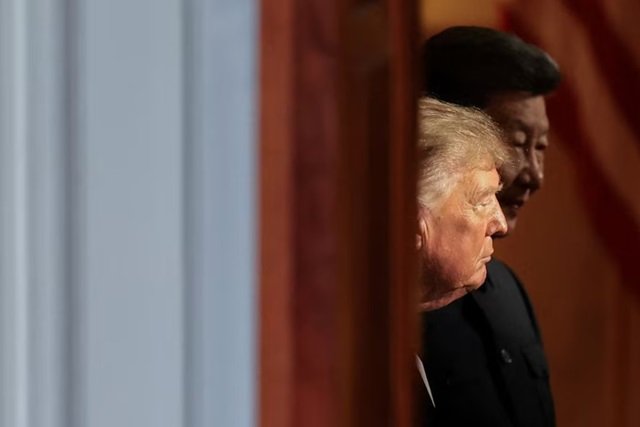
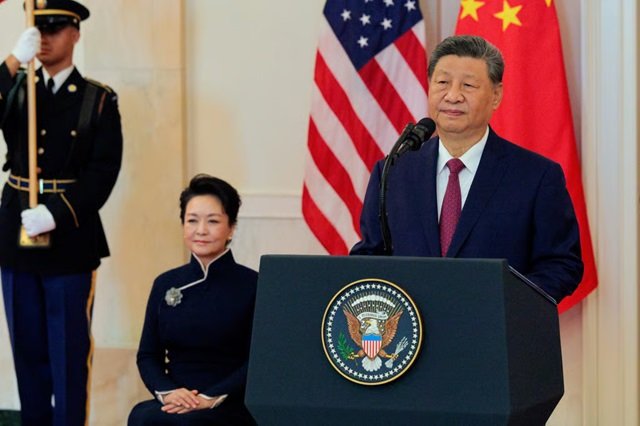
Chinese President Xi Jinping used his arrival ceremony at the White House to frame China-US relations around cooperation, stability and what he described as two national projects that can advance together: the “great rejuvenation of the Chinese nation” and US President Donald Trump’s “Make America Great Again” agenda.
Speaking on Thursday during his state visit to Washington, Xi said China and the United States, despite differences in their national conditions, had a “historic responsibility of advancing human development and progress”. He said he was visiting at Trump’s invitation to “carry on our friendship, expand cooperation, and promote the well-being of both our peoples”.
Xi referred to an agreement reached during Trump’s visit to China earlier this year to build what the two leaders had described as a constructive China-US relationship of strategic stability. He said the arrangement was “widely welcomed by the people of our two countries and the international community” and compared the relationship to a “giant ship” that the two presidents should steer steadily into the future.
His remarks were organised around three priorities: communication, cooperation and peaceful coexistence. Xi said differences between the two countries made sustained dialogue necessary, arguing that “through candid, in-depth and continued dialogue, our two countries can understand each other better, seek common ground while shelving differences, and build up mutual trust”. He also highlighted his personal relationship with Trump, saying the two had developed “personal rapport and stayed in touch”.
Xi called for greater contact between government departments responsible for foreign affairs, economic matters, financial cooperation, law enforcement and people-to-people exchanges. He also said China supported increased exchanges between the two countries’ legislative bodies.
On economic relations, Xi said the interests of China and the United States were “deeply intertwined” and that there was considerable scope for cooperation. “China-U.S. cooperation may not solve every problem in the world. But, without our cooperation, it would be hard to solve many of the world’s problems,” he said.
He reiterated Beijing’s willingness to receive American investment, saying China “keeps its door wide open” to US companies wanting to invest and conduct business there. At the same time, he said Chinese companies should be treated fairly in the United States. “Working together, we can lengthen the list of cooperation, and shorten the list of issues,” Xi said.
Artificial intelligence featured prominently in his economic message. Xi said China and the United States were both leading nations in AI and therefore had both the capability and responsibility to develop and manage the technology “for good”. He called for AI development to remain “under human control” and to serve public well-being.
The Chinese president also identified counternarcotics and law enforcement as areas for greater bilateral cooperation and said the two countries could increase direct flights to facilitate travel and trade.
On strategic competition, Xi acknowledged that rivalry between Beijing and Washington could not simply be ignored. But he argued that it should remain controlled and constructive. “We do not need to avoid mentioning competition, but our competition should be a healthy one and should be kept within bounds,” he said.
He characterised the desired relationship as a race in which the two countries seek to improve rather than a confrontation in which one side must defeat the other. “It should be a race of catching up with one another, not a wrestle in which one either wins or loses,” Xi said.
The president called on both governments to maintain a firm commitment to avoiding conflict and confrontation. He also urged the two militaries to maintain regular dialogue and improve mechanisms for crisis communication and prevention. Referring directly to the theory popularised by Harvard political scientist Graham Allison, Xi declared: “The Thucydides Trap can be overcome.”
Xi then shifted from strategic relations to historical memory and people-to-people ties, invoking the wartime cooperation between the two countries. During the Second World War, he said, Chinese and Americans had “fought shoulder to shoulder against fascist aggression”. He added that Chinese people had not forgotten that history, nor had Americans.
“The hope of the China-U.S. relationship lies in our people, and its future lies with the young,” Xi said. He announced an invitation for 100,000 young Americans to visit China for exchanges and study during the next five years, expanding a people-to-people initiative that has featured prominently in Beijing’s efforts to sustain contact between the two societies.
Xi also used the symbolism of the giant panda, which he described as “an envoy of friendship between the Chinese and Americans”. He announced that two pandas, Ping Ping and Fu Shuang, would arrive within days at Zoo Atlanta, where they would meet the American public.
The speech ended with the clearest reference to the two presidents’ domestic political slogans. Xi said: “Achieving the great rejuvenation of the Chinese nation and making America great again can go hand in hand.” He called on the two sides to respond to what he described as the expectations of their peoples, exercise their “historical initiative”, advance friendship between Chinese and Americans and “work together to build a better world”.