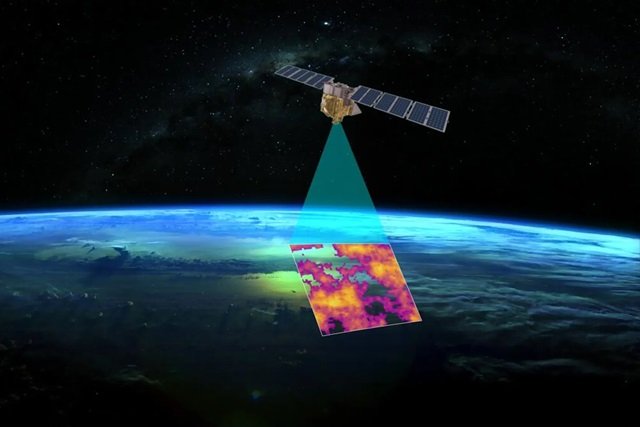
Google is taking its first major step towards putting artificial intelligence computing infrastructure in orbit, launching a prototype satellite carrying four of its custom Tensor Processing Units, or TPUs. The mission, part of the company’s long-term Project Suncatcher programme, is designed to determine whether the chips can operate reliably in the harsh conditions of space.
The satellite is due to launch from California aboard a SpaceX Falcon 9 as part of the Transporter-18 rideshare mission, in collaboration with satellite company Planet. Google says the experiment is not intended to replicate a terrestrial data centre in orbit. Instead, it is an early test of whether individual computing systems can function in space and whether they could eventually form part of much larger networks of satellites linked by high-speed laser communications.
The four TPUs aboard the prototype represent only a fraction of the computing capacity found in a conventional AI data centre. Google’s objective is to gather information that cannot be obtained through testing on Earth, particularly about the effects of radiation, vibration and extreme thermal conditions. The company has already subjected the chips to radiation testing on the ground, but says only an actual orbital mission can provide the necessary operational data.
Cooling is one of the most difficult problems. Terrestrial data centres rely heavily on airflow and other systems to remove the enormous amounts of heat generated by processors. In the vacuum of space there is no air to carry heat away. Google is therefore testing heat pipes and radiators designed to transfer heat from the TPUs to surfaces that can radiate it into space. The prototype will also test whether the processors can operate without overheating during computing workloads.
Google’s longer-term concept is a constellation of satellites capable of communicating through laser links and collectively handling substantial AI workloads. The company has said that future missions will test high-bandwidth communication between satellites, with two further spacecraft planned for 2027. The proposed system would not necessarily replace terrestrial data centres, but could provide another layer of computing capacity in orbit.
The attraction is partly the availability of solar energy in orbit. Google says satellites in low Earth orbit can have access to sunlight for much longer periods than installations on the ground, potentially providing a significant source of power for energy-intensive computing. Space-based infrastructure could also avoid some of the water requirements associated with cooling large terrestrial data centres.
But the project faces substantial technical and economic obstacles. Space radiation can damage electronic components or interfere with calculations, while processors can become obsolete long before an orbital infrastructure project reaches commercial scale. Heat must also be continuously removed, and repairing or replacing failed hardware in orbit is far more difficult than maintaining equipment on Earth. Google’s own research identifies thermal management, communications, reliability and launch economics among the central challenges to scaling the concept.
Launch costs remain another major barrier. Google’s plans depend partly on further reductions in the cost of putting hardware into orbit, making large constellations economically viable. Other companies are pursuing similar ideas: SpaceX and Blue Origin have explored orbital computing concepts, while Starcloud has already tested computing hardware in space. Google’s experiment therefore marks an early practical test in a wider competition to determine whether AI infrastructure can eventually move beyond Earth.