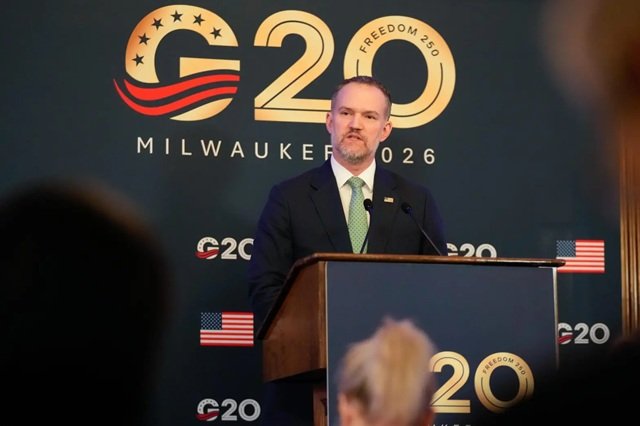
G20 trade ministers have failed to reach broad agreement on a US proposal to address excess industrial capacity and “non-market” economic policies, exposing divisions within the group of major economies as Washington pushes for greater cooperation on trade-related issues.
The US Trade Representative’s office said on Friday that a “handful” of G20 trade ministers rejected a proposed pathway towards cooperative action on excess industrial capacity. The US, which holds the G20 presidency this year, said the draft ministerial statement was supported by all but a few members, some of whom “firmly rejected creating this pathway towards cooperative action”.
The disagreement followed a trade meeting in Milwaukee at which only Mexico and Argentina signed a US-led statement calling for greater work and cooperation to eliminate goods produced with forced labour from global supply chains. The position of the wider group comes as the Trump administration has imposed tariffs of 10 per cent or 12.5 per cent on goods from 59 countries and the European Union over allegations that they have failed to adequately enforce bans on forced labour.
The United States is also conducting a second “Section 301” tariff investigation into 16 trading partners showing signs of excess industrial capacity. The investigation is widely expected to result in new duties in the coming months.
The USTR did not identify the countries that opposed the excess-capacity statement. China, however, had objected to a similar G20 statement condemning forced labour and non-market economic policies linked to excessive exports at a meeting of finance leaders in North Carolina a month earlier.
The US statement said the resistance had “severely disappointed” the American G20 presidency. Excess industrial capacity and industrial subsidies in China have been central themes of US-led G20 ministerial discussions this year. Beijing has rejected claims that its industrial policies have produced excess capacity and has accused Western countries of using the issue to justify protectionist measures.
Despite the disagreement over industrial policy, G20 trade ministers reached consensus on another US-backed issue: the weaponisation of food trade. Members agreed that trade in food and agricultural inputs should not be used as a means of economic or political coercion.
The joint statement defines food weaponisation as measures intended to “slow, stop, block or direct the flow of food and agricultural inputs” in order to exert coercive pressure and obtain unrelated geopolitical concessions. “We condemn food weaponisation, as it poses a significant humanitarian and economic threat,” the ministers said.
The food-trade agreement came as pressure from US President Donald Trump contributed to a separate decision by Group of Seven countries on Friday to release about 100 million barrels of diesel reserves in an effort to reduce record-high US diesel prices. Diesel is widely used in agricultural production. Trump had also threatened a US diesel export ban.
US Trade Representative Jamieson Greer said on Thursday that he had not sought a joint statement on a fourth issue discussed by the ministers: reform of the World Trade Organization’s “most favoured nation” system of published, unconditional global tariff rates.
The MFN principle has underpinned the global trading system since the end of the Second World War. Greer has argued that the principle has been abused by non-market-oriented economies such as China that subsidise industries, while the existing system does not allow those economies to be treated differently.
The US statement said some G20 members had nevertheless expressed willingness to consider changes to the MFN system, including expanding exceptions to the principle and developing new legal interpretations that would permit greater use of existing exceptions.