by Our Correspondent in Colombo
The Kotte Sri Kalyani Samagri Dharma Maha Sangha Sabha has urged Sri Lanka’s Commissioner-General of Prisons not to remove the robe of Ven. Galagoda Aththe Gnanasara Thera while he is serving his prison sentence, arguing that authority over a monk’s ecclesiastical status belongs to the monk and the Maha Sangha Sabha to which he belongs.
The intervention was made in a letter dated October 6, 2026, by Ven. Dr Kotapitiye Rahula, Anu Nayaka Thera of the Maha Vihara Vamshika Sri Jayawardenepura Kotte Sri Kalyani Samagri Dharma Maha Sangha Sabha. The letter was addressed to the Commissioner-General of Prisons at Prison Headquarters in Colombo, with copies sent to President Anura Kumara Dissanayake and the Commissioner-General of Buddhist Affairs at the Ministry of Buddhasasana.
Ven. Rahula said the Sangha Sabha had no objection to the court judgment concerning Gnanasara Thera and fully accepted the supremacy of the judiciary. Its intervention, he said, was specifically concerned with reports that the monk might be disrobed while in prison.
“The full authority concerning the wearing of the robe by a monk and the removal of a monk’s robe rests with the monk who has received full ordination and with the Maha Sangha Sabha to which that monk belongs,” the letter states.
The Sangha Sabha further maintained that, under the procedure currently followed in Sri Lanka, the removal of a monk’s robe as an ecclesiastical act must take place with the approval of the Mahanayaka Thera of the relevant Nikaya or Maha Sangha Sabha.
According to the letter, allowing Gnanasara Thera to retain his robe and to appear in it whenever he is taken outside the prison would be consistent with an established traditional monastic and spiritual practice. Ignoring that practice, the Sangha Sabha argued, could establish an inappropriate precedent for the Buddhist monastic order.
The letter draws a distinction between the authority of the courts to impose a judicial sentence and the authority claimed by the Sangha Sabha over the monk’s ecclesiastical status. Ven. Rahula did not challenge the court judgment itself. Instead, he argued that prison authorities should not independently take action affecting the monk’s robe when, in the Sangha Sabha’s view, that matter falls within the jurisdiction of the monastic institution.
The letter also states that no information had been reported to the Kotte Sangha Sabha establishing that Gnanasara Thera had committed an offence amounting to parajika under the Vinaya Pitaka, or that there was another sufficiently serious reason warranting his disrobing.
“No information has been reported to us that Ven. Galagoda Aththe Gnanasara Thera is a monk who has committed a parajika offence according to the Vinaya Pitaka, or that there exists any other grave reason warranting the removal of his robe,” the letter states.
On that basis, Ven. Rahula said that any disciplinary examination of Gnanasara Thera on ecclesiastical grounds, and any decision on whether he should be disrobed or permitted to retain his robe, was a matter for the Sangha Sabha.
The intervention therefore asks prison authorities to leave the monk’s robe untouched and permit Gnanasara Thera to appear before others wearing it. The request is explicitly framed as an ecclesiastical matter rather than as an objection to the authority of the courts.
The letter identifies Gnanasara Thera as a monk belonging to the Maha Vihara Vamshika Sri Jayawardenepura Kotte Sri Kalyani Samagri Dharma Maha Sangha Sabha. It was issued from the Rajamaha Vihara in Kotte under the name and office of Ven. Kotapitiye Rahula, described in the document as Anu Nayaka Maha Sthavira, retired senior professor, Agga Maha Pandita and Sahithya Chakravarti.
The dispute consequently centres on the treatment of a convicted monk within the prison system and the division of authority between state institutions and Sri Lanka’s Buddhist monastic hierarchy. The Sangha Sabha’s position is that imprisonment does not itself transfer ecclesiastical authority over a monk’s robe to prison officials, and that any disrobing should follow the established monastic procedure and receive the approval of the relevant Mahanayaka Thera.
The letter closes with a formal request that prison authorities refrain from removing Gnanasara Thera’s robe and allow him to appear both inside and outside the prison wearing the robes prescribed for him.
The request, however, was not followed.
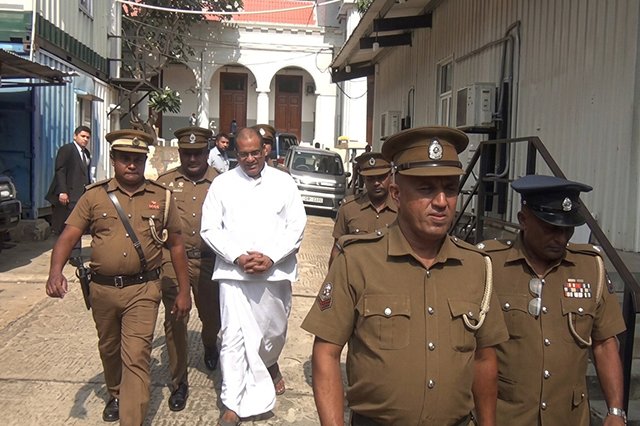
Prison authorities removed Gnanasara Thera’s robe, and he was produced before the Colombo High Court on October 6 wearing prison attire. Prison officials brought him before the court under a warrant issued by the High Court in connection with the case against him.
The case, in which Gnanasara Thera is accused of insulting Islam, was taken up before Colombo High Court Judge Buddhika C. Ragala. After considering the submissions made before the court, the judge ordered that the case be recalled on October 23.