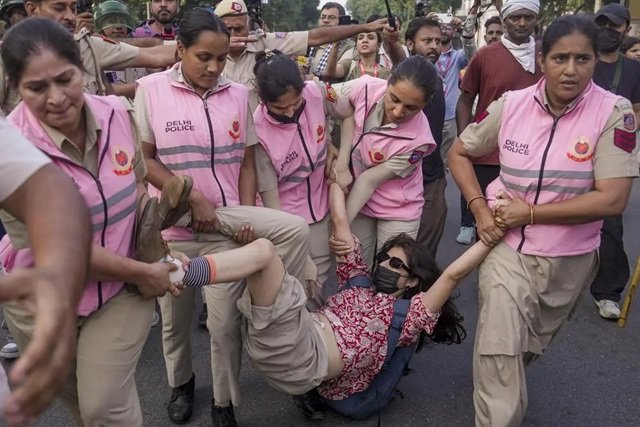
New Delhi was placed under extensive security restrictions on 10 October as authorities moved to prevent a protest organised by the Cockroach Janta Party (CJP), which is demanding the resignation of Chief Election Commissioner Gyanesh Kumar over alleged irregularities in electoral-roll revisions. Metro stations were closed or restricted, trains were cancelled, mobile internet was suspended in central Delhi, and barricades, surveillance cameras, water cannons and security personnel surrounded Jantar Mantar, the designated protest area. Buses stood ready to transport detainees. In a report published by Frontline India, the operation is presented as part of a widening confrontation over electoral transparency, political dissent and the right to peaceful assembly.
The dispute centres on the Election Commission of India’s Special Intensive Revision (SIR) of electoral rolls. The commission describes the exercise as routine verification, but critics allege that its procedures have been opaque and that large numbers of voters have been removed from the lists in ways that could favour the Bharatiya Janata Party (BJP). Questions have also been raised about whether Kumar advanced decisions despite objections from the commission’s other two members. The allegations are contested and have been taken to court, but the revision process has continued while litigation remains unresolved.
The CJP’s campaign began in July with protests against examination paper leaks and wider failures in the education system. The movement followed hunger strikes by Sonam Wangchuk and young activists and culminated in a march towards Parliament. After sustained demonstrations, Education Minister Dharmendra Pradhan resigned on 25 July, meeting the movement’s principal demand. The party’s “School Thik Karo” campaign, meaning “fix the schools”, was subsequently overtaken by spontaneous protests by schoolchildren highlighting poor conditions. As controversy surrounding the Election Commission intensified, the CJP redirected its campaign towards Kumar’s resignation, organising demonstrations around Gandhi Jayanti on 2 October.
The response to the protests escalated over the following days. On 3 October, police barricaded approaches to Jantar Mantar and forcibly moved demonstrators on to buses for detention. Neha Bora, president of the All India Students’ Association, was detained four times over two days. Three women who identified themselves as journalists alleged that they had been sexually harassed and manhandled. One accused Assistant Commissioner of Police Vivek Bhagat of touching her inappropriately while pushing her as she filmed a detention. No first information report was registered against him. Bhagat was subsequently among 12 officers assigned as Additional Deputy Commissioners of Police, but the order was put on hold in his case after he requested that he not take up the post until an inquiry was completed. Police said the promotion process had begun before the protest and described it as routine.
On 6 October, Leader of the Opposition Rahul Gandhi and Congress leader Priyanka Gandhi staged a sit-in lasting more than six hours at Akashvani Bhavan, seeking access to the election commissioners. Both were detained and booked for entering the premises without permission. Rahul Gandhi was carried towards a bus, while Priyanka Gandhi was reportedly injured during detention. The episode added to criticism of the restrictions placed on political leaders seeking to meet the institution responsible for overseeing elections.
By 10 October, the crackdown extended beyond the capital. Police established checkpoints, intercepted young people travelling towards Delhi and, according to activists, detained some at their homes or served preventive notices requiring them to undertake not to attend the demonstration. Students in Maharashtra, Madhya Pradesh and Gujarat reported being stopped or detained, with some removed from trains. CJP leaders Abhijeet Dipke, Saurav Das and Ashutosh Ranka were detained aboard their aircraft after landing in Delhi. YouTuber Dhruv Rathee was also detained. Reports put the number of people stopped or detained nationwide at hundreds, possibly thousands, although estimates varied.
The legal dispute concerns the constitutional protection of peaceful protest. Article 19(1)(b) of the Indian Constitution guarantees citizens the right to assemble peaceably and without arms. In Anuradha Bhasin v. Union of India (2020), the Supreme Court held that internet shutdowns must be temporary, necessary, proportionate, published and subject to review. Critics argue that restrictions designed to prevent demonstrators from reaching a protest site undermine the practical exercise of that right. The wider history of protest policing, including arrests under the Unlawful Activities (Prevention) Act in the Bhima-Koregaon case and prosecutions of activists during demonstrations against the Citizenship Amendment Act, has also fuelled concerns about prolonged detention and the costs of challenging state action.
The controversy over Kumar’s appointment has further complicated the dispute. In 2023, the Supreme Court ruled that, until Parliament enacted legislation, election commissioners should be selected by a panel comprising the prime minister, the leader of the opposition and the Chief Justice of India. Parliament subsequently replaced the chief justice with a Union minister nominated by the prime minister, giving the government a majority on the selection panel. Kumar, who had served under Amit Shah, became chief election commissioner in February 2025 despite the opposition leader’s dissent.
Figures from the SIR process have intensified scrutiny. In Bihar, the draft electoral roll removed 65 lakh names, while the final electorate fell from 7.89 crore to 7.42 crore. In Delhi, approximately 47 lakh names were removed from an electorate of 1.45 crore, while another 33 lakh voters received notices. An RTI response showed that 91% of approximately 82,000 appeals decided in West Bengal had resulted in names being restored, out of 38 lakh appeals filed. The Indian Express has reported that election commissioners Sukhbir Singh Sandhu and Vivek Joshi objected on at least 14 occasions to decisions that Kumar nevertheless advanced in the commission’s name. Petitioners have sought an investigation into deletions affecting an estimated 13 crore names. The commission disputes allegations of partisan manipulation, with sources maintaining that its decisions, including those concerning the SIR, were unanimous.
The Supreme Court’s handling of related challenges has become a central point of criticism in Frontline India’s account. A challenge to the 2023 appointment law was filed in January 2024. In March that year, the court refused to stay the law, describing the government’s haste as “unnecessary and avoidable” while warning that a stay could cause chaos. The case was repeatedly listed between January 2025 and March 2026 without an effective hearing. In March 2026, Chief Justice Surya Kant recused himself because the law had removed his office from the selection panel. On 23 September, a two-judge bench split over whether the matter should be referred to a Constitution Bench.
The court also declined to halt the SIR in Bihar, where elections were held in November 2025 using the revised roll, and upheld the exercise as proportionate in May 2026. On 22 September, it observed that notices sent to 33 lakh Delhi voters appeared to have been issued “almost mechanically” through software, but asked the commission to consider additional safeguards. On 5 October, it declined interim relief in a petition seeking the suspension of a chief election commissioner accused of overriding his colleagues, instead issuing notice.
For critics, the central concern is that judicial proceedings have not kept pace with decisions affecting electoral participation. Opposition parties have challenged alleged election and voter-roll irregularities in Haryana, Maharashtra, Bihar and West Bengal, while the underlying disputes remain contested. As the SIR proceeds and protests face increasingly restrictive policing, the conflict has expanded beyond Kumar’s position to encompass the independence of election administration, the enforceability of constitutional rights and the availability of timely judicial remedies.