by Eric
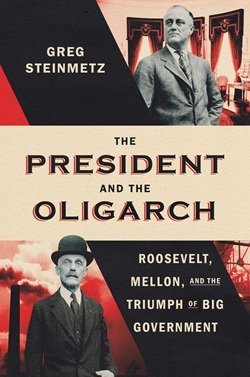
The most consequential battle over American capitalism may not be fought between capitalism and socialism, but between rival groups of capitalists, each claiming to represent the public interest. Greg Steinmetz’s The President and the Oligarch reconstructs a particularly revealing confrontation: the struggle between Franklin D. Roosevelt and Andrew Mellon, the billionaire industrialist who served as secretary of the Treasury under three Republican presidents. At its centre lies an uncomfortable proposition. A government can invoke democracy while pursuing political vengeance; a wealthy industrialist can defend economic freedom while advancing the interests of his own class; and a president who campaigns against concentrated wealth can simultaneously consolidate extraordinary power in his own hands. Steinmetz’s account is therefore more than a history of tax policy or the personalities who shaped American economic life between the world wars. It is an examination of the relationship between private wealth, executive authority and the political manipulation of public grievances. His opening claim that Roosevelt was determined to prosecute Mellon almost from the beginning of his presidency, despite what the author describes as a “flimsy” fraud case (p. 7), immediately challenges the reassuring assumption that political action against the rich necessarily constitutes democratic accountability. The question, however, is whether Steinmetz subjects his own interpretation of that confrontation to the same scrutiny he directs at its protagonists.
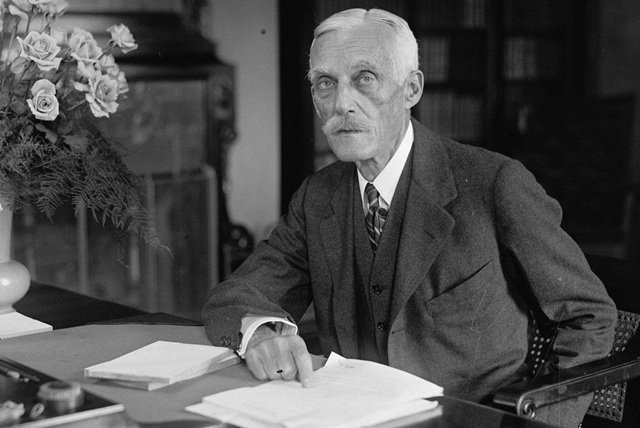
Mellon is an intriguing figure through whom to investigate the relationship between wealth and political power. His fortune, built through interests including aluminium, oil and banking, gave him influence long before he entered government. Steinmetz describes a man whose financial philosophy was disarmingly direct: “You make it, you keep it” (p. 11). For Mellon, taxation was not merely an economic instrument but a question of individual entitlement. His distinction between “tax payers and tax eaters” (p. 12) reduced political economy to a moral division between productive citizens and those supposedly dependent on their labour. This formulation is revealing because it makes the wealthy industrialist’s interests appear synonymous with the interests of society itself. If entrepreneurs create prosperity, then reducing their tax burdens can be presented as a public service, even when the immediate beneficiaries are people who already possess extraordinary resources. Steinmetz recognises the political implications of this outlook, describing Social Darwinism as an intellectual justification for inequality, laissez-faire economics and opposition to progressive reform (p. 13). Yet his treatment of Mellon’s convictions raises a fundamental question: does exceptional business success establish a superior understanding of the public good, or does it merely provide the successful with the means to define that good on their own terms?
Mellon’s appointment as Treasury secretary exposes the tensions inherent in allowing private fortunes to become qualifications for public office. President Warren G. Harding’s advisers regarded his wealth as evidence of competence. One of them reasoned that a man who could quietly make millions must be “little short of a magician” (p. 24). The logic is seductive but dangerous. Expertise in managing private capital does not automatically translate into an impartial understanding of national economic priorities. Mellon promised to separate himself from his businesses “as if I had died” (p. 27), yet the concentration of financial interests in the hands of the country’s principal fiscal policymaker inevitably invited suspicion. Progressive critics warned that oligarchs had effectively taken charge of government (p. 27). Their concern was not simply that a rich man might become corrupt, but that public policy could be shaped by assumptions that privileged the interests of capital before those of workers, consumers and taxpayers. Steinmetz’s account is particularly effective when it shows that conflicts of interest are not exhausted by the question of whether an official personally profits from a decision. They also concern the intellectual framework through which that official determines whose interests deserve protection.
Mellon’s tax programme is the clearest expression of that framework. He believed that reducing rates would stimulate economic activity, encourage investment and ultimately generate sufficient revenue to benefit the Treasury. Steinmetz presents this as a coherent economic argument rather than simply a device for enriching the already wealthy. Mellon also pursued expenditure reductions, applying private-sector management principles to government departments and seeking to eliminate what he considered unnecessary spending (pp. 30–32). The intellectual lineage of his position reaches back to Alexander Hamilton, whose arguments about the relationship between tax rates and revenue anticipated later supply-side reasoning (p. 33). Yet the historical importance of an economic theory should not be confused with proof of its universal validity. Lower rates can encourage investment under particular conditions, but the resulting distribution of benefits, the effects on public services and the relationship between taxation and economic demand remain essential questions. Mellon’s assertion that progressive taxation violated “the traditions of freedom, justice and equality of opportunity” (p. 34) was therefore not a neutral economic observation. It was a political argument about the meaning of equality. By treating differential taxation as an infringement of freedom, he effectively privileged formal equality of treatment over the unequal economic circumstances in which individuals operate. Steinmetz illuminates this ideological conflict, although the broader implications of the tax programme demand more than a contest between competing convictions.
The book becomes especially interesting when it demonstrates that Mellon himself understood taxation as an instrument of political power. His department used the tax code against James Couzens, a wealthy Republican senator who had become an outspoken critic of economic inequality. Steinmetz observes that Mellon was willing to turn the machinery of taxation against a political opponent and that the practice established a precedent followed by later administrations (p. 50). This episode complicates the distinction between the supposedly coercive state and the supposedly independent capitalist. Mellon objected to taxation as an intrusion into private property, yet the authority of his office allowed him to deploy taxation in a political dispute. The principle of limited government, in this instance, did not prevent the exercise of public power; it coexisted with a willingness to use that power selectively. Such contradictions are among the book’s most valuable contributions. They suggest that the struggle between business and government is rarely a straightforward confrontation between freedom and coercion. Powerful private interests may resist state intervention when it constrains their economic choices while welcoming it when government authority can be used against competitors or critics.
Roosevelt’s emergence as Mellon’s principal antagonist does not, however, provide an uncomplicated democratic alternative. Steinmetz portrays the future president as an ambitious and politically calculating figure whose early career included personal indiscretions, dismissive treatment of colleagues and a determination to advance his own prospects (pp. 18–20). His account of Roosevelt’s transformation following polio introduces a more sympathetic dimension. The experience of disability and dependence appears to have altered his relationship with other people, helping to make him more patient and empathetic. Historian Will Durant described him as “a man softened, and cleansed and illumined with pain” (p. 211). The formulation is powerful, but it risks giving suffering an overly convenient moral function. Physical adversity does not automatically produce political wisdom, just as personal ambition does not preclude genuine public concern. Roosevelt’s development is better understood as a combination of changing circumstances, political calculation and an expanding appreciation of social vulnerability. Steinmetz’s portrait is strongest when these elements remain in tension rather than resolving into a story of personal redemption.
The Great Depression transformed the dispute between the two men into a struggle over the responsibilities of government. Roosevelt’s appeal to the “forgotten man at the bottom of economic pyramid” (p. 204) represented a direct challenge to the presumption that economic recovery would follow principally from the protection of capital. His argument that people’s difficulties could be “beyond your individual control” (p. 218) acknowledged something Mellon’s philosophy tended to minimise: individual effort cannot insulate people from systemic economic collapse. Yet Steinmetz also presents Roosevelt as a politician willing to exploit public anger against wealthy opponents. He argues that the prosecution of Mellon offered the president a convenient target through which to associate Republican economic policy with the Depression and to neutralise more radical demands from the political left (pp. 7–9). This interpretation raises a serious question about the relationship between democratic reform and political theatre. A government may have legitimate reasons to investigate a powerful individual while simultaneously exploiting that investigation for electoral advantage. The existence of political motives does not establish that an investigation is unjustified; equally, the invocation of public interest does not guarantee that prosecution is free from vindictiveness. The crucial distinction is between demonstrating that political calculations influenced a decision and establishing that they invalidated its substance.
Steinmetz’s most provocative argument is that Roosevelt’s confrontation with Mellon ultimately served to preserve capitalism rather than dismantle it. Roosevelt was prepared to sacrifice an individual capitalist in order to stabilise the wider economic system (p. 9). The interpretation challenges both celebratory accounts of the New Deal and conservative narratives that equate taxation and regulation with an assault on economic freedom. Roosevelt’s policies expanded the responsibilities of the federal government, strengthened social provision and altered the relationship between citizens and the state. Nevertheless, the book also records how the collapse of private efforts to stabilise the banking system pushed President Herbert Hoover towards unprecedented intervention. The Reconstruction Finance Act required government to decide which financial institutions would receive support and which would be allowed to fail (p. 194). Here was a striking reversal: a president committed to limited government adopted measures that challenged his own principles when the private sector could not adequately contain the crisis. The episode complicates any neat division between Republican economic orthodoxy and Democratic interventionism. The Depression forced political leaders to confront the limits of their theories, although it did not eliminate their ideological commitments.
The book’s central limitation lies in the possibility that its suspicion of Roosevelt’s motives gives Mellon’s position a more sympathetic hearing than its consequences warrant. Steinmetz’s criticism of executive vindictiveness is legitimate, but the prosecution of an oligarch and the political misuse of legal authority are not necessarily equivalent to the democratic regulation of concentrated wealth. Nor does evidence of Roosevelt’s ambition establish that the social demands addressed by his administration were manufactured for electoral gain. Millions of Americans faced unemployment, hunger and financial insecurity. Hoover’s belief that citizens could organise themselves through voluntary cooperation reflected a genuine ideal of civic responsibility, but it also underestimated the limitations of private charity and collective action during a national economic emergency. Roosevelt’s political opportunism and the New Deal’s democratic significance can coexist. A more persuasive assessment must examine not only the motives of those exercising power but also the distribution of economic risks, the effectiveness of policy and the institutional consequences of government action.