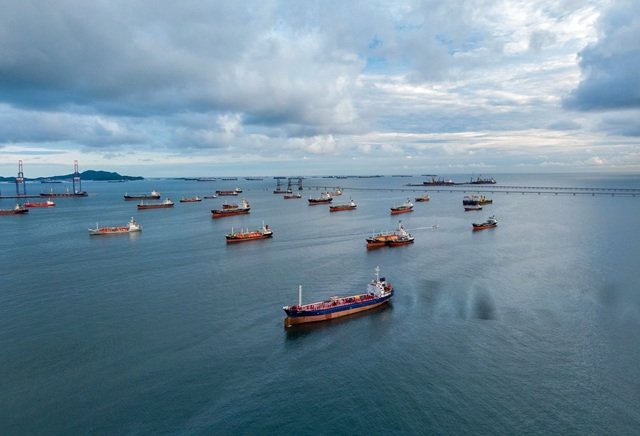
Iran’s proposal to reopen the Strait of Hormuz in exchange for the lifting of the US naval blockade, relief from oil sanctions, the release of frozen Iranian funds and an end to hostilities has shifted attention towards the terms of a possible settlement. The United States initially rejected the proposal, but Qatar has continued to mediate, and Washington has since transmitted a response to Tehran. According to a Pathfinder Alert issued by the Colombo-based think tank Pathfinder, the central disagreement is increasingly about the sequence in which the parties implement their commitments. The more fundamental obstacle, however, is Iran’s nuclear programme, the strategic issue at the centre of the confrontation involving the United States, Israel and Iran.
Reopening the Strait of Hormuz could ease the immediate crisis, but it would not resolve the underlying dispute over Iran’s nuclear capabilities. A settlement would have to address both Iran’s right to peaceful nuclear technology and international concerns about the possibility that its programme could be used to develop nuclear weapons. Without agreement on those issues, a maritime arrangement could provide only temporary relief.
Iran maintains that its nuclear programme is peaceful and that its membership of the Nuclear Non-Proliferation Treaty entitles it to peaceful nuclear technology. Tehran is unlikely to accept an agreement requiring it to abandon uranium enrichment altogether. Its position, however, differs substantially from the restrictions it accepted under the 2015 Joint Comprehensive Plan of Action (JCPOA), which limited enrichment to 3.67 per cent and restricted its stockpile to 300 kilograms of enriched uranium for a specified period.
The most immediate technical problem concerns uranium enriched to 60 per cent. The International Atomic Energy Agency’s latest verified figure was 440.9 kilograms as of June 2025. Since inspectors have subsequently been denied access to enrichment facilities, the agency says it cannot currently establish the size, composition or location of Iran’s enriched-uranium stockpile. This uncertainty complicates negotiations because any new restrictions would have to be assessed against an accurate account of the material Iran possesses.
For Tehran, abandoning enrichment would carry substantial domestic political costs after decades of investment, sanctions and confrontation. The government would have to explain why it had endured sustained pressure to preserve its nuclear programme if it ultimately surrendered enrichment under duress. Pathfinder argues that negotiators could instead distinguish between abandoning enrichment and accepting strict limits on its scope. Under such an arrangement, Iran could retain a peaceful nuclear programme while accepting internationally verified restrictions on enrichment levels, uranium quantities, centrifuges and facilities.
Washington’s central objective, the assessment argues, need not be the elimination of every Iranian nuclear capability. It could instead seek to prevent Iran from moving rapidly from a civilian programme towards producing nuclear weapons. That would leave room for an agreement allowing tightly controlled enrichment, subject to a low enrichment ceiling, a limited stockpile, restrictions on advanced centrifuges and enrichment facilities, and comprehensive IAEA verification. The existing 60 per cent material would also have to be converted, diluted or removed under agreed conditions.
The disposition of that stockpile could become the first major test of whether the two sides can reach a compromise. Iran has reportedly rejected sending its highly enriched uranium abroad, although Iranian sources have indicated that dilution under IAEA supervision could be considered. The Supreme Leader has reportedly ordered the material to remain in Iran. Possible arrangements include dilution to a much lower enrichment level, conversion into a form that cannot readily be re-enriched, transfer abroad under international supervision, or retention inside Iran under exceptionally stringent safeguards.
The IAEA would be indispensable to implementing any such agreement, but its role would be limited to verification. It could establish what Iran possessed, monitor its nuclear activities and assess compliance with agreed restrictions; it could not determine the political terms of the settlement. Negotiators would therefore have to decide not only when inspectors return, but also the extent of their access to enrichment facilities, uranium stocks, centrifuge production, research and development, uranium conversion and locations where undeclared nuclear activity is suspected.
Israel presents a further obstacle. Its opposition to the JCPOA concerned not only the possibility of Iranian non-compliance but also the retention of significant nuclear infrastructure and the time limits attached to important restrictions. Washington might accept limited enrichment if the stockpile, enrichment levels, centrifuge capacity and verification regime made a rapid nuclear breakout sufficiently difficult. Israel could demand stronger and longer-lasting constraints. Reconciling those concerns without requiring Iran to abandon enrichment entirely is likely to be among the most difficult parts of the negotiations.
The concessions would also be unequal in character. Iran would be expected to accept restrictions directly affecting its nuclear capabilities, while the United States would principally ease the economic and military pressure imposed on Tehran. In return for verifiable nuclear limits, Washington could be expected to offer sanctions suspension or removal, restored oil exports, termination of the naval blockade and the release of frozen Iranian funds, alongside assurances about implementation.
Pathfinder proposes a phased approach rather than a single comprehensive transaction. An interim understanding could first halt military operations and establish a mechanism for restoring maritime traffic. Iran could then allow the IAEA to return and establish the status of its nuclear material, followed by an agreement on the 60 per cent stockpile and defined limits on enrichment, centrifuges and uranium quantities. The United States could progressively ease sanctions, permit oil exports, end the blockade of Iranian ports and release frozen assets as the nuclear commitments took effect.
The process would require the Iranian government to demonstrate that it had protected the country’s sovereign nuclear rights while accepting substantial restrictions. The US administration would need to show that military and economic pressure had produced a verifiable reduction in the nuclear threat, while Israel would have to be satisfied that the resulting agreement did not leave Iran with the capacity to recreate the same strategic danger within a few years. Pathfinder also suggests that the results of the US midterm elections might offer another route towards resolving the impasse.