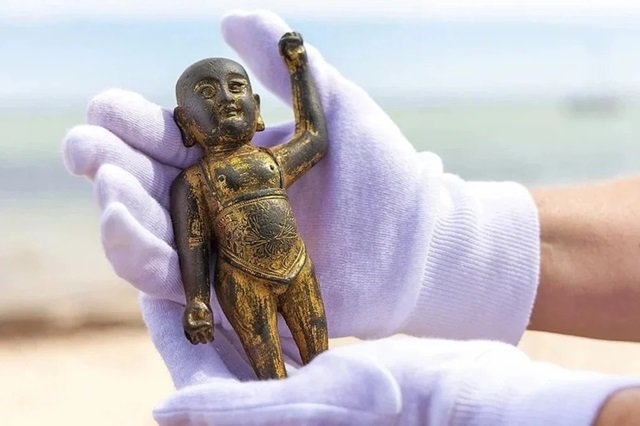
A 500-year-old bronze Buddha statue discovered buried near a roadside in Western Australia has been returned to China, ending years of uncertainty over its custody but leaving unanswered questions about how the artefact reached the country.
The 15cm (six-inch) figurine was formally handed over to Chinese consular representatives during a ceremony on Tuesday in Denham, a coastal town in Shark Bay, the Australian public broadcaster ABC reported. It will be taken to China for further evaluation to establish its history before being displayed at a museum in Beijing.
The statue was discovered in 2018 by Leon Deschamps and Shayne Thomson, who were testing metal-detecting equipment in the area. Since finding it, the pair have said that the artefact should be returned to China as a gesture of goodwill.
Simon Wu, president of the Australia China Friendship Society Western Australia, described the repatriation as an act of generosity and a demonstration of cultural respect.
“Today is an example of how we can bring cultures, countries and people together through a small object. It is showing respect and goodwill,” Wu told the ceremony.
The figurine is believed to be the oldest Chinese artefact ever found in Australia. It was used in ceremonies marking the Buddha’s birthday, during which worshippers poured water over the statue’s shoulders while chanting sutras to encourage good deeds and compassionate thoughts.
Asian art specialist Lee Young authenticated the object as a genuine artefact from China’s Ming dynasty, which ruled from 1368 to 1644. However, its age and authenticity have not established when or how it arrived in Australia.
Some media reports have suggested that the statue might have been transported aboard the treasure ships of Zheng He, the celebrated 15th-century Chinese seafarer. There is, however, no evidence that Zheng He ever reached Australia, leaving the proposed connection unconfirmed.
A more plausible theory is that Chinese pearlers or fishermen brought the figurine to Western Australia during the 19th century. Shark Bay became the birthplace of Western Australia’s pearling industry, which depended heavily on Malay, Chinese and Indigenous Australian labourers.
Records held by the Western Australian Museum show that a census conducted in 1886 counted more than 200 people working in the local pearling industry. They included 60 Europeans, 102 Chinese and 68 Malays. The same year, 68 pearling vessels operated in the area, seven of which were owned by Chinese interests.
The industry subsequently declined, while local authorities introduced a series of restrictions on Chinese immigration. Although the historical presence of Chinese workers and vessel owners provides a possible route by which the statue reached Australia, the available information does not establish that it arrived during this period.
According to ABC, the Buddha will be returned alongside some of Shark Bay’s distinctive red earth and a golden pearl shell, linking the handover to the region where the figurine was found.
The repatriation follows an earlier return of Chinese cultural property by Australia in 2023, when a collection of valuable relics was sent back to China. The items included objects seized by customs, pieces donated by the National Gallery of Australia and an artefact contributed by a private citizen.