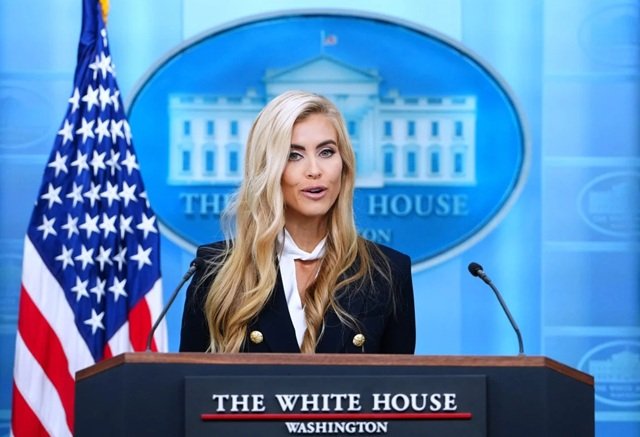
White House press secretary Katie Zacharia has acknowledged that she failed the California bar exam after previously telling reporters she had passed one when she moved to China, prompting renewed scrutiny of her legal credentials and professional background.
In an interview on Thursday with conservative commentator Jack Posobiec on the right-wing streaming channel Real America’s Voice, Zacharia said she had sat the California bar exam after graduating from Pepperdine University’s law school in 2011 but had not passed. She said the result was “somewhat inconsequential, because I knew I wouldn’t need the bar in China”, where she moved with her husband for his job.
“There’s no Chinese bar,” she said. China does require aspiring lawyers to pass the National Unified Legal Professional Qualification Examination to practise on the mainland, although only Chinese citizens may sit the examination under rules established by the Ministry of Justice. Chinese law firms can employ foreign nationals, but those employees cannot be licensed as lawyers in China.
Zacharia said there had been “a lot of misinformation” about her use of the term “lawyer”, arguing that “absolutely across the board you can call yourself a lawyer”. She said she had consulted several people in the field but did not identify them. In an interview with The New York Times on Wednesday, she said Pepperdine’s president had advised her that she could describe herself as a lawyer, but not as an “attorney” or “esquire”.
The State Bar of California, which regulates lawyers in the state, told the South China Morning Post that it had no record of Zacharia being licensed under either her married name or her maiden name, Black. It said state law generally makes it unlawful for anyone who is not an active licensee or otherwise authorised to present themselves as practising, or entitled to practise, law in California.
US President Donald Trump referred to Zacharia as an attorney when announcing her appointment last week. She had previously said she practised international transaction law “with all the appropriate credentials”. She later told The New York Times that she had misheard a question about the bar exam during her White House debut because of noise from the presidential helicopter.
Zacharia’s professional history has also attracted attention because her LinkedIn profile lists her as an associate at Zhong Lun Law Firm, one of China’s largest, from 2011 to 2013. She told Posobiec that she had been “offered a job at an international practice division of a Chinese law firm”.
Gary Gao, a Shanghai-based partner at Zhong Lun, told The New York Times that the firm frequently hired foreign nationals to provide language assistance and that “they are not practising Chinese law at any time”. He said Zacharia’s position would probably have resembled a paid internship.
In the same interview with Posobiec, Zacharia questioned China’s rise as a global power, recalling her reaction after arriving from the country following Trump’s 2016 election victory. “I remember this very distinctly, having just come from China, thinking, ‘How is China the next country on the horizon? They don’t even have proper toilets,’” she said.
Zacharia has also claimed on a podcast that she was “the outside counsel to the IFC and the World Bank”, according to a clip first identified by independent journalist Judd Legum.
On Wednesday, the watchdog group Campaign for Accountability asked the State Bar to investigate whether Zacharia had violated state law by presenting herself as a lawyer and whether her work as general counsel of Fix California, a non-profit organisation led by former Trump administration official Richard Grenell, constituted unauthorised legal practice. The group said the State Bar had acknowledged receiving its complaint and that it had also shared the complaint with the DC Bar.
Michelle Kuppersmith, the group’s executive director, said the distinction between “lawyer” and “attorney” was “a distinction without a difference”. “She was not entitled to hold herself out as a lawyer,” she said.
The State Bar declined to confirm whether it had received a complaint or was investigating, citing the confidentiality of disciplinary matters. The White House did not respond to repeated requests for comment from the South China Morning Post, and Zhong Lun did not respond to a request for comment.