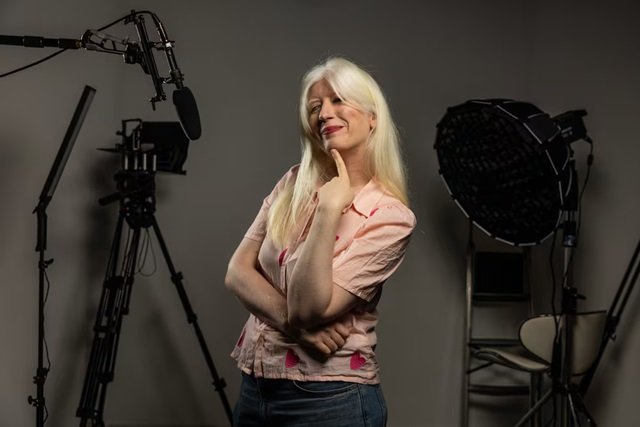
Patty Bonet, a 41-year-old journalist, television presenter, actress and inclusion activist from Valencia, has become a familiar face in Spanish households through her nightly appearances co-presenting ONCE lottery draws on Televisión Española. Yet, despite her growing public profile, she says the acting profession continues to limit her opportunities because of her appearance, with casting directors repeatedly offering her roles designed to frighten audiences rather than portray people in ordinary life.
“Solo me ofrecen papeles que dan yuyu, pero soy actriz y tengo que comer” — “They only offer me roles that are creepy, but I’m an actress and I have to eat” — Bonet told El País in an interview about her career, experiences of discrimination and determination to secure more substantial opportunities on screen. Her television work, she says, has helped change how people perceive her, but the entertainment industry has yet to offer her the range of roles she wants to play.
When Bonet was born, the doctor attending her delivery told her parents that their daughter was very blonde, very white and blind. None of those descriptions was accurate. Two years later, an ophthalmologist established the correct diagnosis: albinism, a genetic condition that affects pigmentation and can be associated with visual impairment. “Your daughter is albino, she will have visual limitations, but she will be able to do whatever she wants,” the specialist told her parents, according to Bonet’s recollection.
Her visual impairment remains significant. She estimates that she has around 10% of her vision, a limitation that affects her access to public spaces and cultural activities. Attending a musical, for example, can mean paying €150 for a seat in the front row, where she can see more of the performance but still misses important details. “Someone with a lot of money can pay €150 to see The Lion King in the front row. I have no other option,” she said.
Bonet’s relationship with performance began at the age of five, when she and her sister joined the Coral Allegro choir of ONCE in Valencia. The group brings together people with and without disabilities, combining singing with dancing and spoken performances. Although she was shy and introverted as a child, she found that her inhibitions disappeared on stage. “I felt free, confident and happy. I told myself: ‘I want to live here all my life’,” she said.
The experience also helped her cope with bullying at school. Bonet recalls being excluded from games and repeatedly left unchosen during physical education classes. Teachers struggled to accommodate her visual impairment, while her need to sit in the front row and use a lectern during adolescence made her feel conspicuously different from her classmates.
One incident remains particularly painful. During a school excursion, a group of boys began throwing stones at her. Rather than intervening in a way that reassured the 10-year-old, a teacher told her: “Well, get ready, because you will have worse things in the future.” Bonet says adults frequently failed to support her when she faced hostility.
She believes ignorance about albinism persists despite greater public awareness. She recalls visiting a dermatologist whose nurse did not know that albinism was a genetic condition rather than an illness. On another occasion, a woman complimented her hair before asking whether it was naturally blonde. When Bonet explained that she had albinism, the woman responded: “And where is that?”
A make-up artist once asked her how many hours of sunshine there were in her country after learning about her condition. Another encounter occurred during a BlaBlaCar journey, when a child began touching her hair. The girl explained that her mother had told her touching Bonet’s hair would bring good luck.
Bonet connected the incident to accounts of people with albinism being persecuted and killed in parts of Africa because of beliefs that their body parts possess healing properties. Experiencing a related superstition in Spain left her angry. Although she describes herself as optimistic and rejects what she calls victimhood, she acknowledges that the cumulative effect of such encounters can be difficult. She attends therapy to address these experiences and their impact on her self-esteem.
For Bonet, greater representation in entertainment is central to changing public attitudes. She wants audiences to see more characters with albinism and people who are blind or deaf, rather than repeatedly encountering performers with conventionally idealised bodies. She argues that familiar exposure to different appearances and experiences could help make diversity an ordinary part of television and film.
The same barriers, she says, shape her professional life. Bonet has played a member of a satanic sect in a Netflix series, a role that provided her first significant opportunity on a film or television set. She remembers the experience fondly and says she learned a great deal. But she believes casting decisions often associate her appearance with fear, restricting the characters she is offered. She has also been turned down for period dramas and questions why people with albinism should be excluded from stories set in the 19th century.
The Albinism Association ALBA is among the organisations campaigning against such limitations, and Bonet says she shares its efforts to widen opportunities. Her immediate concern is that she has gone a long time without even being invited to audition. She hopes to work with Spanish directors including J. A. Bayona, the filmmaking duo Los Javis, Patricia Font and Alejandro Amenábar.
Her admiration for Amenábar is tied to a memory of her mother, who was seriously ill when Bonet lived in Valencia. After watching his film Mar adentro, she became an enthusiastic admirer. Her mother took her to the Goya awards in Madrid in the hope that the director would sign the screenplay, although they failed to meet him that day. Shortly before her mother died, Bonet moved to Madrid to pursue her ambitions. Years later, she encountered Amenábar while walking her dog, Pirulo, near the Temple of Debod and told him the story. He signed the screenplay the following day.
Meanwhile, her television career has given her a different kind of recognition. After four years presenting ONCE lottery draws, Bonet says viewers increasingly identify her with her work rather than her appearance. “I’m no longer the girl with albinism. Now I’m the woman from television, and for me that is an enormous step,” she said. “People associate me with my work and not my physical appearance.”
She is also learning to use a white cane after a frightening incident prompted her to reconsider how she navigates the city. She admits that she sometimes feels reluctant to be seen with it, as she continues to adjust to the change. The experience reflects the ongoing negotiation between independence, visibility and self-confidence that she describes in her interview with El País.
For Bonet, television has demonstrated that audiences can become accustomed to seeing people who have traditionally been treated as different. The challenge now is to extend that acceptance beyond presenting roles and into the acting profession, where she continues to seek the opportunity to audition for characters that are not defined by her albinism.