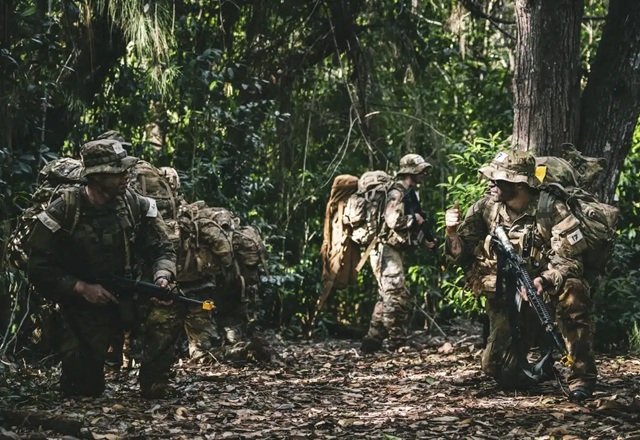
The United States is expanding its direct military involvement in Latin America’s fight against drug cartels, with American special forces and counternarcotics officials participating in a major operation in Ecuador alongside local security forces. The deployment signals a shift from a strategy centred on intelligence sharing, training and maritime interdictions towards a more forward military presence on land, as the Trump administration increasingly treats transnational criminal organisations as national security threats.
According to an analysis published by the Soufan Center, 50 American personnel from the armed forces and the Drug Enforcement Administration (DEA) participated in a September 24 operation targeting a suspected drug trafficking network with alleged links to Mexico’s Jalisco New Generation Cartel (CJNG). Ecuadorian law enforcement and military forces conducted raids across Guayaquil and several coastal cities in the south-west, including Daule, Machala, Vinces, Babahoyo, Ventanas and Puebloviejo. More than 370 officers took part after over eight months of mapping and surveillance. Authorities arrested more than 30 alleged members of the criminal organisation and seized weapons, cocaine and aircraft.
Ecuador’s interior minister announced that the national police had carried out the operation with the DEA and troops affiliated with US Southern Command (SOUTHCOM). During a visit to Ecuador, US Secretary of State Marco Rubio praised the cooperation, describing the country as Washington’s most “aggressive” partner in its counter-cartel campaign. He also confirmed that American “elite forces” were working alongside Ecuadorian counterparts and said the administration would seek an additional $45 million in security funding for efforts against what it calls “narco-terrorists”.
The operation follows a series of increasingly direct US interventions in the region. On March 3, American commandos and Ecuadorian forces jointly launched an airstrike against a suspected drug trafficking camp near the Ecuadorian-Colombian border, reportedly using amphibious and airborne equipment. The two governments have also strengthened cooperation on extradition, including the transfer to the United States of Adolfo Macías, the notorious leader of the Los Choneros gang, on drug trafficking charges. Macías escaped from a maximum-security prison in 2024 and was recaptured a year later.
President Daniel Noboa has advocated a more direct American military role in Ecuador, arguing in April that US troops could help address the country’s security crisis. However, domestic opposition has constrained the expansion of Washington’s military presence. Ecuador’s National Assembly voted in June 2025 to reverse a constitutional prohibition on foreign military bases introduced in 2008. Voters rejected the change in a November 2025 referendum, effectively blocking the establishment of permanent foreign military bases.
The Soufan Center identifies the designation of cartel organisations as foreign terrorist organisations as a central element of the administration’s changing approach. In February 2025, the US Treasury Department began designating groups including the CJNG, Mara Salvatrucha (MS-13) and the Sinaloa Cartel as foreign terrorist organisations. The administration has continued to pursue a broader campaign against 22 cartel groups, using a framework that seeks to extend the resources, personnel and operational capabilities available beyond conventional law enforcement.
The change has accompanied a wider expansion of American military activity. On June 14, US forces conducted an airstrike targeting Héctor Rusthenford Guerrero Flores, widely known as “Niño Guerrero”, the leader of the Tren de Aragua criminal organisation. In Venezuela, the January US operation that removed former president Nicolás Maduro and established a transitional government has contributed to a more active counter-cartel campaign, including drone surveillance and strikes against suspected trafficking networks.
In Colombia, the Trump administration and the government of President Abelardo de la Espriella signed an agreement in August enabling direct American military operations against cartel networks operating in and through the country. The Pentagon also finalised agreements with Panama, Honduras and Colombia in October to deploy troops from the Army’s 10th Mountain Division, based at Fort Drum, for joint exercises, training and support for special operations personnel advising counter-cartel operations.
Some of these arrangements restrict American forces from participating in combat, even alongside local troops. Nevertheless, US Southern Command chief General Francis Donovan has indicated that ground strikes remain under consideration. Speaking to the Wall Street Journal shortly after the deployment announcement, he said: “Do I see land strikes as options? Yes. We want all options at the table.”
The expanding military footprint represents the latest stage in a campaign that began with a restructuring of the legal framework governing action against trafficking networks, followed by Joint Task Force Southern Spear, which targeted vessels suspected of transporting illicit drugs in the Caribbean Sea. Washington has since replaced that initiative with Joint Task Force Western Hemisphere, reflecting a broader effort to establish a forward operational presence and conduct operations with regional partners against organisations classified as foreign terrorist groups.
The strategy is developing as the United States faces competing demands on its military and security resources. The Soufan Center notes that the expansion coincides with cuts to personnel and resources across counterterrorism agencies, continued American involvement in the war against Iran and the Houthis, and reported shortages of munitions. The administration’s ability to sustain a wider military commitment in Latin America will depend on the capacity of its defence industry, the structure and availability of its forces, and domestic public support, alongside the risks of potential hostilities with cartel organisations across the region.