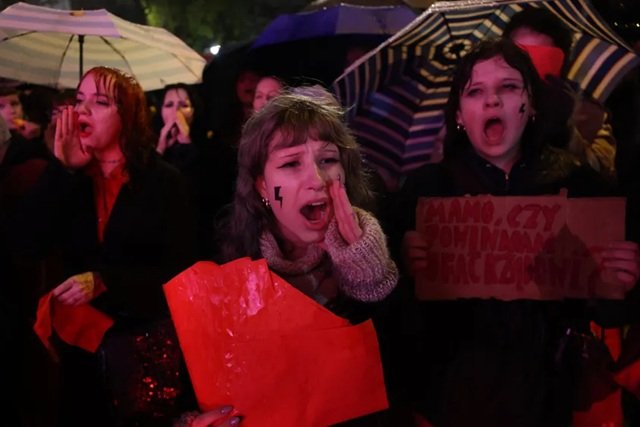
Thousands of people demonstrated across Poland to demand abortion rights, accusing Prime Minister Donald Tusk’s government of failing to deliver on its election promise to liberalise the country’s restrictive abortion laws. The protests came after parliament passed two bills intended to ease access to abortion, although both measures face an expected veto from conservative President Karol Nawrocki.
Around 1,000 people took to the streets of Warsaw despite heavy rain, while demonstrations were held in about 20 other cities across the country. Activists criticised the government for failing to fulfil its campaign commitments, arguing that the parliamentary votes amounted to a symbolic gesture rather than a substantive change in abortion rights.
Poland’s parliament approved the two bills on Tuesday. However, Nawrocki is expected to block them, leaving their prospects of becoming law uncertain. The anticipated veto has fuelled criticism of the government’s approach, particularly among campaigners who have called for a more comprehensive reform of the country’s abortion legislation.
Poland, a predominantly Catholic country, has some of the strictest abortion laws in Europe. A near-total ban introduced in 2020 prompted some of the largest demonstrations in the country since the fall of communism in 1989. The restrictions have remained a major political issue, with Tusk’s governing coalition promising to ease the law after taking office.
That pledge has proved difficult to fulfil because the coalition is divided over abortion reform. The lack of agreement has delayed the promised changes, while the prospect of presidential opposition has further constrained the government’s ability to introduce broader legislation.
Tusk acknowledged the difficulties in 2024, admitting that his government would probably be unable to overcome a presidential veto. Rather than securing a comprehensive overhaul of the law, his administration introduced measures intended to prevent hospitals from refusing legally permitted abortions on religious grounds.
Under the current rules, abortion is permitted only when a pregnancy results from a criminal act, such as rape or incest, or when it poses a threat to the mother’s life or health. The restrictions were tightened following a ruling that removed severe foetal abnormalities as a legal ground for abortion.
The two bills passed by parliament address different aspects of the restrictions. The first proposes partially decriminalising abortion and assistance in carrying it out, activities that can currently result in imprisonment. The second would reverse the ruling that made severe foetal abnormalities insufficient grounds for a legal abortion.
Although the measures would ease some restrictions, they fall short of the broader liberalisation promised by Tusk’s coalition. Their passage through parliament has therefore done little to reassure campaigners seeking more extensive changes, particularly as Nawrocki is expected to use his presidential veto to block both bills.