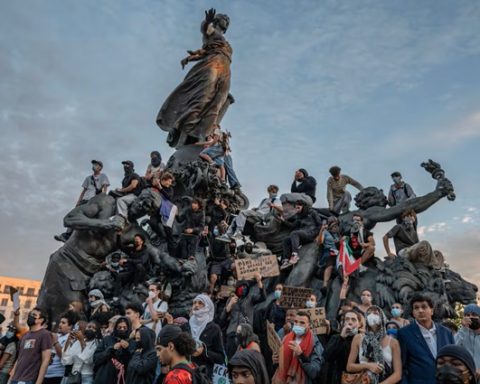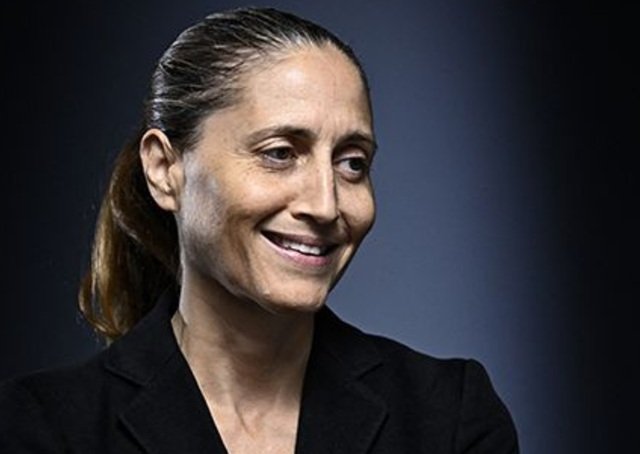
France’s latest wave of protests has exposed a widening divide between citizens demanding economic relief and better public services, and those who increasingly view violence as a legitimate means of confronting the state. While hundreds of thousands of people demonstrated largely peacefully against rising living costs and for improvements to the education system, violent incidents on 17 October have intensified concerns about the country’s political divisions. In an interview with the German weekly newspaper Die Zeit, philosopher and psychoanalyst Cynthia Fleury warned that the violence could escalate into deadly confrontations while preventing meaningful debate about the grievances driving the demonstrations.
Fleury, a 52-year-old professor based in Paris whose recent German-language book is titled Klinik der Würde (2024), said she had followed the events of 17 October both in person and through social media, television news and radio. The demonstrations, she argued, revealed not a convergence of social movements, as some optimists had suggested, but a society divided into competing groups with fundamentally different demands. The Yellow Vests movement had sought recognition, she said, whereas looters were seeking the power that comes from being feared and turning violence into a spectacle.
She described how some participants filmed themselves laughing while stealing goods, then resold their limited spoils online the following day. “In violence, revenge reveals itself,” Fleury told Die Zeit. She also criticised what she regarded as an emerging public narrative that justified violence through the argument that violence could be answered with violence. For her, the distinction between legitimate protest and destructive acts was essential to understanding the divisions exposed by the demonstrations.
Fleury cautioned that international coverage could distort perceptions of the protests by privileging dramatic images of violence over the experiences of ordinary citizens. The livelihoods and living conditions of some people had been devastated, she said, and their voices deserved attention alongside the footage of looting and confrontation. She recalled a warning made in 2018 by former interior minister Gérard Collomb, who feared that France was no longer standing side by side but increasingly turning against itself.
The divisions, in Fleury’s assessment, extend beyond disagreements over government policy. She described a confrontation between young people and the state, as well as between citizens who regard radicalism and violence as legitimate instruments for breaking with liberal politics and those seeking greater cross-party agreement in pursuit of the common good. The debate over whether violence can be justified as a means of achieving social justice is longstanding, she said, but has gained renewed momentum in France and elsewhere in Europe.
Fleury argued that the cultivation of hatred depends on denying the complexity and individuality of other people. Young people have reasons both to love and to resent their country, she said, meaning that the choice to embrace hatred is ultimately ideological and political. The looters’ use of mobile phones to record their actions also had a significance beyond the immediate crimes: by filming and circulating their behaviour, they were taking control of the media spectacle and influencing how the events were represented.
Yet Fleury regarded this violence as a profoundly inadequate political project for achieving social justice, describing it as compatible with the excesses of a consumer society rather than a challenge to its underlying structures. She connected the behaviour to resentment, which she defines as a form of endless rumination that deprives individuals of their capacity to act and judge. It becomes a process of self-poisoning in which people remain trapped in a sense of humiliation and victimhood without developing a constructive response.
“Social progress does not emerge from resentment as a historical driving force,” she said. Social justice, in her view, requires the transformation of violent impulses into constructive forms of action. Instead, she argued, the current protests have revealed an excessive enjoyment of violence, with destructive behaviour displacing the political questions that initially brought people onto the streets.
That displacement is particularly troubling because the demonstrations have included large numbers of peaceful participants and demands that Fleury considers politically significant. The violence has pushed these concerns into the background, preventing sustained discussion of the underlying problems. With France approaching its presidential election in April, she argued, the coming months should be devoted to substantive political debate rather than allowing the spectacle of confrontation to dominate public attention.
Nor does Fleury consider the phenomenon uniquely French. Although the French Revolution occupies a prominent place in the country’s political culture, she pointed to similar developments in Italy, Albania, Belgium and Greece. The unrest, she argued, cannot be explained solely as opposition to French government policy. Global inequalities associated with ultraliberal globalisation form part of the context, but she also identified what she called a hostile victim mentality, particularly among younger people, which social networks can reinforce.
The French government, Fleury said, must urgently calm the situation because violence of the kind seen on 17 October can rapidly become fatal. However, the presidential election campaign and the deadlock in the National Assembly are making sustained government action more difficult. She did not suggest that restoring order alone would resolve the underlying grievances.
Instead, Fleury advocated greater use of democratic experimentation at the local level, where communities can develop policies suited to people’s actual needs. Such initiatives, she argued, can help rebuild trust between citizens and public institutions while producing practical improvements in everyday life.
She cited an action-research programme conducted by the philosophy chair she holds in collaboration with the southern French municipality of Saint-Médard-en-Jalles. The project is developing local measures and municipal strategies concerning the health centre, end-of-life care, the Simone de Beauvoir retirement home and forest management. Its aim is to develop public policy collaboratively rather than impose solutions from above.
The programme draws on a charter titled What Cannot Be Stolen, which Fleury developed with designer Antoine Fenoglio. It establishes ten non-negotiable principles for life in the world, including silence, the horizon, care for the dead, quality of life, physical and mental health, care for others and the right to experiment with new approaches.