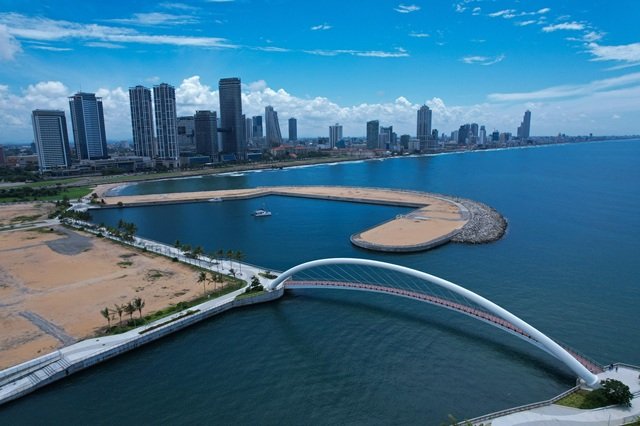
Sri Lanka’s luxury property market is attracting renewed investor interest, with Chinese-backed developments among the projects benefiting from rising demand in Colombo. Yet analysts warn that the recent surge in prices and expectations of substantial returns could encourage speculative excess, particularly in a market where oversight of property presales remains limited.
The South China Morning Post has reported on the wider challenges facing Chinese companies expanding overseas, including property investments exposed to oversupply, financing difficulties and changing market conditions. Sri Lanka’s property rally offers new opportunities for developers, but the experiences of Chinese investors in other countries demonstrate the risks of relying on sustained price growth to justify large-scale projects.
“Chinese developers, having already learned a hard lesson from the property market [slump in China], need to stay cautious,” said Wang Feng, chairman of Shanghai-based financial services group Ye Lang Capital. “I bet they won’t get carried away by the recent price surge in Sri Lanka because of their high risk-awareness.”
Three new luxury residential projects in Colombo Port City have attracted strong interest from local buyers, according to a report by online magazine The Diplomat. The developments, built by Sri Lanka’s leading real estate firms, represent a combined investment of US$650 million. Developers have marketed them with projected returns of up to 100 per cent over four years, the report said.
The scale of those projected gains illustrates the expectations surrounding Colombo’s higher-end residential market. However, such returns remain projections rather than established outcomes, and the growing use of property as an investment raises concerns about the relationship between prices, demand and the capacity of the market to absorb new supply.
Colombo Port City is a US$1.4 billion development being built on reclaimed land by China Harbour Engineering Co (Chec) and the Sri Lankan government. Chec is a subsidiary of China Communications Construction, a Chinese multinational engineering and construction company. Construction began in September 2014, when the project was described by China’s State-owned Assets Supervision and Administration Commission as the largest foreign direct investment-backed infrastructure project in Sri Lanka.
The development was conceived as a new central business district focused on tourism, financial services and logistics. According to the state-assets regulator, the plan envisaged the area eventually accommodating 280,000 residents and workers. Its scale and economic ambitions have made it a major component of Chinese-backed infrastructure investment in Sri Lanka, which participates in China’s Belt and Road Initiative, launched by President Xi Jinping in 2013 to strengthen trade and infrastructure connections across Asia, Africa, Europe and beyond.
Chinese investment in Sri Lanka has also extended beyond luxury property. In May, Chec held a topping-out ceremony for an affordable public housing project in Colombo expected to deliver an initial 112 homes for low-income residents, with another 1,884 units planned. The project sits alongside the high-end developments drawing attention from investors, although the source material does not establish whether the two segments face the same demand or financial conditions.
Figures from Sri Lanka’s central bank indicate that investment demand is playing a significant role in the apartment market. More than 20 per cent of flats were purchased for investment purposes in the first quarter of 2026. Developers have increasingly shifted towards higher-end projects to capitalise on rising demand, while the proportion of home sales involving expensive properties has grown.
About 52 per cent of home sales in the three months ending in March were priced above 50 million rupees (US$150,600), compared with 33 per cent a year earlier, according to the central bank survey. The figures point to a market increasingly weighted towards higher-priced housing, while the share of purchases made for investment suggests that some buyers are seeking financial returns rather than acquiring homes primarily for their own use.
Questions remain over whether Sri Lanka’s regulatory framework can adequately supervise this activity. The Diplomat reported that the Condominium Management Authority oversees the country’s luxury homes, but its principal responsibility is monitoring and supervising completed buildings. Its ability to regulate the fast-moving presale market, where investors can commit money to properties before construction is finished, is limited.
That gap matters in a market where projected gains can influence purchasing decisions before the final supply of completed homes and their longer-term demand are established. The concern is not limited to Sri Lanka. Over the past decade, Chinese developers expanding internationally have encountered mixed results, particularly after Beijing tightened controls on capital outflows and China’s domestic property crisis weakened financing conditions.
One prominent example is Country Garden’s Forest City development in Johor, Malaysia, launched in 2016 with plans to house 700,000 people in a vast complex of condominiums, office towers, hotels, shopping malls and schools. Despite selling 28,000 units during its first phase, the project had only about 9,000 residents by 2020. The difference between units sold and people living in the development illustrates how property sales do not necessarily translate into the population or activity anticipated by developers.
Sri Lanka has also seen setbacks involving Chinese investment outside the residential sector. On 15 October, China Merchants Port Holdings announced that it would withdraw from a US$280 million logistics hub project in Colombo. The South Asia Commercial and Logistics Hub, established in 2023 as a joint venture in which the Chinese company held a 70 per cent stake, was planned as a complex comprising a bonded warehouse and container yard.
In a filing with the Hong Kong stock exchange, China Merchants Port Holdings said terminating the project was in the best interests of all parties involved. The decision adds to the mixed record of Chinese-backed projects in Sri Lanka as the country’s property market attracts fresh investment and developers pursue opportunities across different price segments.