For decades, the label “Made in China” was associated with inexpensive clothing, plastic toys, furniture and basic electronics. That association is becoming increasingly outdated. Chinese factories are now exporting electric vehicles, industrial robots, sophisticated chemicals and essential equipment for data centres, challenging manufacturers in industries long dominated by the United States, Germany, Japan and other advanced economies.
The shift, documented in a Reuters examination of China’s changing export profile, reflects a state-backed effort lasting more than a decade to move the country up the global manufacturing value chain. Vehicles have become the most visible symbol of this transformation, but the expansion extends into the machinery, electrical components and industrial materials required to manufacture products and operate modern infrastructure.
China now sells more cars abroad than Germany and the United States combined, according to the Reuters report. Its exports of complex machinery, high-end chemicals and data centre equipment are also increasing, while shipments of traditional products such as shoes, toys and furniture have declined or stagnated. The resulting competition has created opportunities for overseas consumers seeking affordable products but intensified pressure on manufacturers and workers in countries struggling to match Chinese prices and production capacity.
The export boom is partly supported by government subsidies intended to sustain economic activity while policymakers confront a prolonged property crisis. With household wealth closely tied to housing, Chinese consumers have become more cautious about spending, leaving factories under pressure to find buyers abroad. The combination of substantial manufacturing capacity, domestic competition and government support has helped propel Chinese products into markets previously served by established international producers.
Artificial intelligence infrastructure offers a particularly clear example of how this transformation is extending beyond finished consumer goods. Although the most advanced AI chips are designed by American companies and manufactured in Taiwan, the surrounding hardware includes components that Chinese suppliers are increasingly well positioned to provide. These include mature-node chips, conventional memory, server parts, transformers, cables and electrical control boards used in data centres.
Export data covering 2015 to 2025 show that China’s shipments of several categories of electrical equipment associated with AI infrastructure have increased, making it the leading exporter in five of eight categories examined. The categories include products with applications beyond artificial intelligence, however, and the figures do not establish that every shipment is destined for AI facilities.
“AI is changing China’s trading landscape,” said Ruby Osman, senior geopolitical adviser at the Tony Blair Institute for Global Change. “When you look at the mature chips and the physical inputs that surround them, once again, it’s just China in the lead again.”
Chinese chip shipments nearly doubled in the first half of 2026 to $177.28 billion, while computer and server shipments rose 41.3%, according to the figures cited in the report. The growth highlights the importance of Chinese manufacturing not only to consumer electronics but also to the physical infrastructure supporting the expansion of computing capacity.
Chemicals represent another area in which Chinese companies are moving into higher-value production. China has traditionally manufactured basic chemical products while importing more sophisticated varieties from Europe, Japan and the United States. Its expanding capabilities now include materials used in vehicle bumpers, solar panels and carbon fibre products.
Chinese exports of organic chemicals and plastics in primary form have grown substantially over the past decade, placing the country among the two largest exporters in both categories. In several specialised segments, including polyacetals, polycarboxylic acids, ethers and vinyl chloride polymers, Chinese exports have increased sufficiently for the country to become the leading exporter, according to the Reuters analysis.
Government support has contributed to the expansion. Chinese chemical companies received about $75 billion in subsidies over the past decade, with payments peaking at approximately $15 billion in 2023, according to Organisation for Economic Co-operation and Development data. Chinese data indicate that about 5,000 new chemical companies were established between 2018 and 2023.
The rapid expansion has also produced excess capacity in commodity chemicals used to manufacture products such as footwear and adhesives. Some factories have been forced to idle, while producers have sought overseas markets for accumulated inventories. BASF, Dow, LyondellBasell, Sumitomo Chemical, INEOS and Mitsubishi Chemical have warned investors over the past year that competition from Chinese producers, particularly their advantages in pricing and scale, threatens profitability.
China’s growing industrial machinery exports create a further complication for governments seeking to revive domestic manufacturing through tariffs. Industrial robot exports have risen by more than 300% since 2015, taking market share from American, German and Italian manufacturers whose shipments have fallen. China has also overtaken Germany as the world’s largest exporter of machine tools.
Europe continues to dominate capital goods, but its share of global demand by volume has declined from 54% in 2005 to 43%, while China’s share has increased from 7% to 24%, according to Goldman Sachs estimates. German optical equipment and Dutch chipmaking machines remain difficult to replicate, but Chinese manufacturers are expanding in the more widely used machinery needed to equip factories.
“Building a factory may require Chinese machinery, but the bigger issue is that the production process itself will likely remain dependent on Chinese-made components,” said Fred Neumann, chief Asia economist at HSBC.
Electric vehicles remain the most politically contentious part of the export expansion. Chinese car shipments have increased in value by 1,871% since 2015, with growth accelerating from 2020 as manufacturers sought overseas customers. Affordable prices have helped attract buyers, while excess domestic production has intensified the need to find markets abroad. The United States and Europe have responded with trade barriers intended to protect their automotive industries.
European sales figures nevertheless indicate growing demand. Sales of vehicles made by Chinese manufacturer Leapmotor in Europe increased by 558% in the first half of 2026 compared with the same period in 2025, while sales of BYD models rose by 146%, according to the European Automobile Manufacturers’ Association.
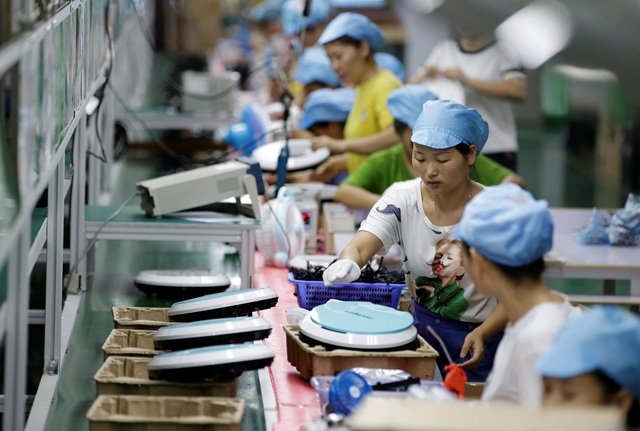
Chinese manufacturers are also extending their reach into smart household appliances, including robotic vacuum cleaners and lawnmowers. These products allow companies to apply artificial intelligence, data-processing capabilities and satellite-positioning systems developed during the automotive boom to new consumer markets. Robotic lawnmowers, for example, use high-precision satellite positioning similar to systems employed in assisted-driving technology to map lawns and operate within virtual boundaries.
The competitive consequences are already visible. iRobot, the Massachusetts-based company behind the Roomba robot vacuum cleaner, filed for bankruptcy last December after losing ground to Chinese competitors, including Picea, a Shenzhen household-appliance manufacturer that had once supplied the American company and is now its owner.
Europe, the world’s largest market for robotic lawnmowers, has become a major destination for Chinese products. Last November, Brussels opened an anti-dumping investigation after a local producer complained that Chinese competitors were undercutting prices by about 40%. In the United States, powered lawnmower shipments fell by $746 million last year from $1 billion in 2023, while China’s exports more than doubled to $2.8 billion from $1.3 billion.