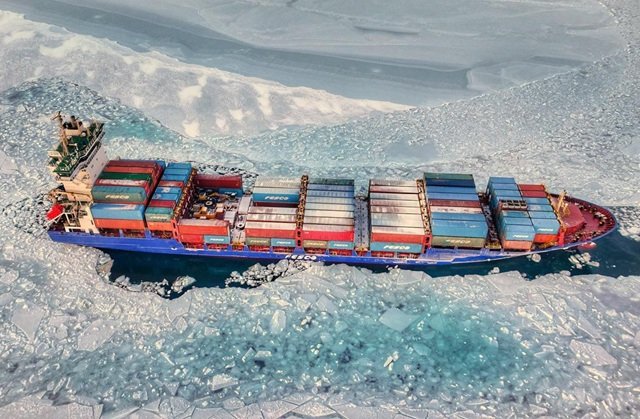
China and Russia have agreed to expand freight traffic along Arctic shipping corridors, deepen links between their ports and increase cooperation on building polar vessels, intensifying competition with Europe over a region gaining strategic importance as polar ice melts.
The agreement, announced last week, followed the European Union’s unveiling of a new Arctic strategy intended to counter growing Russian and Chinese influence. Analysts say, however, that Europe faces significant obstacles in challenging the partnership because Russia controls the main shipping corridor while China supplies much of the commercial and industrial capacity needed to develop it.
Alicia Garcia-Herrero, chief economist for Asia-Pacific, the Middle East and Africa at Natixis CIB, said Europe could not realistically challenge Chinese and Russian dominance of Arctic shipping within a meaningful timeframe. Moscow controls access to the Northern Sea Route, including shipping permits, transit fees and a fleet of nuclear-powered icebreakers, while Beijing provides cargo, vessels and industrial resources.
Europe, by comparison, has limited icebreaker capacity and infrastructure in the Arctic. Its position as a major destination market gives it some commercial leverage, but analysts say this is insufficient to displace the emerging partnership.
The Northern Sea Route offers a shorter alternative to the traditional passage through the Suez Canal. According to data provided by Fertmax FZCO, journeys between Asia and Europe using the Arctic corridor could take 18 to 22 days, compared with 28 to 35 days through Suez, a reduction of about 35%.
The route has particular significance for Moscow as Western sanctions constrain its access to European markets and encourage it to redirect energy exports towards Asia. For Beijing, it offers another potential trade corridor that could reduce dependence on established maritime chokepoints.
David Roche, a veteran strategist at Quantum Strategy & Geonomics, said the route’s principal geopolitical significance lay in the growing economic dependence between the two countries, particularly Russia’s reliance on China to purchase its energy exports as it loses access to European gas markets.
EU foreign policy chief Kaja Kallas described the region as a focus of international competition, saying: “With Russia and China increasing their footprint and ambition, the Arctic has become a front line of global power competition.”
The EU’s new strategy proposes expanding European icebreaker capacity, strengthening maritime surveillance, improving infrastructure connecting Arctic trade networks with European markets and establishing a maritime security hub. It also calls for greater protection of undersea cables amid concerns about Russian military activity and threats to critical infrastructure.
Garcia-Herrero said Europe could increase the commercial and regulatory costs of operating along the route, but would struggle to prevent or replace the partnership without a sustained industrial investment programme. European shipping companies’ concerns about environmental and commercial risks also limit their involvement.
Daeijin Lee, former global head of research at Fertmax FZCO, said Western operators faced sanctions, insurance and compliance complications that made the route less attractive than it was for Chinese companies. “The Arctic gives diversification, not independence,” he said.
Despite the strategic attention, Arctic shipping remains a small part of global trade. Roche estimates that it accounts for about 0.3% of global shipping and could reach roughly 1% by 2030. Figures from Russia’s state nuclear corporation Rosatom and United Nations Trade and Development data indicate that 37.02 million tonnes of cargo travelled along the Northern Sea Route in 2025, compared with 12.72 billion tonnes of global seaborne trade in 2024.
However, traffic is increasing. Data from the Centre for High North Logistics showed 104 confirmed transit voyages carrying an estimated 3.7 million tonnes of cargo by the end of September 2026, exceeding the 3.2 million tonnes recorded during the entire 2025 navigation season.
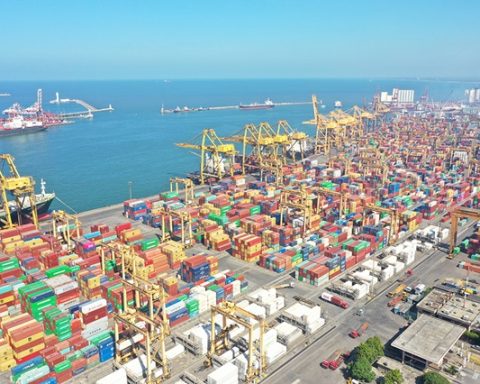
Most existing traffic consists of Russian oil, liquefied natural gas and other commodities rather than international container shipments. Seasonal ice, specialised vessels, insurance costs and Russian transit fees continue to limit the route’s commercial appeal, while a study published in the WMU Journal of Maritime Affairs projected that melting polar ice could raise its annual transit capacity to between 127 million and 463 million tonnes by 2050.