by Eric
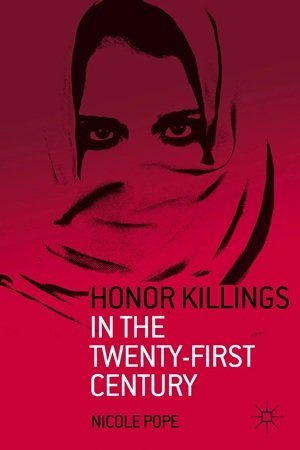
The most disturbing phrase in Nicole Pope’s Honor Killings in the Twenty-First Century may also be its most revealing: “The relatives have decided not to kill the girl.” It is how a lawyer introduces the case of Rojin, a teenager who had been raped, become pregnant and concealed the assault for months because she feared her family’s reaction. The lawyer describes the outcome as an unusual case with “a happy ending”. Yet what kind of society makes survival from a possible family execution appear a happy ending? And what kind of moral vocabulary allows a girl who has already suffered sexual violence to become the person whose conduct must be explained, judged and contained? Pope’s investigation begins with precisely this intolerable contradiction. Rather than treating so-called honour killings as isolated acts of spectacular brutality, she examines the social arrangements that make violence against women possible, justifiable and, in some circumstances, acceptable to those around them.
The book’s most important intervention is its refusal to accept the conventional boundaries of the subject. Pope admits that she initially approached the phenomenon through what she calls “textbook honor killings”: a young woman is accused of damaging the family’s reputation, relatives convene, and one member is appointed to kill her. The apparent simplicity of that pattern soon collapses. She discovers that the language of honour is applied to a much wider range of abuses, including forced marriages, bride exchanges, restrictions on women’s freedom and demands for sexual obedience. Some of the cases she examines do not end in murder. This expansion is intellectually significant because it shifts attention from the final act of violence to the system of control that precedes it. A woman need not be killed for her life to be governed by the threat of punishment.
Pope’s decision to place the word “honor” in inverted commas is therefore more than an editorial preference. It is an ethical refusal to grant the perpetrators ownership of the language through which they justify their actions. “Discrimination and violence against women are never honorable,” she writes, even when those responsible believe they are restoring their family’s reputation. The distinction matters. To repeat the term without qualification risks reproducing the moral logic of those who commit these crimes. Yet Pope also recognises the practical difficulty of marking every occurrence typographically, explaining that the quotation marks should be understood even when they are absent. Her position is clear: the supposed honour belongs to the perpetrators’ worldview, not to the violence itself.
The more controversial dimension of her argument is the attempt to connect these crimes to gender-based violence in Western societies. Pope describes a “continuum of violence” in which honour killings occupy the extreme end but cannot be separated entirely from forms of abuse more familiar to Western audiences. She goes further, proposing an “arch of patriarchal bullying” linking violence committed in the name of family reputation to crimes against women elsewhere. This is a deliberately unsettling proposition. It challenges the comforting assumption that such brutality belongs to distant societies with fundamentally alien values. The control of women, the policing of their sexuality and the punishment of perceived disobedience are not confined to one religious or geographical setting.
But the argument requires careful handling. Establishing a continuum does not mean that every form of misogyny is equivalent, or that the particular dynamics of collective family violence can be reduced to ordinary domestic abuse. Honour-based crimes may involve extended kinship networks, community surveillance, collective reputational anxieties and decisions taken by several relatives. These features deserve analytical distinction rather than absorption into an all-encompassing category of patriarchy. Pope is strongest when she demonstrates connections without erasing differences. Her argument would lose precision if the language of continuity were allowed to make the specific mechanisms of each form of violence disappear.
Her rejection of the idea that honour-based violence is inherently Islamic is equally important. Pope argues that Western media have too often presented these crimes as an expression of Muslim culture, thereby transforming a gendered system of power into a religious stereotype. She instead locates the common denominator in patriarchal values, which assume different forms across countries and communities. This does not mean religion is irrelevant to every individual case, but it does mean that religious identity cannot serve as a sufficient explanation. The distinction is essential in a climate where the reporting of violence against women can become an instrument for reinforcing prejudice against entire populations.
Pope also resists the opposite simplification: the notion that cultures associated with these practices are unchanging and internally uniform. She observes that patriarchal customs differ not only between countries but sometimes between neighbouring villages. They are neither “monolithic nor immutable”; they are continually adapting. Within the same society, she encounters educated and economically secure women who enjoy considerable freedom, as well as less privileged individuals who reject discriminatory traditions and challenge them from within their own communities. This is a welcome correction to the familiar portrait of passive victims trapped in an immovable culture and waiting for outside intervention. The women and men working for change are not peripheral characters in Pope’s account. They are central to its political argument.
Her research across Turkey, Pakistan and the United Kingdom gives this comparative ambition a practical foundation. The three settings allow her to examine different social and political circumstances without treating the phenomenon as the exclusive property of any one country. Turkey is particularly important to the narrative because Pope lives there and has longstanding access to women’s rights organisations and local sources. Pakistan provides another field of investigation, while the United Kingdom introduces the question of how honour-based violence is understood and addressed within a Western liberal democracy. Nevertheless, the comparative framework also invites questions about the limits of the investigation. The author acknowledges that her field research was concentrated in these three locations, even though she collected reports and essays from elsewhere. The material presented here establishes the value of comparison, but it does not by itself demonstrate that the selected cases can represent the full global range of honour-based violence.
The account of Rojin gives these large arguments a human and institutional dimension. Raped by a married man with children, she remained silent for seven months, fearing what her own relatives might do if they discovered her pregnancy. Her half-sister Zekiye intervened before the news spread through the family. A woman with nine children and considerable authority within the extended household, she took Rojin under her protection and eventually persuaded male relatives to spare her life. The episode complicates any simple division between men as perpetrators and women as victims. Women may possess authority within patriarchal structures, and that authority can be used either to enforce their rules or to resist them. Zekiye’s intervention is particularly significant because it demonstrates that the family itself is not a politically or morally uniform institution.
Yet Rojin’s survival should not be mistaken for a resolution. She gave birth to a boy who was subsequently placed for adoption. The rape, the prolonged fear, the threat of death and the separation from her child remain. The description of the case as a happy ending exposes how profoundly expectations have been lowered: not being murdered becomes the measure of success. Pope’s decision to investigate the family’s internal deliberations is valuable because it moves beyond the familiar news report of a crime and towards the social calculations that can determine whether a woman lives. But the extract also leaves an important question hanging. The account gives considerable attention to Zekiye’s authority and the relatives’ decision, while Rojin’s own voice is less visible. A study concerned with restoring agency to threatened women must remain alert to the danger of allowing family members and intermediaries to speak in their place.
The wider Kurdish context adds another layer to the investigation. Pope situates Rojin’s experience in a region devastated by decades of conflict between the Kurdistan Workers’ Party and Turkish security forces, mass displacement and economic hardship. The contrast between the beauty of the landscape and the political violence surrounding it is effectively rendered. More importantly, the account resists treating violence against women as though it develops independently of political and economic conditions. Displacement, poverty and the breakdown of established livelihoods can intensify vulnerability, although the relationship between armed conflict and honour-based violence requires more than geographical proximity to establish causation. Pope’s reporting is valuable precisely because it attempts to place private suffering within a wider social history.
There is also an important question of journalistic method. Pope describes a decade-long investigation that depended on activists, lawyers, relatives, survivors and people directly involved in painful cases. Her acknowledgements recognise these networks rather than presenting the work as the achievement of an isolated investigator. Her personal involvement is not concealed: she admits that the subject became an emotional and professional journey. That candour gives the project moral urgency, although emotional commitment cannot substitute for the critical distance required to test testimony, distinguish individual experience from broader patterns and examine competing explanations.
The book’s lasting contribution, then, is not simply its exposure of horrific crimes. It is the challenge it poses to the categories through which societies excuse, exoticise or overlook violence against women. Pope refuses to make patriarchy the cultural property of a distant population, while also refusing to portray the communities she investigates as incapable of reform. Her argument is most persuasive when it holds these positions together: the violence is culturally and politically specific, but its underlying logic is neither geographically confined nor beyond challenge. Rojin’s survival is not the happy ending the lawyer initially promised. It is evidence of what can happen when someone within a family refuses to obey the demands of a destructive social code. In a book about the power of collective pressure, that individual act of resistance may be its most consequential finding.