China is seeking to advance regional economic integration across the Asia-Pacific as leaders prepare to gather in Shenzhen for the 33rd Asia-Pacific Economic Cooperation (APEC) summit on November 18 and 19. Beijing is pushing for a framework to coordinate trade rules and economic policies among the bloc’s 21 member economies, while Mexico has used the preparations for the meeting to promote an ambitious investment programme worth a projected $432 billion through 2030.
The Chinese initiative centres on the long-discussed Free Trade Area of the Asia-Pacific (FTAAP), a proposal that has remained on APEC’s agenda for two decades. Chinese Vice Commerce Minister Li Chenggang said on Monday that member economies were intensifying consultations on a separate declaration that could be adopted at the leaders’ meeting. The document would establish guidelines for further work towards the proposed regional trade arrangement, rather than formally announce the creation of a free trade area.
The distinction is significant. Although the FTAAP has long been regarded as a possible route towards deeper economic cooperation across the Pacific, progress has depended on building consensus among economies with different levels of development, trade priorities and regulatory systems. The proposed declaration would provide a basis for continuing negotiations without committing members to an immediate agreement.
China is also advancing negotiations on a framework for digital trade cooperation, which Li said was nearing completion. Work during the year has included initiatives covering electronic maritime transport documents, digital services and cross-border e-commerce. An APEC centre has also been launched to promote paperless trade, reflecting efforts to reduce administrative barriers and facilitate commercial transactions across national borders.
The digital trade discussions complement a roadmap approved by APEC trade ministers in May to guide cooperation in the services sector over the next decade. Together, these initiatives indicate that Beijing is seeking to make trade integration relevant not only to traditional goods and manufacturing but also to the rapidly expanding digital economy.
The push for closer economic coordination was also prominent at the APEC CEO Summit, which concluded on Sunday in Beijing. Business leaders reaffirmed their support for the multilateral trading system centred on the World Trade Organization (WTO), while expressing opposition to unilateral trade measures and protectionism.
Held under the theme “Openness, Connectivity and Synergy, Uniting Asia-Pacific for a Shared Future”, the forum brought together business representatives and members of the APEC Business Advisory Council to discuss economic growth, regional integration, connectivity and artificial intelligence. Participants highlighted the economic weight of the 21 APEC economies, which together account for approximately one-third of the world’s population, more than 60 per cent of global economic output and nearly half of international trade.
China’s emphasis on open cooperation and interconnected supply chains formed an important part of the discussions. The message also reflected concerns among business leaders about the consequences of trade restrictions and disruptions to international production networks.
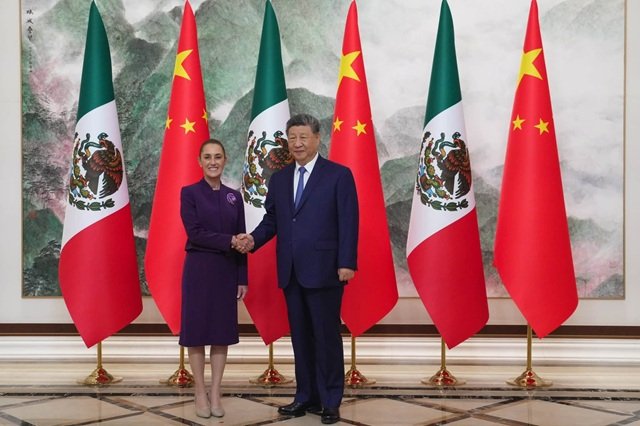
Mexican President Claudia Sheinbaum used the forum to present Plan Mexico, her government’s economic strategy for the 2024–2030 presidential term. The programme envisages $432 billion in public, mixed and private investment in infrastructure, with the aim of strengthening domestic production, attracting capital and expanding Mexico’s role in international supply chains.
Sheinbaum described the strategy as a development model based on shared prosperity, arguing that economic performance should be assessed not only through production and investment figures but also through improvements in living standards and social conditions.
“Mexico is demonstrating that there is another way to understand and promote development, one in which the strength of an economy is measured not only by how much it produces but also by the well-being it generates,” she told the business leaders. She added that investment should translate into rights, wealth into shared prosperity and development into better living conditions for the population.
Plan Mexico is organised around five principles: shared prosperity, energy and food sovereignty, infrastructure investment, regional incentives based on local productive strengths, and environmental responsibility in addressing climate change. The strategy seeks to connect investment with domestic industrial capacity and regional development rather than relying solely on the expansion of manufacturing for export.
Sheinbaum also presented Mexico’s economic position as an advantage for international investors. She identified the country as the world’s 13th-largest economy and fifth-largest recipient of foreign direct investment. Among countries with populations exceeding 100 million, Mexico ranks fifth in gross domestic product per capita, according to figures cited in her address.
She highlighted legal certainty, simplified administrative procedures, a wide network of trade agreements and a skilled workforce as factors supporting the country’s investment appeal. Mexico’s engineering education system was another point of emphasis, with Sheinbaum saying the country ranks among the world’s five leading nations in the field.
A further priority, she said, is to move Mexico beyond its established manufacturing role in global value chains by expanding technological capabilities and developing strategic industries of its own. The objective is to increase domestic participation in higher-value production and strengthen the country’s capacity to compete in emerging industrial sectors.
Sheinbaum concluded by invoking the principle associated with former Mexican president Benito Juárez that “respect for the rights of others is peace”. Applying the idea to international economic relations, she argued that one country’s development should not come at the expense of another, but should be advanced through the exchange of knowledge, trade and investment.
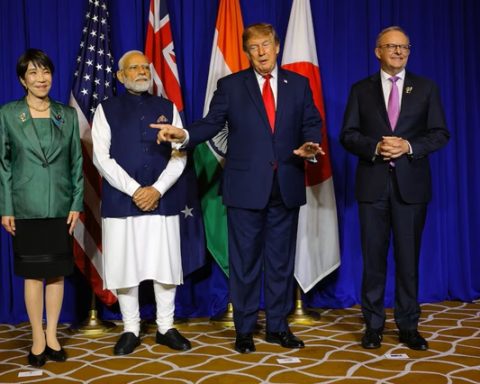
The Shenzhen summit is also expected to provide a setting for significant diplomatic engagement beyond trade. China’s Foreign Ministry confirmed on November 16 that Chinese President Xi Jinping, US President Donald Trump and Russian President Vladimir Putin would meet in the city on November 19, on the sidelines of the APEC gathering. The meeting adds a major geopolitical dimension to a summit already focused on the future of regional economic cooperation and the rules governing international commerce.