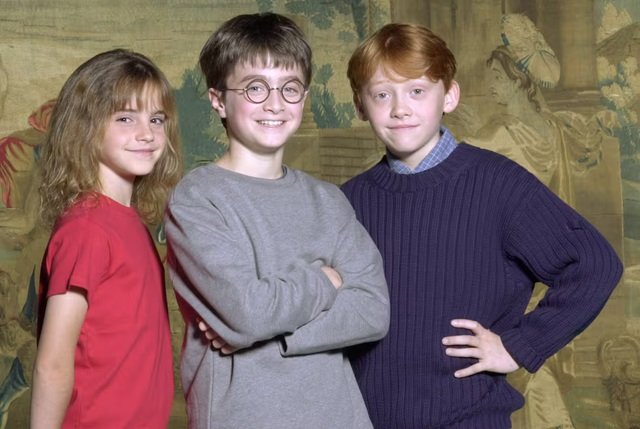
Twenty-five years after Harry Potter and the Philosopher’s Stone first reached cinemas, Emma Watson is reflecting on the personal consequences of becoming one of the world’s most recognisable young actors before she had fully understood the profession she was entering. The British actress, who played Hermione Granger in all eight film adaptations of the fantasy series, has described the isolation, emotional strain and professional frustrations that accompanied her extraordinary early success. While a new generation of actors prepares to take over the roles in an upcoming HBO Max television adaptation, Watson, now 36, remains in no hurry to return to the screen.
The first Harry Potter film was released internationally on 16 November 2001, transforming Watson, then an 11-year-old with virtually no professional acting experience, into a global celebrity. Born in Paris and raised in Oxford, she had entered the casting process almost by chance, among thousands of candidates being considered for the role of Hermione, Harry Potter’s close friend and one of the central characters in J.K. Rowling’s literary series. After approximately ten auditions, she secured the part, beginning a decade-long association with a franchise that became one of the defining popular culture phenomena of its generation.
Watson grew up in front of cameras alongside her co-stars Daniel Radcliffe and Rupert Grint. The success of the films brought her international recognition, commercial opportunities and acceptance within the film industry, but it also left her with the difficult task of establishing an identity beyond Hermione. She subsequently worked with prominent directors including Sofia Coppola, Darren Aronofsky and Greta Gerwig, and appeared in Disney’s commercially successful adaptation of Beauty and the Beast. Yet professional recognition did not necessarily translate into personal satisfaction.
In an interview with the Financial Times, Watson explained that she had become increasingly uncomfortable with aspects of the acting profession, particularly the commercial obligations surrounding film production. Promoting films often required her to sell projects over which she had little creative control. “I wasn’t very happy, if I’m honest. I felt a little trapped,” she said, explaining why she eventually decided to take a break from acting. “I had no say,” she added, describing her frustration with being expected to promote work without having meaningful influence over its creative direction.
Her last major film appearance was in Greta Gerwig’s Little Women in 2019. She has since remained largely absent from film sets and public promotional events, although she has continued pursuing academic, business and personal interests. In September 2025, she told Hollywood Authentic that she was “happier and healthier than ever”, offering an indication of how she viewed her life away from the demands of a full-time acting career.
One of the most painful aspects of her experience, she has explained, was discovering that the close relationships she developed during the Harry Potter productions were not necessarily representative of the wider film industry. Having spent a decade working alongside the same cast and crew, she had come to regard the production environment as a community built on lasting personal relationships. She expected similar connections when she moved into other Hollywood projects, but found the reality considerably different.
Speaking on the On Purpose podcast, Watson recalled arriving at film sets believing that colleagues would eventually become her family and that professional relationships would develop into lifelong friendships. “I would go to work looking for friendship and, outside the Harry Potter universe, in Hollywood, that was a very painful experience for me,” she said. Describing the emotional impact, she added: “It was so painful that it was like having my bones broken.”
She acknowledged that many people in the industry approached their work primarily through the demands of their own careers and the opportunities available to advance them. Watson said she did not possess sufficiently thick skin to navigate such competitive environments comfortably. Nevertheless, she appeared reluctant to regard her expectations of friendship as a weakness. “I suppose that means I still have something left to break. I still have a heart left to break,” she said.
The pressures of early fame had become apparent long before she left acting. At 16, Watson seriously considered abandoning the Harry Potter franchise. The scale of the phenomenon had left her feeling overwhelmed and isolated, while the constant attention surrounding the films made it difficult to maintain an ordinary sense of identity. In an interview with British Vogue, she acknowledged attending therapy and struggling with the guilt of not enjoying experiences that many young actors might have welcomed, including international promotional tours, red-carpet appearances, magazine covers and crowds of fans calling her name.
“Why me? Someone else would have enjoyed and wanted this part more than I did,” she recalled thinking. “I thought: ‘I should be enjoying this more. I should be more excited.’ And actually, I am having a really hard time.”
She has previously described feeling disconnected by the sheer scale of her celebrity. To maintain a sense of personal identity, she reminded herself that she was a daughter, a sister and a member of a family, with roots and relationships that existed independently of her public image. Those connections, she said, were essential to understanding herself beyond the character that had made her famous.
Away from acting, Watson has continued her education and developed other interests. She graduated in English Literature from Brown University in May 2014 and subsequently returned to academic study, undertaking a master’s degree in creative writing at Oxford. She has also pursued commercial projects, including work with Prada on its Paradoxe fragrance campaign, which she directed, and the launch of Renais, a premium gin brand developed with her brother Alex.
Her public activities have also included her role as a United Nations Goodwill Ambassador and occasional social media interventions on environmental issues, Palestine and transgender rights. Her position on transgender rights brought her into a public disagreement with Rowling, who criticised Watson and described her as “ignorant”. Rowling also argued that the actress had never experienced adult life without the protection provided by wealth and fame.
The next chapter of the Harry Potter franchise is scheduled to arrive on television this Christmas, with Arabella Stanton taking over the role of Hermione in HBO Max’s new adaptation. For Watson, the anniversary of the original film’s release comes at a time when she has largely withdrawn from the profession that brought her international recognition. While another young actress prepares to experience the demands of portraying one of fantasy literature’s most familiar characters, Watson has given little indication that she intends to resume her acting career soon.