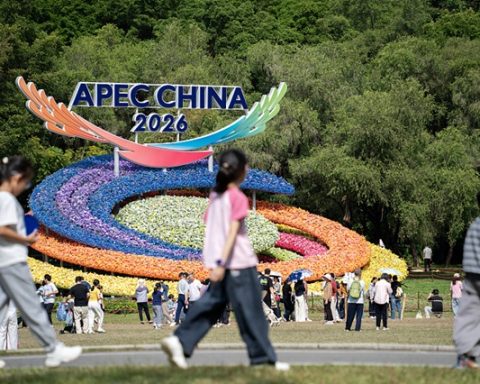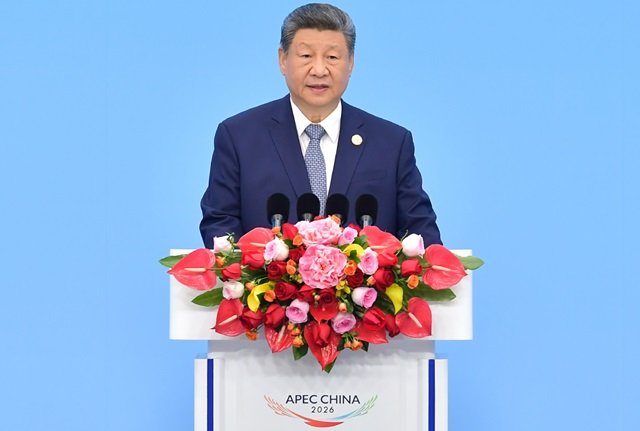
Chinese President Xi Jinping used a major Asia-Pacific economic gathering on Wednesday to make a renewed case for open trade, investment and regional cooperation, presenting China as a destination for international business at a time when global commerce faces mounting trade barriers and uncertainty. His address to the APEC CEO Summit 2026 in Shenzhen combined calls for greater economic integration with an offer of expanded access to the Chinese market, technological cooperation and participation in the country’s next phase of development.
“We should remove trade and investment barriers,” Xi said, according to an official English translation of his speech. He identified balanced development as a central reason for reducing restrictions and argued that Asia-Pacific economies faced a fundamental choice between opening their markets and closing them. Opening, he suggested, was essential to economic progress. He did not directly refer to US tariffs or identify particular trade measures, instead framing his proposals around the wider need to sustain international commerce and economic cooperation.
The timing gave the remarks added significance. Xi was expected to host Russian President Vladimir Putin and US President Donald Trump during the same week as the APEC CEO and Economic Leaders Summit. Against this diplomatic backdrop, his speech presented China as an advocate of trade openness while addressing concerns over the direction of the international economic system. The emphasis was on removing barriers, maintaining supply-chain stability and strengthening cooperation rather than confronting individual countries over their trade policies.
Xi described China as a promising destination for global businesses, offering a large market, development opportunities and an environment conducive to cooperation. He said Beijing intended not merely to reduce tariffs and widen market access but also to reform regulations and rules to provide foreign companies with “full manufacturing access”. The proposal suggests that China’s effort to attract international business is intended to extend beyond the sale of goods into the conditions governing foreign participation in manufacturing.
The country’s 15th Five-Year Plan, covering 2026–30, formed a central part of this proposition. Xi presented the development blueprint as a source of opportunities for Asia-Pacific economies and the wider international business community, describing it as an invitation to participate in China’s economic development. He pledged that China would offer international businesses access to its large, open market, alongside extensive development prospects and an environment in which cooperation could generate mutual benefits.
However, the appeal for greater openness comes against continuing tensions over the international distribution of manufacturing and trade. Chinese exports have steadily increased their share of global manufactured goods, prompting criticism from the European Union and other regions over industrial overcapacity. The expansion of China’s manufacturing strength has therefore become an important point of contention in discussions about the balance of global production and competition.
Trade relations between Washington and Beijing also remain subject to unresolved commitments. Although the two largest economies agreed last year to maintain lower tariffs, they have yet to implement a planned reduction of $30 billion in duties on goods traded between them by each side. Xi avoided discussing these outstanding arrangements directly, but his call to eliminate trade and investment restrictions placed market access and tariff reduction at the centre of his broader economic message.
He acknowledged that the global economy lacked momentum but argued that international trade continued to expand despite adverse conditions. He also pointed to the faster pace of technological breakthroughs as evidence of opportunities for future growth. For Asia-Pacific economies, he called for closer coordination in the digital economy and artificial intelligence, identifying technological innovation as a major source of regional economic development.
Xi referred to the emergence of numerous high-growth technology companies, commonly known as unicorns, and the development of large artificial intelligence models. He said innovations were increasingly being applied across industries and reaching millions of households. His remarks placed particular emphasis on strengthening scientific and technological partnerships, expanding cooperation in digital industries and AI, and accelerating the transition towards greener, low-carbon development.
The geographical setting reinforced the technological dimension of his message. Shenzhen, one of China’s major technology centres, is part of the Greater Bay Area, which also includes Hong Kong and Macau. Xi referred to plans for cooperation in the Bay Area, presenting regional development and business collaboration as part of China’s wider economic opening. The reference also carried international resonance because the San Francisco region, another major technology centre, is commonly known as the Bay Area.
Beyond individual trade and technology initiatives, Xi called for a more integrated Asia-Pacific economic framework. He urged member economies to support free and open trade and investment, preserve stable and efficient global industrial and supply chains, and advance negotiations towards a Free Trade Area of the Asia-Pacific. He also called for removing restrictions on commerce while ensuring that economic development was both inclusive and balanced, arguing that efficiency and fairness should be pursued together.
His address also linked economic prosperity to regional security and political stability. “There can be no stability without security, and no security without stability,” he said. He urged governments to uphold the post-Second World War international order, resolve differences through dialogue and consultation, and respond to shared challenges through greater solidarity and coordination.
The central proposition of Xi’s address was that the Asia-Pacific’s economic future depends on maintaining openness, strengthening regional connections and expanding technological cooperation. Yet the practical significance of that proposition will depend on how far commitments to market access and trade liberalisation are translated into policy, particularly amid continuing concerns about manufacturing capacity and unresolved tariff arrangements.
For international businesses, China’s offer combines access to a vast market with an invitation to participate in the country’s next development cycle. For the wider Asia-Pacific, Xi’s message is that regional prosperity requires fewer barriers and stronger economic coordination. Whether these ambitions can be reconciled with the trade tensions confronting the global economy remains a central question.