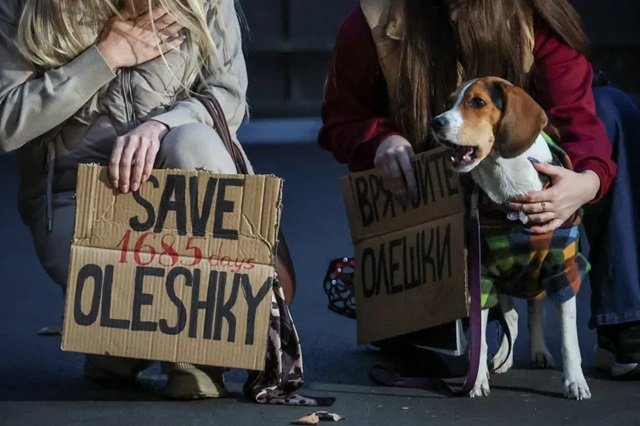
For the first time since Russia launched its full-scale invasion of Ukraine in 2022, Moscow and Kyiv have agreed to a temporary ceasefire to facilitate the evacuation of civilians from an entire city. The arrangement concerns Oleschky (Oleshky), a Russian-occupied town on the eastern bank of the Dnipro River, where an estimated 1,500 to 1,700 people remain trapped after months of isolation, dwindling food supplies and increasingly dangerous conditions. The agreement, which had held as of Thursday, provides for buses and ambulances to enter the city on Friday morning to collect residents wishing to leave. Ukraine’s human rights ombudsman, Dmytro Lubinets, had already set out for Oleschky on Thursday to oversee the operation.
Under the agreement, residents will be allowed to choose whether they remain in the occupied territory, travel to Ukrainian-controlled territory or relocate to Russia. Those wishing to return to Ukraine will initially be transported to Anapa in southern Russia. A Russian transport aircraft will then take them to Gomel in Belarus, from where they can continue their journey into Ukraine. Those choosing to remain in Russian-controlled territory will be transported in a separate convoy to the occupied Crimean peninsula. The arrangement represents the beginning of what is described as the largest humanitarian operation in Ukraine since 2022, although the number of people who will actually leave remains uncertain.
Oleschky, which once had a population of more than 20,000, has become one of the most isolated civilian settlements along this section of the front. The Dnipro forms the frontline between Russian and Ukrainian forces, with both sides conducting regular military operations across the river. Russian troops fire hundreds of drones and artillery shells from Oleschky and its surrounding areas on ordinary days, while Ukrainian forces retaliate from the opposite bank. The remaining population consists largely of elderly residents, many of whom have been unable or unwilling to leave despite the deteriorating conditions.
The city has been without gas, a central electricity supply and piped water since 2023. Numerous residential buildings have suffered severe damage from drone attacks and artillery fire, while the local hospital is among the few buildings that remain largely intact. Nearly all access roads have been mined, severely restricting the movement of vehicles and preventing regular deliveries of essential supplies. According to residents interviewed by the German newspaper Die Zeit, the last substantial delivery of food by the Russian occupying authorities arrived in May. Since then, the Ukrainian government has warned of an approaching hunger crisis.
Residents have largely survived on stored supplies of buckwheat, canned food and preserved vegetables, supplemented by produce from their gardens, including cabbage and potatoes. The Ukrainian military has also periodically used cargo drones to drop food supplies to civilians on the occupied bank of the Dnipro. However, these deliveries have been insufficient to meet the population’s needs.
For those attempting to obtain additional food, the journey to Radensk, another Russian-occupied settlement approximately 20 kilometres away, has become a dangerous necessity. Although Radensk is further from the frontline and comparatively safer, residents of Oleschky refer to the route as the “road of death” because of the mines scattered along it. One woman told Die Zeit that she had made the six-hour return journey three times in recent weeks to purchase food. On her fourth trip, a mine exploded nearby, injuring her and two other women. “We were lucky. A few days later, three people were killed on the same road,” she wrote. She also described how residents could be recognised in Radensk because they immediately opened the sausage they had purchased outside the shop.
The responsibility for the humanitarian crisis remains contested. The Ukrainian government accuses Russian occupying forces of deliberately mining roads around Oleschky to prevent civilians from escaping and using the remaining population as a form of human shield. Ukrainian military personnel have also alleged that Russian soldiers occupy private homes and wear civilian clothing. Russian occupying authorities, meanwhile, claim that Ukrainian drones attack Russian supply vehicles, making food deliveries difficult. They have also accused Ukrainian drone operators of dropping mines onto roads around the city. Ukrainian soldiers have acknowledged that their forces use drones to mine certain roads in an effort to disrupt Russian military supplies, a tactic employed by both sides.
Not all the competing allegations can be independently verified. However, the Russian occupation administration had denied that conditions in Oleschky were critical as recently as July. In late September, Vladimir Saldo, head of the Russian occupation administration, acknowledged that evacuation was possible but argued that supplying residents should take priority. Ukraine, meanwhile, had been pressing for the establishment of a humanitarian corridor since February. Under international humanitarian law, occupying forces are responsible for providing for the civilian population in occupied territory or facilitating its safe evacuation.
The negotiations over Oleschky had continued since the spring without Russian cooperation. The recent breakthrough has coincided with pressure from US President Donald Trump, who is seeking to demonstrate progress in his peace process during the American election campaign. Russian President Vladimir Putin, for his part, has an interest in maintaining a constructive relationship with Trump and presenting Moscow as willing to participate in humanitarian initiatives.
Despite the agreement, the prospect of a mass departure remains uncertain. On Monday, Yana Lantratova, the Russian government’s human rights commissioner, rejected Ukrainian demands for a complete evacuation, saying that “there are not too many people in Oleschky who want to leave”. She argued that delivering humanitarian assistance to the city was more important than removing its population.
Several residents are also reluctant to leave because of fears about renewed shelling, forced relocation to Russia and possible legal consequences after reaching Ukrainian-controlled territory. One Ukrainian woman, who requested anonymity to protect her relatives, told Die Zeit that her three family members in Oleschky had no intention of leaving. “My family is afraid that shelling will resume during the evacuation or that they will be taken against their will to a place in Russia,” she said. Others fear difficulties arising from the absence of Russian or Ukrainian identity documents, while some worry that they could face accusations of collaboration with the Russian occupying authorities if they return to Ukrainian-controlled territory.
The temporary ceasefire is scheduled to expire on the evening of 1 November. During the pause, Russian forces are using the opportunity to move ammunition, provisions and reinforcements towards their positions along the Dnipro. Ukrainian units on the opposite bank are also expected to use the period to strengthen their positions. An activist communicating with residents through a closed online group has warned that those who remain could soon face even more difficult conditions when fighting resumes.