A couple of weeks ago, I left my car in the hands of an Arab mechanic. He repaired what the garage described as potentially life-threatening faults in the braking system. It never occurred to me that trusting him might be dangerous.
The day after the Israeli election, I visited my local clinic. Our wonderful family doctor had served alongside Mansour Abbas, chairman of Ra’am, the United Arab List, in the Arab students’ association at Hadassah, and he has never once tried to kill me. From there I went to the pharmacy, where an Arab pharmacist handed me my medication. I swallowed it without a second thought. That evening, we took the children to our favourite restaurant in Abu Ghosh.
Despite all the troubles and wars, this is what shared Israeli life looks like in so many places. It is the everyday experience of millions of Israelis, who barely give it a thought. Then politics intervenes, always a generation behind reality, and suddenly the doctor, the mechanic, the pharmacist and the cook become dangerous suspects. For no other reason than that they wish to exercise their civic right, and responsibility, to have a say in their own lives and future.
This is the profound hypocrisy of Israeli existence. Jewish society has learnt to work alongside Arabs, eat in their restaurants, the finest in the country, and entrust them with its health. Only politics still insists on treating them as strangers in their own homeland. Jewish supremacy allows them to participate in life while denying them a say in the rules by which that life is governed.
This unwritten arrangement has accompanied the state from its very beginning. From the years of military rule over Arab citizens to Yitzhak Rabin, who insisted on passing the Oslo Accords with a “Jewish majority” and was embarrassed to acknowledge the Arab votes when he needed them. The Jewish majority has never fully accepted Israel’s Arab citizens as equals. Even when Ra’am joined the government a few years ago, its participation was presented as an awkward compromise for which an apology was somehow required.
Arab citizens understood the message and voted with their feet. Their turnout steadily eroded until it fell below half of the population. Despair, estrangement, a leadership that seemed preoccupied with itself and a media that spoke about them but never to them or with them turned elections into a ritual belonging to a state in which they felt like strangers.
Then came Netanyahu’s extreme rightwing government. Four years of discriminatory legislation, relentless incitement, streets abandoned to crime and murder, slaughter in Arab towns and a police force under the command of a criminal minister who built his political career on hatred of Arabs. This government set out to entrench Jewish supremacy. Instead, it awakened the very force that may now begin to undermine it.
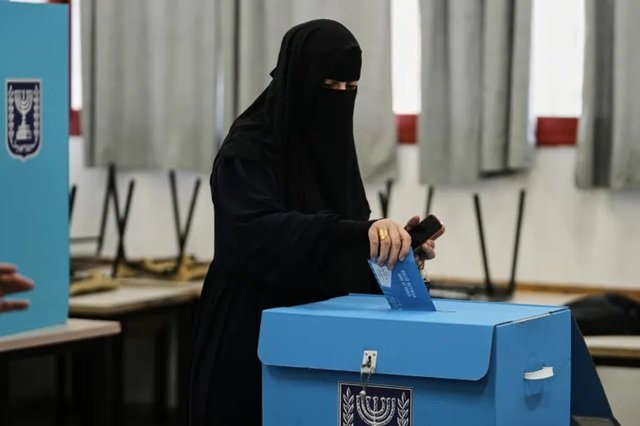
On election day, as the prime minister circulated images of queues in Arab towns as though they were an invasion, the people waiting to vote were those who had realised that the ballot box was one of the last instruments of protection left to them. More than three quarters of Arab voters turned out, almost the same proportion as Jewish voters. This was a vote of self-defence, which has finally become an act of civic rebellion. Those who came to the polling station to save themselves discovered their own power.
A new political consciousness was born in this election. An entire generation of Arabs in Israel tried to integrate without receiving their full political rights. Now they understand that integration without a share in government is a one-sided bargain. Arab leaders understand this too, displaying a political maturity that their Jewish opposition counterparts can only envy. Abbas is offering to enter the government. Yousef Jabareen, leader of the Palestinian-led Joint List, is prepared to support a minority government from outside. Both understand that real influence requires moderating separatist rhetoric.
Their Palestinian identity remains intact, as does their struggle against the occupation. But they have chosen to pursue their legitimate demands inside the rooms where Israeli decisions are made, rather than remain outside.
That is the paradox of this moment. Those whose loyalty Israeli democracy has so often questioned are now offering it the partnership that could save it. They are displaying a maturity and sense of responsibility that Israel’s Jewish political leaders are afraid to embrace. Gadi Eisenkot and Avigdor Liberman, who promised their voters change, are discovering that change runs through the very people they pledged to exclude.
The numbers leave no room for ambiguity. Nineteen seats for the Arab parties, a figure approaching their share of the population. Israel’s democratic camp will never be able to form a government without Jewish and Arab partnership. There is no escaping this reality. The only route to a parliamentary majority capable of replacing the appalling right runs through the Arab parties. Anyone who recoils from that prospect is, in effect, choosing the continued destruction of democratic Israel.
The revolution of this election lies in the moment when the Jewish majority began to discover the limits of its own power. For 78 years, Israel could pretend that a country could be governed without a fifth of its citizens. That pretence ended last Tuesday.
Israel has already become a shared society, in operating theatres and garages, universities and kitchens. Now it must decide whether politics will finally catch up with reality or remain estranged from life itself. Will we continue to be an ethnic democracy reserved for Jews alone, or grow into a democracy of equal partners?
This choice is, above all, a question for Jews. A Jewish society confident in its identity and culture can build a state in which that identity flourishes without requiring the exclusion of Arabs. A frightened society will go on looking for enemies in its own clinics and garages. For generations, we have been warned that equality threatens our identity. The opposite is true. Partnership is what will finally free us from fear.
The political establishment will try to seal the crack that this election has opened in the wall of Jewish political dominance. It may succeed for a while. But the revolution is already under way. Something in the Israeli understanding of citizenship has changed irrevocably. Hundreds of thousands of people who had grown accustomed to being treated as guests in their own country have decided to behave as its rightful owners. They have stopped asking for a seat at the table because they have understood that the table belongs to them too.
This is the dawn. The revolution is about to rise in full daylight. And perhaps, in one of Israel’s maternity wards, the country’s first Arab prime minister has already been born.