The United Nations mission in Western Sahara is facing an abrupt end after 35 years without achieving the central purpose for which it was established: organising a referendum on self-determination. Its departure could remove one of the few remaining international observers from a territory where a fragile ceasefire has collapsed, military incidents are continuing and the risk of a wider regional confrontation is growing.
The United Nations Mission for the Referendum in Western Sahara (MINURSO) reached the end of its latest annual mandate amid an extraordinary confrontation within the Security Council. A resolution promoted by the United States received 11 votes in favour and three abstentions, but opposing vetoes by Russia and the United States left the mission’s future in limbo. The outcome marked an unusual breakdown in the Council’s routine decision-making, recalling the divisions of the Cold War.
Established in 1991, MINURSO was tasked with organising a referendum to determine the future of the former Spanish colony. That vote never took place. Years of disagreement between Morocco and the Polisario Front, which seeks independence for Western Sahara, made the original mandate increasingly difficult to fulfil. The mission gradually became a monitoring operation, observing a low-intensity conflict on both sides of the vast sand wall that divides the territory.
Morocco effectively controls around 80% of Western Sahara, while the Polisario Front continues to demand independence. The ceasefire agreed by the two sides in 1991 collapsed in November 2020, shortly before the United States recognised Moroccan sovereignty over the territory, fundamentally altering the international diplomatic context.
In the years since, MINURSO has remained one of the few sources of independent observation on the ground. Its presence has become particularly significant because no other UN agencies operate in Western Sahara, while international non-governmental organisations and foreign media have no permanent presence there.
A senior UN official told EL PAÍS three years ago that the mission continued to serve as an early-warning mechanism, much like a canary in a coal mine, alerting the international community to developments that could threaten stability across the Maghreb. The official described its role as a political “tripwire” between Morocco and the Polisario Front, as well as between Morocco and Algeria.
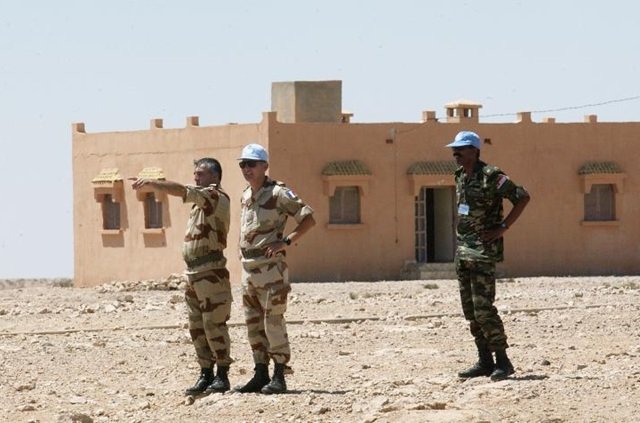
The official warned that the situation could deteriorate considerably without the mission’s presence, with consequences extending beyond Western Sahara. MINURSO has approximately 500 personnel, including 300 civilians and 200 military observers, who conduct patrols without carrying weapons.
Morocco has moved quickly to press for the mission’s departure following the Security Council confrontation. A statement issued by the Royal Cabinet on Friday night declared that MINURSO’s presence should come to an end, with Moroccan media suggesting that its withdrawal should be completed within a month. Rabat also wants the Western Sahara question removed from the agenda of the Security Council and other UN bodies, shifting the dispute towards bilateral and regional negotiations.
The Royal Palace described the decision as the closing of a 35-year chapter, calling the mission an instrument through which a regional dispute had been internationalised. It nevertheless reaffirmed Morocco’s commitment to the 1991 ceasefire, while insisting that this must be respected alongside the country’s territorial integrity and national security.
The proposed withdrawal has prompted a sharp response from the Polisario Front. Its representative to the United Nations, Sidi Mohamed Omar, has described the Sahrawi people’s right to self-determination as a non-negotiable “red line”. He argues that the US-backed proposal would have reversed the entire UN process on Western Sahara by abandoning the referendum option and establishing Morocco’s autonomy plan under Moroccan sovereignty as the sole framework for negotiations.
Western Sahara remains on the United Nations list of non-self-governing territories awaiting decolonisation. The dispute therefore concerns not only competing territorial claims but also the internationally recognised question of self-determination.
Morocco is preparing to address the end of MINURSO’s mandate through a joint session of its two parliamentary chambers, scheduled for Monday. Lahcen Haddad, a Moroccan parliamentarian, academic and political analyst, has indicated that the country intends to bring the mission’s presence to an end and remove the Western Sahara issue from the United Nations. He argues that successive postponements have prevented a settlement for 35 years.
But the consequences of withdrawing the observers could be felt most immediately on the ground. MINURSO personnel have traditionally operated in a buffer zone east of the sand wall, where Moroccan forces and Polisario units have formally refrained from military intervention. Their departure could weaken that restraint and increase the likelihood of military operations spreading beyond the areas where clashes have so far occurred.
A source familiar with conditions on the ground, consulted in El Aaiún, warned that Moroccan military operations in response to Polisario attacks could expand if the UN observers leave. Operations involving the pursuit of Sahrawi fighters could extend beyond the areas close to the borders of Mauritania and Algeria, raising the possibility of a broader international dimension to the conflict.
The ceasefire’s collapse in 2020 has already brought renewed incidents along the dividing wall, including attacks involving drones. MINURSO’s observers have been among the few international personnel able to monitor developments directly. Without them, the international community could lose an important source of information at a moment when the security situation remains volatile.
The mission’s impending departure also reflects the growing difficulty of sustaining international diplomacy around Western Sahara. The Security Council’s failure to agree on its future has exposed divisions among major powers, while Morocco and the Polisario Front remain far apart over the territory’s political status.
After more than three decades, the referendum promised in 1991 remains unrealised. But the immediate danger is no longer simply the failure to organise a vote. It is that the withdrawal of the international observers could leave an already unstable conflict with even fewer safeguards against escalation, at a time when the consequences could reach well beyond the disputed territory.