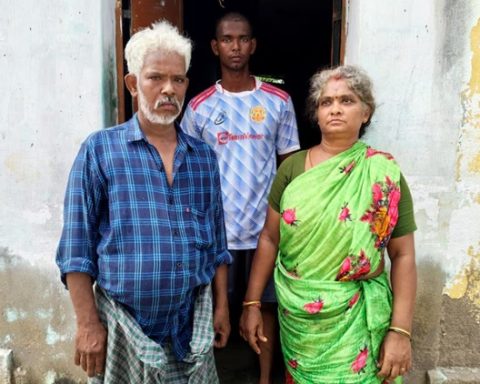
For more than two years, the plight of Hindu citizens in Bangladesh has been a wound that refuses to heal. Homes have been attacked. Shops have been looted. Temples have been vandalised. Families have lived with fear. Too often, the anguish of citizens has been reduced to statistics, political arguments, or competing narratives.
But citizenship is not a statistic.
A Hindu citizen of Bangladesh is not a guest in Bangladesh. Not a tolerated minority. Not a political bargaining chip. Not someone whose safety depends upon the mood of a Muslim mob.
A citizen is a citizen.
The violence that followed the terrorist assault of August 2024 exposed the particular vulnerability of Hindu communities. Human Rights Watch documented attacks on Hindu homes, businesses and places of worship in several districts, while thousands of Hindus reportedly gathered near the Indian border amid fears for their safety.
The danger did not end with those first terrible days.
Human Rights Watch subsequently reported continuing attacks and, in July 2025, documented the damaging of at least 14 Hindu homes in Rangpur. It also noted broader continuing violations affecting minority communities.
These facts demand something greater than political rhetoric.
They demand protection.
They demand justice.
They demand the restoration of confidence that the law belongs equally to everyone.
Bangladesh’s Constitution promises equality before the law and prohibits discrimination on grounds including religion. The principle is fundamental: the State cannot be neutral between the victim and the mob. It must stand unequivocally with the citizen whose home is burning, whose temple is threatened, whose livelihood has been destroyed, or whose family is living in fear.
The deeper crisis, therefore, is not merely communal violence. It is also a crisis of citizenship.
Whenever a Hindu family begins to wonder whether its religion makes it less secure, something profound has already gone wrong. Whenever a citizen feels compelled to conceal his identity, abandon his ancestral home, surrender his property, or remain silent because speaking out may invite retaliation, the promise of equal citizenship has been gravely weakened after 5 August 2024.
There have also been some examples of Muslims protecting Hindu temples and Christian churches during periods of violence. Human Rights Watch documented such acts of solidarity. These acts matter. They remind us that Bangladesh’s social fabric is larger than the extremists who seek to tear it apart.
The answer, therefore, cannot be Hindu versus Muslim.
It must be citizens versus violence.
It must be law versus impunity.
It must be humanity versus hatred.
Every attack on a Hindu citizen is an attack on Bangladesh’s constitutional promise. Every vandalised temple is an assault upon the freedom of worship. Every destroyed Hindu home is an injury to the nation’s moral conscience.
And every failure to prosecute perpetrators encourages the next crime.
The government—whatever its political complexion—has a solemn duty to protect every citizen without discrimination. Police must respond swiftly. Investigations must be credible.
Perpetrators must face due process and punishment under law. Victims must receive protection, compensation where appropriate, and access to justice. Minority communities must not merely be reassured with speeches; they must be protected through institutions that work.
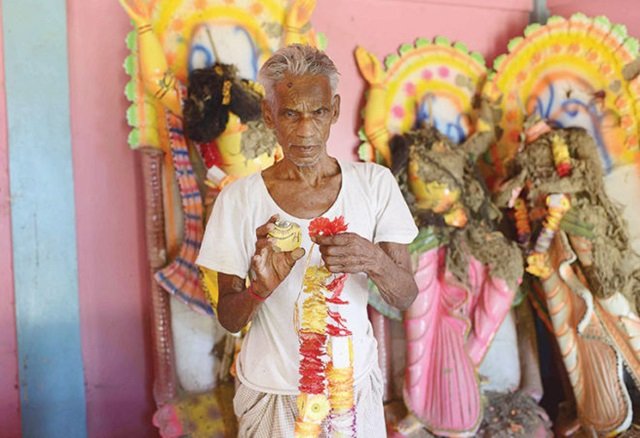
In the meantime, Durga Puja, is fast approaching in this month in the country, is celebrated in Bangladesh as a massive five-day national festival featuring elaborate temporary pavilions called mandaps, cultural programs, and community-wide gatherings.
As the poet beautifully captures:
“Nil akasher megher bhela,
Padma phuler papri mela,
Dhaker taale kasher khela,
Anande katuk sharadbela.
Shubho Durga Puja.”
Bangladesh was born from the conviction that human dignity matters.
That conviction cannot be selective.
A country cannot claim genuine freedom while some of its citizens live behind invisible walls of fear. Nor can democracy flourish when religious identity becomes a liability.
The Hindu citizens of Bangladesh do not need pity nor patronage.
They need what every citizen deserves:
security, dignity, equality and justice.
For more than two years, their suffering has demanded attention.
Now it demands action.
Because the true measure of Bangladesh is not how it treats its powerful.
It is how faithfully it protects the vulnerable.
Hindu and Muslim—we grew up together. We lived together. We ate together. We shared our joys and sorrows. Religion never came between us.
Now, at 74, I still refuse to judge a human being by religion. To me, humanity comes first.
In 1971, Hindu and Muslim including me alike stood shoulder to shoulder and fought valiantly against the brutal Pakistani army and its dreaded collaborators, particularly the mass-murdering forces of Jamaat-e-Islami. We fought not as Hindus or Muslims, but as Bangladesh’s people—for freedom, dignity, and a sovereign homeland.
Yet the forces that once opposed Bangladesh’s birth have never truly disappeared. In concert with Pakistan, criminal America, Jamaati mass murderers and other extreme right-wing fundamentalist forces, they were instrumental in the removal of Bangladesh’s most successful Prime Minister, Sheikh Hasina, on 5 August 2024.
Since then, Bangladesh has been bleeding profusely, with no respite in sight. Among the worst sufferers are Awami League supporters and, tragically, our Hindu brothers and sisters.
I have spent 52 years of my life working in the private corporate world. I have witnessed Bangladesh through triumphs, trials, hopes, and heartbreaks. But since 5 August 2024, peace has deserted my mind.
My eyes fill with tears and my heart aches whenever I hear of any tragedy or injustice that befalls my Hindu brothers and sisters.
What pains me most is not merely the horrific terrorist assault on Bangladesh’ foundational soul during July, early August 2024 and till today. It is the tearing apart of a social fabric in which Hindus and Muslims once lived as one people.
I still believe in that Bangladesh which we attained at the bay of blood in 1971. A Bangladesh where religion is a matter of faith, never a measure of a person’s worth.
A Bangladesh where Hindu and Muslim stand together—not as strangers, but as brothers and sisters.
That Bangladesh is worth defending.