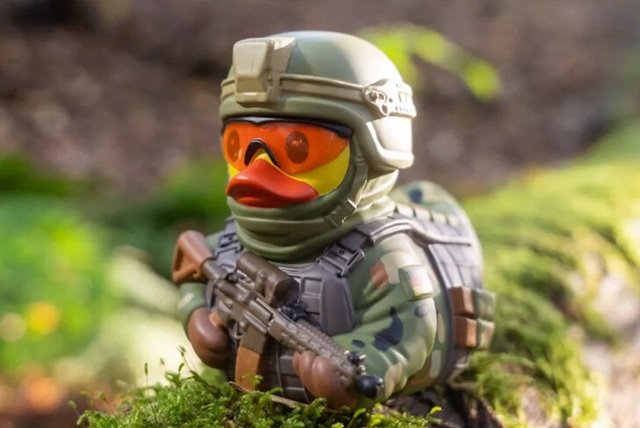
An armed rubber duck has become the unlikely centre of Germany’s latest debate over military expansion, recruitment and the normalisation of military culture. The miniature toy, dressed in a Bundeswehr uniform and carrying an assault rifle, sold out within hours of the launch of the German armed forces’ official online merchandise store, exposing a growing divide over how far the military should go to make itself attractive to the public.
The online shop opened on Thursday to coincide with the 71st anniversary of the Bundeswehr’s establishment. Alongside the rubber duck, its merchandise includes baseball caps, jackets, flashlights, carabiners and children’s products such as a teddy bear wearing a camouflage sweatshirt bearing the army insignia. The extraordinary demand overwhelmed the website during its opening hours, leaving its warehouses empty.
“We were completely overwhelmed. Even we didn’t expect this,” the store announced, promising to replenish its stocks.
But the commercial success has generated an uncomfortable political question: is Germany turning its armed forces into a consumer brand, using ordinary lifestyle products to make military identity more appealing at a time when the country is pursuing one of Europe’s most ambitious rearmament programmes?
The controversy centres particularly on the rubber duck, which critics say reduces the realities of military service and armed conflict to colourful merchandise. Others have questioned the appropriateness of military-branded products aimed at a wider public, including children.
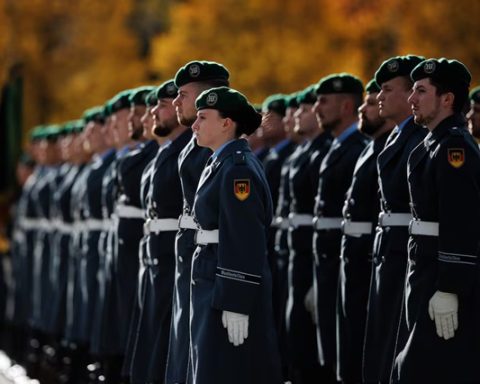
The launch is part of a broader effort to strengthen the Bundeswehr’s public standing as Germany seeks to build the European Union’s largest conventional military force. Berlin aims to increase its troop numbers from approximately 186,200 to 260,000 by 2035, requiring a substantial expansion of recruitment.
Defence Minister Boris Pistorius has argued that the armed forces are becoming more firmly established in German society. He has expressed confidence that the country’s new voluntary military service model, introduced at the beginning of 2026, could help meet future personnel requirements without making military service compulsory.
However, the growing number of conscientious objection applications suggests that the country’s changing security environment is also generating apprehension. Germany received 12,102 applications between January and August 2026, compared with 3,879 during the whole of 2025 and 2,249 in 2024. The figures, however, need to be considered alongside the introduction of the new voluntary service system in January.
Pistorius has defended the merchandise initiative as another way of bringing the military closer to ordinary Germans. The Bundeswehr says the products are intended to make the institution more visible in everyday settings, from workplaces to running routes. Its website specifically states that the merchandise is not intended to be worn with military uniforms.
The shop is operated by an external company selected through a public tender, which holds the official concession and licence. The Bundeswehr itself receives no revenue from the merchandise sales.
Defence Ministry spokeswoman Natalie Jenning rejected suggestions that the rubber duck was designed to introduce military imagery into children’s lives, describing it instead as a collector’s item. She argued that the overwhelming public response demonstrated the campaign had achieved its intended visibility.
The opposition, however, has been considerably less enthusiastic. Sören Pellmann, parliamentary group leader of the left-wing Die Linke party, accused the military of trivialising armed service through colourful lifestyle products.
“When we demanded that the German army withdraw from schools, we certainly did not mean that it should bring its advertising into the bathtubs of young children,” he said, arguing that selling rubber ducks carrying assault rifles was an inappropriate treatment of the risks associated with military service.
The dispute reflects a wider sensitivity in Germany, where the country’s military history continues to influence public attitudes towards the armed forces and the use of military imagery. Previous Bundeswehr recruitment campaigns have also attracted criticism, including advertising on Munich trams in 2025 that prompted several drivers to refuse to work on the vehicles.
Another campaign this year sent personalised postcards to more than 600,000 young people approaching their eighteenth birthdays, inviting them to attend the German Armed Forces Day on 6 June. The initiative was intended to increase public engagement and encourage enlistment.
As El País reported, the merchandise controversy comes amid Germany’s broader effort to reshape the public image of its armed forces and attract a new generation of recruits.
The rubber duck may be a harmless collector’s item to some, but its popularity and the reaction it has provoked point to a much larger debate. As Germany expands its military capabilities, the question is no longer simply how many soldiers it can recruit, but how far it should go in making military culture an ordinary part of civilian life.