Alternative for Germany (AfD) has doubled its representation in three German state parliaments following September elections, bringing a number of new lawmakers whose pasts and public activities have attracted scrutiny.
In Saxony-Anhalt, AfD won the state election and now has the possibility of governing for the first time since the fall of Nazi Germany. In Mecklenburg-Western Pomerania, the party won 38% of the vote in Sunday’s election. In Berlin, where AfD finished third, its representation rose from 17 to 29 seats.
The party has frequently attracted criticism from German state institutions over positions described as violating democratic principles. Its rapid expansion has also required it to fill a large number of new parliamentary positions in a short period, resulting in candidates with varied and sometimes controversial backgrounds.
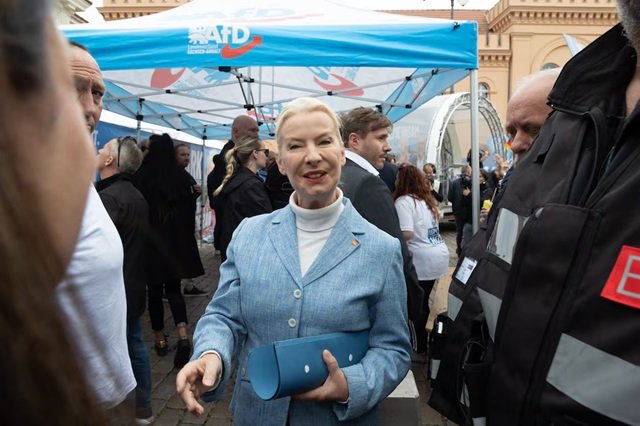
In Mecklenburg-Western Pomerania, newly elected MP Petra Federau was removed from the party’s regional election lists in 2016 after German media reported that she had worked as a pimp, arranging sexual services by women living in Germany for clients in the United Arab Emirates. Federau, 56, is now a property agent and has attracted attention in recent years for racist statements, including a call for migrants from Africa to be deported on the grounds that they introduce AIDS into Germany.
Women remain a small minority among AfD’s new lawmakers. Only six of the 32 members of the party’s new parliamentary group in Mecklenburg-Western Pomerania are women. In Saxony-Anhalt, AfD has 39 MPs, only two of whom are women. The party’s election programmes propose abolishing gender-equality policies while promoting motherhood and childcare according to traditional values.
Several Saxony-Anhalt lawmakers also have controversial personal histories. Ronny Kumpf, a former regional AfD vice-president and family-policy official, became known in 2017 after taking a colleague to court over the nickname “Porno Ronny”. Videos of Kumpf taking part in adult-film castings had circulated within the organisation. Another new MP, Phillipp-Anders Rau, previously worked as an actor in the pornography industry and has criminal convictions. In 2010, he was sentenced to one year in prison after stealing 100 towels, 80 sets of bed linen, 21 soap dispensers and other property worth €1,500 from a hotel. In 2017, he received another eight-month prison sentence for falsifying academic qualifications. Rau cited cocaine addiction at the time as a mitigating circumstance.
Saxony-Anhalt has also produced cases involving alleged links to illegal extremist organisations. Two new AfD representatives are being investigated by prosecutors as suspected members of an illegal far-right organisation. Police searching Sebastian Koch’s home found two unregistered air-pressure weapons and a stun gun during an operation targeting Artgemeinschaft, described in the source as an illegal ultranationalist organisation. Prosecutors are also investigating Simon Lansmann over allegations that he hosted meetings of the group at his home.
The state’s AfD leader Ulrich Siegmund was reported by Der Spiegel to have attended youth summer camps organised by the now-banned Patriotic Youth of Germany, where participants studied “racial differences”, marched in uniform and painted swastikas on their faces. Another new MP, Frank-Ronald Bischof, 78, previously held senior rank in the Stasi, the security service of communist East Germany.
In Berlin, the party’s parliamentary group is described as less radical than those in some eastern states, reflecting its strategy of gaining support in a multicultural and progressive capital. Nevertheless, MP Julian Adrat was fined €2,000 in 2024 over messages targeting transgender women and was convicted in 2026 over a homophobic text directed at Tokio Hotel singer Bill Kaulitz.
AfD lawmakers also include prominent supporters of Russian President Vladimir Putin. Gunnar Lindemann, one of the party’s longest-serving Berlin politicians, has attended Kremlin-organised congresses in Moscow and travelled to Russian-occupied territories in Ukraine and Georgia. He has also run a YouTube cooking channel under the name “Maitre Gunnar”; his latest video features him preparing “camembert with Marzahn sauce”, named after the Berlin district he represents, where AfD won 26% of the vote on 20 September.