Editorial
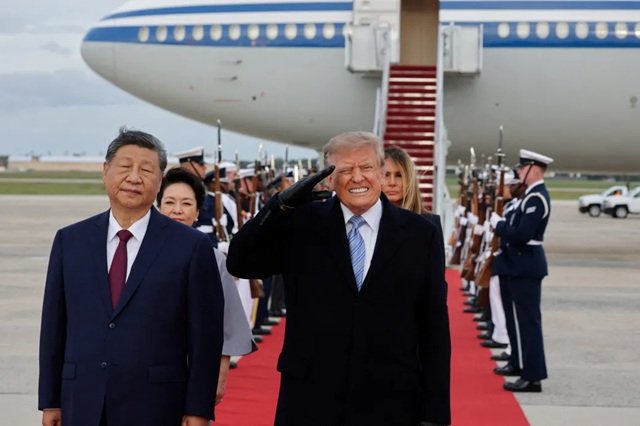
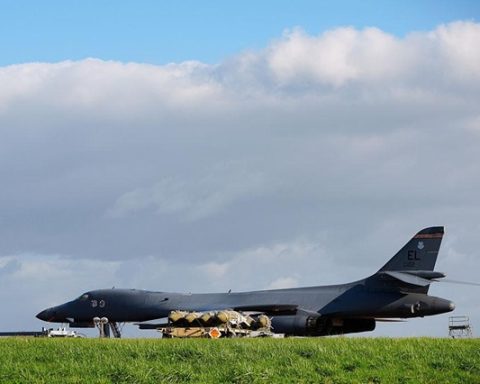
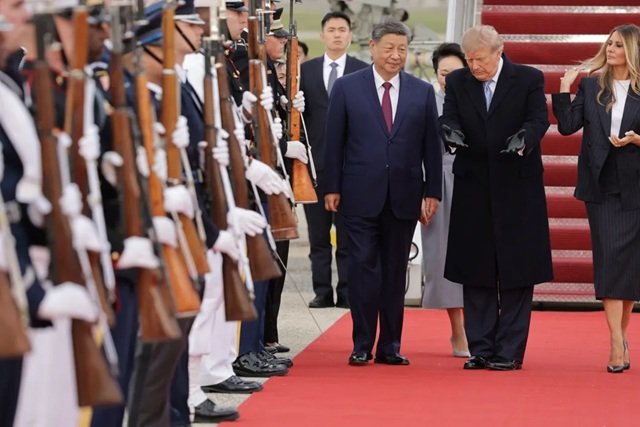
Donald Trump has never been famous for subtlety, so perhaps the 100-foot red carpet rolled out for Xi Jinping was the most Trumpian way imaginable to acknowledge an inconvenient fact. The president who built a political brand around tariffs, threats and the promise of making America “win” again travelled to the airport to meet the Chinese president himself. There was a military band, ceremonial fire, flowers, handshakes and a bomber screaming overhead. The theatre was unmistakably American. The reason for the theatre was Chinese. Washington is discovering, with some reluctance, that power is not measured by the volume of a presidential threat but by what the other side can actually do without you.
For years Washington has approached China as though economic pressure were a substitute for industrial strategy. Tariffs became weapons. Export controls became instruments of containment. Supply-chain dependence was treated as something that could be legislated away. Yet factories do not relocate because a presidential speech demands it. Industrial ecosystems take decades to construct. China now possesses one of them on a scale that is extraordinarily difficult to reproduce. In 2025 China accounted for 56.1 percent of global shipbuilding output and 69 percent of new orders. The US Trade Representative’s own investigation found that the United States was building fewer than five commercial ships a year while China was producing more than 1,700. This is not a difference in public relations. It is a difference in physical capacity.
The same arithmetic appears in the technologies Washington has identified as strategically decisive. China accounted for more than 80 percent of global battery manufacturing capacity at the end of 2025 and more than 80 percent of actual battery production. Chinese producers supplied almost 75 percent of global electric-car battery deployment. China also accounted for 70 percent of global electric-car production, roughly 85 percent of cathode active-material production and more than 90 percent of anode active-material production. These are not theoretical capabilities sitting in a government white paper. They are factories, supply contracts, minerals, engineers, ports and products moving through the world economy.
Then there are the minerals. The United States can restrict technology exports, threaten tariffs and speak of economic security, but an industrial economy cannot manufacture critical inputs out of presidential rhetoric. US Geological Survey data show that China accounted for more than 70 percent of rare-earth extraction and 87 percent of processing in the latest figures cited by the agency. A Congressional commission has separately noted China’s control of more than 90 percent of permanent-magnet production and the United States’ reliance on China for a large share of rare-earth compounds and metals. The uncomfortable lesson is that Washington spent years constructing a financial and technological superpower while allowing an extraordinary portion of the physical machinery beneath modern industry to migrate elsewhere.
This is why the airport handshake matters, but not because a handshake proves Chinese supremacy. It matters because it exposes the limits of coercion. Trump can threaten China. China can absorb pressure, retaliate selectively and continue supplying industries that the American economy itself needs. Washington can attempt to sever dependencies, but Beijing has spent years building alternative markets, industrial capacity and overseas supply relationships. The result is a relationship in which neither side possesses the clean freedom of action that political rhetoric pretends exists. Reuters reported that Washington and Beijing have now extended their trade truce until January 10, 2027, while major disagreements over Taiwan, rare earths and technology remain unresolved. The contradiction is the point. The two governments are still rivals, yet they keep negotiating because the costs of permanent economic confrontation are real.
America therefore faces a choice that is considerably less theatrical than Trump’s political language suggests. It can continue treating every Chinese industrial success as an affront to American prestige, or it can confront the more difficult question of why China possesses capabilities that the United States now needs to rebuild. If Washington wants shipyards, it needs shipyards. If it wants batteries, it needs factories and mineral processing. If it wants resilient rare-earth supply chains, it needs mines, refineries, magnets and the industrial workforce to operate them. None of these can be summoned by a tariff announcement. They require investment, infrastructure, patience and an industrial policy that survives longer than an election cycle.
That is the irony of the red carpet. Trump may present the meeting as another exercise in deal-making and personal leverage. Xi does not need to win an argument on television. His country arrives carrying something more difficult to dismiss. It arrives with factories. It arrives with ships. It arrives with batteries. It arrives with electric cars. It arrives with mineral-processing capacity. It arrives with supply chains painstakingly assembled while Washington was busy announcing that China could be contained.
The United States still possesses extraordinary economic, financial, technological and military strengths, and China’s industrial power does not erase them. But that is precisely why the spectacle should be read seriously rather than triumphantly. A superpower does not become weaker because it talks to a rival. It becomes vulnerable when its rhetoric repeatedly promises outcomes that its productive capacity cannot deliver. The red carpet at Andrews was therefore less interesting as a gesture of deference than as an admission of reality. Washington can continue arguing with Beijing. What it cannot indefinitely do is pretend that it can afford not to deal with it.