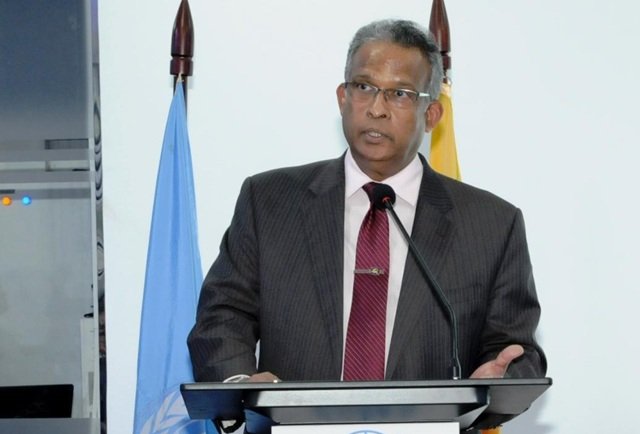
Sri Lanka’s future prosperity will depend on how effectively it positions itself within an increasingly complex and uncertain global environment. At a recent LEADS Forum discussion, veteran diplomat Prasad Kariyawasam, former Secretary to the Ministry of Foreign Affairs, High Commissioner to India, Ambassador to the United States, and Ambassador and Permanent Representative to the United Nations in New York and Geneva, outlined the strategic choices Sri Lanka must make to secure long-term stability and economic advancement. Drawing on decades of diplomatic experience, historical perspective and an understanding of international affairs, Kariyawasam offered a practical assessment of how Sri Lanka can navigate a rapidly changing international system without compromising its national interests.
His central message was clear: Sri Lanka must exercise strategic agency by engaging all major international partners while safeguarding its national interests. For a small country situated at the intersection of important maritime and economic routes, foreign policy cannot be reduced to diplomatic symbolism or shaped primarily by the personalities of individual political leaders. It must serve the broader economic, social and security aspirations of the country and its people.
Kariyawasam emphasised that foreign policy is inseparable from domestic priorities. As the discussion noted, “foreign relations often reflect the medium- and long-term aspirations of a country’s people and its leadership.” Governments must therefore develop external relations that correspond with the country’s economic and social expectations rather than allowing short-term political impulses to undermine long-term national interests. Foreign policy should be understood not simply as the management of relations between states, but as an instrument through which Sri Lanka can expand opportunities for its citizens, attract investment and technology, strengthen economic resilience, protect national security and create greater access to international markets.
Sri Lanka’s own history demonstrates that the island has never been isolated from the wider world. From its ancient connections with India and Southeast Asia to its links with Arab, Persian and Chinese maritime networks, Sri Lanka developed through sustained interaction with surrounding regions and distant trading centres. The historical record illustrates an important distinction: “geography creates opportunity, but geography alone does not create prosperity.” Location can provide a country with significant advantages, but institutions, infrastructure, human capital and public policy determine whether those advantages are converted into sustained economic development. Colombo’s emergence as a cosmopolitan trading centre and Galle’s role as a resupply station for Indian Ocean shipping during the colonial period illustrate how deeply Sri Lanka has been embedded in global commerce for centuries.
The experiences of Japan, South Korea, Taiwan, Singapore and Vietnam provide further lessons, although Sri Lanka cannot simply reproduce the policies of any one of these countries. Their historical circumstances, political systems and economic structures differ considerably. Yet their development trajectories contain several recurring elements: sustained investment in human capital and infrastructure, merit-based institutions, integration into global markets, the attraction of investment and technology, the development of export-oriented industries and strategic engagement with both China and Western economies. For Sri Lanka, the lesson is therefore not imitation but continuous adaptation and constructive integration with the global economy. The challenge is to identify which elements of these experiences can be adapted to Sri Lanka’s own circumstances rather than treating another country’s development model as a ready-made formula.
India’s transformation into a major global economy presents Sri Lanka with both an opportunity and a responsibility. India is already Sri Lanka’s largest source of tourists and an important investor, while its expanding economy, technological capabilities and growing consumer market create possibilities across multiple sectors. As Kariyawasam puts it, “The larger question is how effectively Sri Lanka can participate in and benefit from India’s growth.” That question extends well beyond conventional trade. A stronger partnership could encompass more modern and open pathways for trade, investment, logistics, energy, technology, digital services, education and professional mobility. At the same time, the asymmetry between the two economies must be handled with maturity and foresight. Sri Lanka needs to seek arrangements, including appropriate special and differential treatment where necessary, that allow it to participate meaningfully in India’s growth while protecting legitimate national economic interests.
China remains another significant economic partner, and Sri Lanka should avoid viewing its relationship with Beijing through a purely zero-sum framework. The objective should be productive, transparent and mutually beneficial engagement, with particular attention to the quality and sustainability of investment, better terms of trade and meaningful technology transfer. At the same time, Sri Lanka must continue to nurture important relationships with the United States, the European Union, the United Kingdom, Japan, Australia, ASEAN and the Gulf states. These relationships need not produce dependency. Properly managed, they can form a broad network of pragmatic partnerships that expands Sri Lanka’s economic and diplomatic options while strengthening its resilience.
This approach becomes particularly important as the international system becomes more fragmented and volatile. Trade tensions, armed conflicts, sanctions, supply-chain disruptions, climate change and technological competition increasingly influence national security and economic policy. In such an environment, “foreign policy cannot be separated from economic policy.” Sri Lanka’s recent economic crisis demonstrated the importance of international confidence, access to external financing and resilient supply chains. Energy security, food security, cybersecurity and digital infrastructure can no longer be treated as issues separate from national strategy. They are increasingly integral to a country’s economic sovereignty and security.
The principle of strategic agency should therefore guide Sri Lanka’s external relations. Strategic agency does not mean attempting to distance the country from major powers or seeking isolation. Nor does it mean refusing to engage with competing centres of power. It means retaining the ability to make decisions according to national interests while expanding, rather than narrowing, the country’s available choices. India is essential to Sri Lanka’s regional and economic calculations; China is an important economic partner; and the United States, Europe, Japan, Australia, ASEAN and the Gulf are also significant to different aspects of Sri Lanka’s international engagement. The objective should be to construct a web of partnerships that strengthens resilience and autonomy rather than creating dependence on any single external actor.
Sri Lanka possesses several strategic assets that could support such a policy if they are developed systematically. Geography remains one of the country’s most important advantages. Ports such as Colombo, Hambantota, Trincomalee and Galle have the potential to develop specialised roles, but ports alone cannot transform the economy. Their value depends on their integration with logistics, manufacturing, services, investment and export networks. Sri Lanka therefore needs to think of its maritime position as part of a wider economic system rather than simply as an opportunity to expand port activity.
Digital connectivity represents another emerging strategic asset. Submarine cables, data centres, cloud services and cybersecurity infrastructure are becoming increasingly important components of national competitiveness. Sri Lanka’s geographical position can therefore provide both a maritime and a digital advantage if the country develops the necessary infrastructure, regulatory environment, technical skills and investment framework. The objective should be to connect physical connectivity with digital connectivity and use both to support higher-value economic activity.
Tourism and natural heritage also offer substantial opportunities, but the emphasis should increasingly shift from visitor numbers towards value creation. Wellness tourism, heritage tourism, ecotourism, cruise tourism, education and meetings, incentives, conferences and exhibitions can create opportunities for higher-value services while reducing excessive dependence on volume-based tourism. Such an approach would require investment in infrastructure, skills, environmental protection and the quality of services rather than simply pursuing ever-increasing tourist arrivals.
Human resources will be equally important. High literacy, while a major achievement, is no longer sufficient in an economy increasingly shaped by technological change. Sri Lanka needs stronger capabilities in technology, engineering, artificial intelligence, logistics and advanced manufacturing, particularly as demographic ageing creates additional pressure on the domestic labour force. The country’s migrant workforce should also be treated as a strategic asset rather than merely a source of remittances. Bilateral labour agreements, recognition of professional and technical qualifications, skills development and structured engagement with the diaspora could become important components of both foreign and economic policy.
Sustained prosperity will ultimately depend on a combination of external opportunity and domestic capacity. Peace and security, access to international markets, productive investment, a skilled and productive workforce, modernised agriculture, higher-value tourism, demographic preparedness, climate resilience and strong, predictable institutions will all be necessary. Foreign policy can open doors, but domestic institutions determine whether Sri Lanka is capable of walking through them. Diplomatic access has limited value if domestic systems are unable to convert international opportunities into investment, employment, innovation and sustainable growth.
This places particular responsibility on the state. Sri Lanka does not necessarily need a larger state; it needs a more capable one. Policy continuity, professional institutions, predictable regulation and effective measures against corruption are essential for building confidence among both domestic and international economic actors. Geography does not change, and many of the country’s long-term national interests do not change with each election. Relationships that have been deliberately developed over decades should therefore not be repeatedly reinvented according to short-term political cycles. A credible foreign policy requires continuity, institutional memory and a clear understanding of the difference between national interests and temporary political priorities.
International trust is another strategic asset. Sri Lanka needs to be recognised as a country that honours its commitments and maintains predictable policies. This matters not only for diplomatic relations but also for investment, trade, development cooperation and long-term economic partnerships. Trust is accumulated gradually through consistent behaviour and can be weakened quickly when commitments are repeatedly altered. Predictability, therefore, should be treated as an economic and diplomatic resource in its own right.
Sri Lanka also does not need to choose between India and China, or between Asia and the West. The more useful question is what each relationship can contribute to national development and how those relationships can be managed without compromising sovereignty or freedom of decision-making. A mature foreign policy should allow Sri Lanka to cooperate with different partners in different areas while maintaining the ability to assess each agreement, investment and strategic engagement according to its own interests.
Sri Lanka’s geography is an inheritance, but prosperity is not guaranteed by geography. The international environment is changing rapidly, and great-power competition, technological disruption, economic fragmentation and climate vulnerability are creating new challenges alongside new opportunities. Sri Lanka therefore needs a foreign policy that is pragmatic, adaptive and anchored in national interest. It must build partnerships without creating dependencies, maintain strategic agency without turning towards isolation, and integrate more deeply with the global economy while strengthening the domestic institutions and capabilities required to benefit from that integration.
The essential takeaway is that Sri Lanka cannot change its location, but it can determine how effectively it uses that location. As Kariyawasam put it: “We cannot change where Sri Lanka is. We can, however, determine what Sri Lanka becomes because of where it is.”