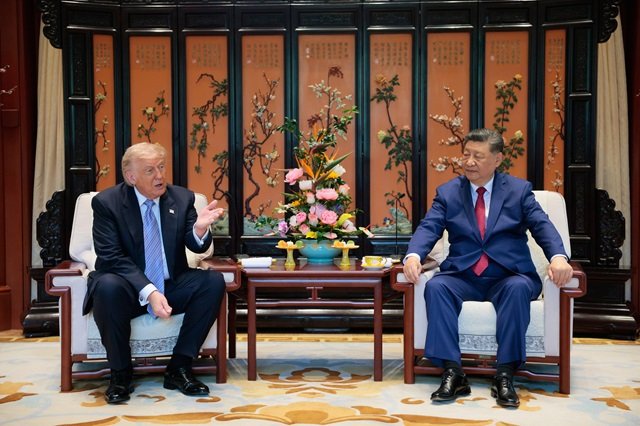
US President Donald Trump is preparing to welcome Chinese President Xi Jinping at Joint Base Andrews outside Washington on Wednesday, in a break with six decades of protocol that signals the importance he attaches to the relationship with Beijing. The Financial Times, from which this account is drawn, reports that it will be the first time a US president has greeted a foreign leader at the base since John F. Kennedy met British prime minister Harold Macmillan there in 1962. Xi did not travel to Beijing airport to greet Trump when the US president visited China in May.
The gesture comes after 20 months of tariffs and escalating confrontation followed by a fragile truce, and illustrates the tension within Trump’s China policy. Since returning to the White House last year, Trump has repeatedly frustrated officials who expected him to revive the aggressive approach towards Beijing that characterised the final year of his first term. Julian Gewirtz, a Columbia University historian who served as a senior China official under Joe Biden, told the Financial Times that “Trump was never the pure China hawk some people imagined”. Gewirtz said Trump’s political rhetoric had focused heavily on China’s economic treatment of the US, while he had shown less interest in human rights and traditional security issues in the western Pacific.
Beijing initially had reason to expect a harder line. Trump appointed several prominent China critics to senior positions, including Marco Rubio as secretary of state, Mike Waltz as national security adviser and John Ratcliffe as CIA director. Ivan “Lizard” Kanapathy, a former Top Gun fighter pilot instructor, became the National Security Council’s senior director for Asia. Defence secretary Pete Hegseth was not regarded as soft on China, while Elbridge Colby, an advocate of stronger deterrence, was appointed under-secretary of defence for policy. Treasury secretary Scott Bessent and US trade representative Jamieson Greer were also regarded as more assertive towards Beijing than their predecessors.
The shift came during Trump’s global trade war in April 2025, when Washington imposed steep new tariffs on China. Beijing retaliated, prompting Trump to raise US levies on Chinese goods to 145 per cent. The confrontation unsettled global markets and reached the US Treasury market, while Bessent warned that the tariffs amounted to a de facto trade embargo. China then restricted exports of critical metals and rare-earth materials used in products ranging from mobile phones to missiles. Bessent dismissed the move as Beijing playing a weak hand with “a pair of twos”, but US companies reported shortages of critical magnets and other materials. Georgetown University professor Evan Medeiros said China had developed a “new toolkit of precision economic weapons” after Trump’s first trade war in 2018 and was now deploying them with “scale and at speed”. “China didn’t have a pair of twos, it had a royal flush,” Medeiros said.
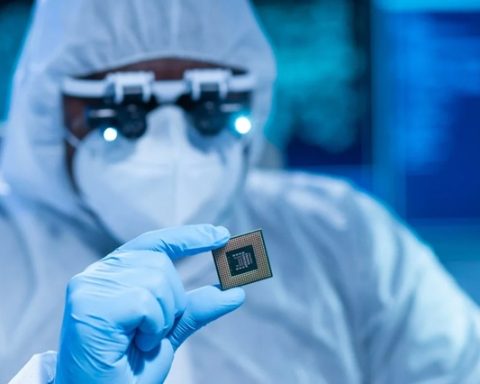
The episode also weakened efforts to impose further restrictions on China’s access to advanced semiconductor technology. In May 2025, Jeffrey Kessler, the Commerce Department official responsible for export controls, said the administration was preparing substantially more measures against China. His team had assembled a series of proposals, but the rare-earth restrictions and concern over preserving a Trump-Xi meeting contributed to their abandonment. A former US official told the Financial Times that Trump was simultaneously saying the US had to win the AI race while allowing China access to chips, describing the policy as having “no administration strategy or backbone on export controls”. The administration disputes that characterisation. A senior official said it had retained Biden-era controls on advanced chips and strengthened enforcement.
The Commerce Department said its Bureau of Industry and Security had increased fines 18-fold to $324mn in 2025 and expanded its enforcement unit by 52 per cent in 2026, including doubling the number of officers overseas. The bureau said it had completed major enforcement cases involving unlawful exports to China, including cases involving Applied Materials and Cadence, and had led a probe into a $2.5bn chip-smuggling operation that resulted in indictments and arrests of executives at Super Micro.
The pattern continued during preparations for the October Trump-Xi summit in Busan, South Korea. After the two leaders agreed a one-year trade truce, Washington held back new export controls while Beijing delayed further rare-earth restrictions. The agreement expires on November 10, leaving officials to balance measures against China with Trump’s determination to preserve the détente. Trump had also fired Waltz and other National Security Council officials who favoured a tougher China policy. Rubio replaced Waltz and has since concentrated publicly on implementing Trump’s agenda and maintaining relations with Xi.
The hawks have nevertheless retained room to act, particularly on security. The Federal Communications Commission under Brendan Carr created a national security unit focused on China and banned several Chinese products, including drones. The Pentagon placed companies including Alibaba and BYD on a blacklist over alleged links to the People’s Liberation Army, while the Treasury Department sanctioned Chinese refineries importing Iranian crude oil. Yet the approach remains inconsistent: Treasury later halted plans to sanction China’s Ministry of State Security over cyber espionage to avoid disrupting the trade truce.
Taiwan has exposed the contradictions most clearly. Trump paused a proposed $14bn arms package after Chinese warnings that it could jeopardise a summit, but later approved a record $11.1bn package. After meeting Xi in Beijing, he described arms sales to Taiwan as a “good negotiating chip”. Melanie Hart of the Atlantic Council said the Chinese reaction was one of surprise, while describing the handling of the issue as “deft diplomacy”. For the China hawks, the challenge remains what Jon Czin, a former CIA China expert, described as “having a lid on a boiling pot”: the pressure for tougher action persists, but security measures must be calibrated around Trump’s relationship with Xi.