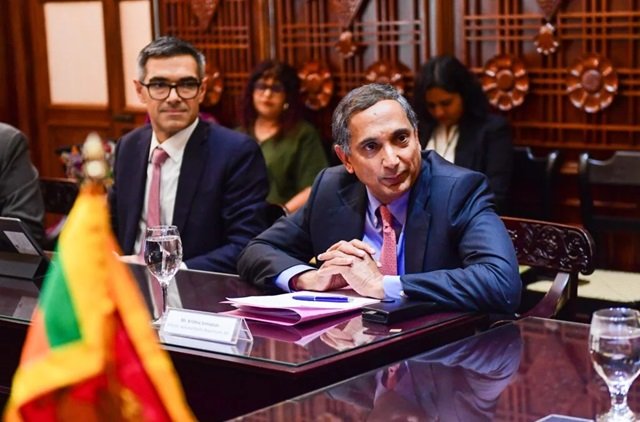
An International Monetary Fund (IMF) staff team has concluded discussions with Sri Lankan authorities on the country’s seventh review under its Extended Fund Facility (EFF) arrangement and the 2026 Article IV Consultation, saying further talks will continue towards reaching agreement on the policies and parameters needed to complete the review.
The IMF team, led by Evan Papageorgiou, visited Sri Lanka from September 10 to 23. In a statement issued at the end of the mission, the Fund said the economy had remained resilient despite successive shocks, but warned that risks were still tilted to the downside. The mission will not result in a discussion by the IMF Executive Board.
“Sri Lanka’s economy has proved remarkably resilient to successive shocks,” Papageorgiou said. Economic activity expanded by 4.2 per cent in the second quarter of 2026, marking 11 consecutive quarters of strong growth. Gross official reserves reached US$6.9 billion at the end of August, while banks remained well capitalised and profitable. The IMF also said the fiscal outturn for the first half of 2026 was strong and that debt restructuring was largely completed.
The Fund said headline inflation had risen to 8 per cent year-on-year in August, driven by the global oil price shock, although inflation expectations remained broadly anchored. It said Sri Lanka continued to face risks linked to uncertainty over the duration and intensity of the Middle East war, global trade policy and the effects of El Niño.
The IMF called for continued prudent policies to rebuild fiscal and external buffers, maintain price stability and advance governance reforms while strengthening social safety nets for vulnerable groups. It identified the development and implementation of a medium-term revenue strategy as a key priority, including measures to broaden the tax base, rationalise tax exemptions and incentives and strengthen revenue administration.
The Fund also urged Sri Lanka to maintain cost-recovery energy pricing to limit fiscal risks arising from state-owned enterprises. It said bottlenecks affecting capital spending execution should be addressed, including efforts to accelerate recovery and reconstruction related to Cyclone Ditwah.
On monetary policy, the IMF said the authorities should remain prepared to respond to inflationary pressures and maintain price stability within the medium-term flexible inflation-targeting framework. It also called for greater exchange-rate flexibility to help absorb shocks and support reserve accumulation.
At the first statutory review of the inflation-targeting framework, the IMF said it would be prudent to retain the 5 per cent inflation target and the existing accountability band. Papageorgiou said the current target provided flexibility amid volatility in food and energy prices, while convergence towards a lower target could be considered at the next review after a sustained record of low and stable inflation.
The IMF also expressed concern over recently tabled amendments to anti-corruption legislation, saying that “select clauses” could weaken transparency and accountability. It said preserving the integrity of the legislative framework was critical to strengthening public trust.
The Fund said Sri Lanka’s transition from economic stabilisation to transformation would require sustained structural reforms, including liberalising trade, modernising business and labour regulations, broadening access to finance and advancing digitalisation. The IMF team also visited Jaffna, where discussions with private-sector and civil-society representatives focused on investment opportunities in connectivity, skills, agriculture, fisheries, tourism and renewable energy.
The team met President and Finance Minister Anura Kumara Dissanayake, Prime Minister Harini Amarasuriya, senior ministers, Central Bank Governor P. Nandalal Weerasinghe and other government officials, as well as parliamentarians, private-sector representatives, civil-society organisations and development partners. The IMF said discussions would continue with the goal of reaching a staff-level agreement “in the near term” to facilitate timely completion of the seventh review.