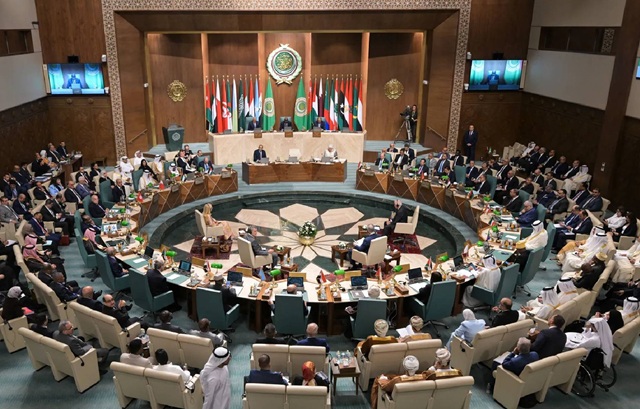
The 34th Arab League Summit concluded Saturday in Baghdad with a unified call for the “urgent and unhindered” delivery of humanitarian aid to Gaza and a strong condemnation of Israel’s continued military actions in Syria. The summit, held amid one of the most volatile periods in the region in recent years, also marked Iraq’s first time hosting the pan-Arab gathering since 2012 and only its fourth time in history.
In its final communiqué, the League urged the international community—especially powerful global actors—to take immediate action to end the ongoing humanitarian catastrophe in Gaza. “We urge the international community, especially influential nations, to fulfill their moral and legal responsibilities by exerting pressure to end the bloodshed and to ensure the unhindered delivery of urgent humanitarian aid to all affected areas in Gaza,” the statement read, as reported by Anadolu Agency.
Arab leaders also condemned what they described as persistent Israeli violations of Syrian sovereignty, citing frequent airstrikes on Syrian territory that have targeted both Iranian-aligned forces and Syrian military assets. “We call upon the international community and the UN Security Council to apply pressure to halt these attacks and to respect the sovereignty of nations,” the League added.
Gaza War Overshadows Regional Diplomacy
The summit took place as Israel continues its intensified military campaign in Gaza, which has drawn widespread international condemnation for the scale of destruction and civilian casualties. Arab nations, many of whom have formalized relations with Israel in recent years through the Abraham Accords or similar arrangements, now find themselves under renewed domestic pressure to reassert traditional support for the Palestinian cause.
Despite differences over normalization with Israel and internal rifts, the member states presented a united front at the summit on the humanitarian crisis, reiterating long-standing support for a two-state solution and Palestinian self-determination.
A League Often Divided: History and Controversies
Founded in 1945 in Cairo, the Arab League was originally conceived as a platform to promote cooperation among Arab states and coordinate political action on issues of mutual concern, especially the Palestinian cause. Over the decades, however, the League has often struggled to present a unified stance, particularly during times of conflict.
The 2003 Iraq War exposed deep divisions within the League, with some member states supporting the U.S.-led invasion while others opposed it vehemently. The 2011 Arab Spring further fractured the League’s cohesion, as uprisings swept across member states, toppling regimes and plunging countries like Libya and Syria into civil war. The League controversially suspended Syria’s membership in 2011 following President Bashar al-Assad’s violent crackdown on protesters—an issue that remains a point of contention to this day.
While some summits have produced symbolic gestures or humanitarian pledges, critics argue that the Arab League often fails to translate resolutions into actionable policy. Internal rivalries, conflicting alliances, and foreign influence have long undermined its effectiveness. For example, the League was notably silent or divided during crises in Yemen and Libya, and its impact on halting Israeli military operations in Palestinian territories has historically been minimal.
Nonetheless, recent summits have shown a renewed effort to restore the League’s relevance amid shifting geopolitical tides, including rapprochement between Saudi Arabia and Iran, renewed attention to Gaza, and a recalibration of U.S. influence in the region.
Iraq’s Moment in the Spotlight
Hosting the 34th Summit was symbolically significant for Iraq, a country still recovering from decades of war, occupation, and internal strife. Baghdad used the summit to project a message of regional reintegration and diplomatic normalization, amid its efforts to balance relationships with Iran, the Gulf States, and Western powers.
In his opening remarks, Iraqi President Abdul Latif Rashid stressed the importance of Arab solidarity in confronting regional crises and emphasized the need to “build bridges of dialogue and cooperation, not walls of division and silence.”