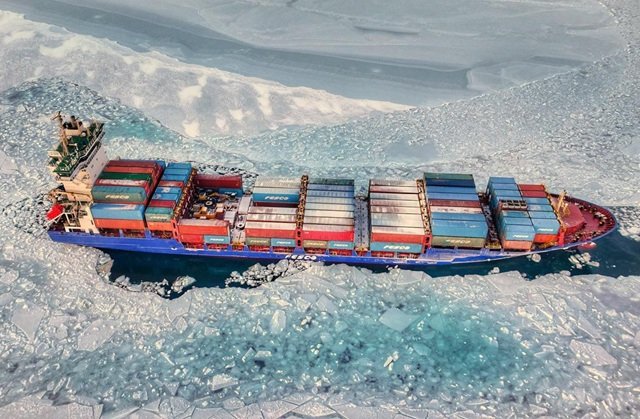
For centuries, the Arctic was less a highway than a barrier. European explorers searched for a northern maritime passage to Asia from the 1500s onwards, repeatedly confronting ice, distance and extreme conditions. Now, as climate change opens a seasonal window through the Arctic and geopolitical upheaval disrupts established shipping routes, Asian commercial interests are turning towards the same waters.
China, South Korea and India are all preparing to make greater use of the Northern Sea Route (NSR), the maritime corridor running along Russia’s northern coast. The shift is being driven by two forces that have little to do with conventional commercial planning: a warming Arctic and growing instability around the Middle East.
Last Saturday, Chinese shipping company Sea Legend launched the first scheduled weekly container service across the top of the world, marking the realisation of Beijing’s long-held ambition to build a “Polar Silk Road”.
The company will not remain alone for long. On Sunday, South Korea’s PanStar Group plans to send its own pilot vessel from Busan through the NSR towards ports in the UK, the Netherlands and Poland. India is also preparing to dispatch its first cargo ship along the same corridor next year.
“In 2027, we are planning to have the first pilot vessel running through the Northern Sea Route. We are seeing huge possibilities,” S. Venkatesapathy, a joint secretary in India’s shipping ministry, reportedly told the Arctic-Regions Forum in Arkhangelsk, Russia, on August 13.
The Arctic opening is closely connected to climate change. Rising sea temperatures mean that the Arctic ice pack is no longer impassable during summer, creating a navigable period roughly between July and October.
At the same time, geopolitical disruption has made traditional routes increasingly expensive and uncertain. Threats to shipping in the Red Sea, combined with the near-total closure of the Strait of Hormuz amid the Iran war, have forced many vessels to divert around southern Africa. Those diversions can add mounting costs and up to two weeks to journeys that previously passed through the Suez Canal.
The NSR offers a potentially dramatic alternative. It can shorten shipping distances between Asia and northern Europe by as much as 40 per cent and reduce transit times by roughly two weeks compared with the Suez route.
Sea Legend says it can travel from Ningbo in China to Felixstowe in the UK in around 20 days, compared with about 40 days via Suez.
“The NSR and the related Northeast Passage have great potential to connect Asia and Europe faster and more easily, and this potential is gradually starting to be realised,” said Ivan Lidarev, an Asian security expert at the Institute of South Asian Studies in Singapore.
“Significantly, it will also help transit more Russian energy resources to Asia.”
For China, the commercial attraction is particularly clear. Two-way goods trade between China and Europe reached €759 billion (US$887 billion) last year, according to European Union statistics, making the reliability and efficiency of connections between the two economies a significant consideration.
“China will be the main beneficiary,” Lidarev said. “The route will greatly facilitate its trade with Europe, a crucial trading partner amid tensions with Washington, and avoid US-controlled sea lanes and chokepoints.”
China’s interest in the Arctic route also has a longer history than the latest commercial developments. Its first commercial transit of an Arctic shipping route by a Chinese merchant ship took place in 2013, five years before Beijing formalised its Polar Silk Road ambitions in a 2018 policy paper.
India’s interest is driven by both logistics and strategic considerations. Cedomir Nestorovic, a geopolitics professor at ESSEC Business School, said using the route would allow New Delhi to advertise its “strategic autonomy” to Washington while opening another channel for accessing Russian oil, gas and minerals.
The shorter route could also reduce India’s shipping times to Europe, while providing Delhi with additional leverage in negotiations on a long-awaited free-trade agreement with the United States, Lidarev said.
The NSR could also strengthen India’s connections with Russia’s far east. Uday Chandra, a political-science professor at India’s Ashoka University, pointed to Delhi’s parallel efforts to increase links between Vladivostok and Indian ports including Chennai, Visakhapatnam and Paradip.
South Korea is approaching the route from a more explicitly commercial perspective. Its planned pilot voyage is intended to test the viability of the NSR, with its vice-minister of oceans and fisheries, Nam Jae-hon, recently describing the Arctic passage as “bound to become an alternative to Middle Eastern routes”.
The government-funded Korea Institute for Economic Policy has estimated that an Arctic journey to Europe could cut travel time by about 10 days while reducing the distance travelled by approximately 7,000km.
South Korea is unlikely to be the last Asian economy to explore the possibility. Lidarev said Japan had also shown interest, while Southeast Asian states such as Singapore could follow if geopolitical conditions align.
“Over the long term, if climate trends further extend the navigable window, East Asian economies will inevitably utilise the corridor to optimise seasonal trade,” Nestorovic said.
Yet the emergence of an Arctic shipping route does not mean the established maritime system is about to be replaced.
Traffic through the NSR remains modest. Last year, the Norwegian non-profit research foundation the Centre for High North Logistics recorded 88 vessels making 103 transits, compared with 97 in 2024 and only 43 in 2022.
Tanker shipments carrying Russian crude oil and petroleum products accounted for most of the traffic last year, according to an analysis by the Eurasian Rail Alliance Index, alongside dry bulk carriers likely transporting coal eastward.
The route also cannot solve Asia’s most immediate energy vulnerabilities. Historically, the Middle East has accounted for roughly half of China and India’s oil imports, meaning that disruption around the Strait of Hormuz remains a problem that an Arctic corridor cannot address.
“The NSR cannot replace the Strait of Hormuz or the Strait of Malacca for Asia’s energy security,” Nestorovic said.
“The Arctic route connects northern Europe and Russian energy fields to East Asia, but it is geographically irrelevant for Middle Eastern energy flows.”
Practical limitations are equally significant. The NSR can be navigated without icebreaker support for only three to four months a year. Shifting Arctic ice can make conditions unpredictable, while shallow waters prevent mega-ships from using parts of the route. Sparse search-and-rescue coverage, high insurance costs and environmental regulations further restrict the corridor’s commercial potential.
For these reasons, Nestorovic said the NSR should be regarded as a supplementary seasonal corridor rather than a replacement for existing maritime arteries.
There is also a striking environmental contradiction at the heart of the Arctic shipping boom. The warming that is making the route increasingly accessible is itself being accelerated by climate change. Environmental groups including the Clean Arctic Alliance and the Norwegian Bellona Foundation have warned that soot from ships settles on Arctic snow and ice, increasing heat absorption and accelerating the melting of polar ice.
The commercial opening of the Arctic therefore comes with a paradox: the same climatic changes helping to make the route navigable are contributing to the environmental conditions that make its expansion possible.
For Asian shipping companies, however, those contradictions have not halted the search for alternatives. China has already begun regular services, South Korea is testing the route, and India is preparing its first pilot voyage.
The Northern Sea Route is unlikely to replace Suez, Hormuz or Malacca. But it no longer belongs entirely to the age of exploration. For a few months each summer, a passage that once defeated generations of explorers is becoming something far more consequential: a commercial route shaped by warming seas, geopolitical disruption and Asia’s search for new ways to reach Europe.