Chinese President Xi Jinping has called for deeper cooperation and mutual openness between China and the European Union (EU), stressing the importance of managing differences constructively while rejecting economic protectionism.
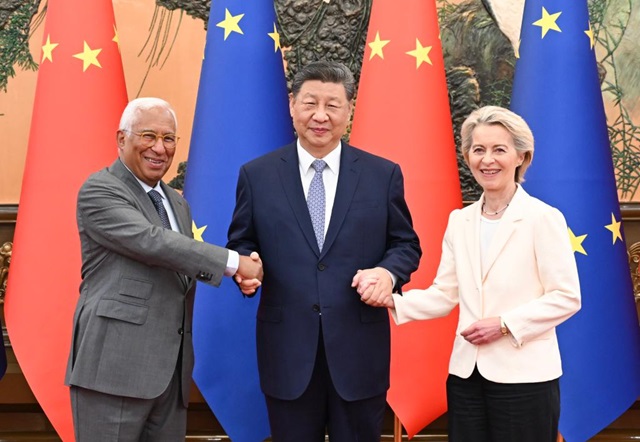
Speaking at the 25th China-EU Summit in Beijing on Thursday, President Xi met with European Council President António Costa and European Commission President Ursula von der Leyen, emphasizing the need for continued engagement between the two major global actors amid rising geopolitical tensions and economic headwinds.
“Interdependency is not a risk, and convergent interests are not a threat,” Xi said. “Boosting competitiveness should not rely on building walls or barriers. Decoupling and severing supply chains will only result in self-isolation.”
The summit comes at a time when both China and the EU face increasing pressures to recalibrate trade policies and navigate complex supply chain dependencies. Some EU member states have advocated for reducing economic reliance on China, particularly in key sectors like green technology, semiconductors, and critical minerals.
However, Xi warned that efforts to “reduce dependency” should not become a pretext to scale back China-EU cooperation. He described the bilateral economic relationship as “complementary and mutually beneficial” and emphasized that a “dynamic equilibrium” could be achieved through continued development and dialogue.
Highlighting China’s commitment to high-quality development and further opening-up, Xi said the country’s growth would unlock new opportunities for EU-China collaboration, especially in the areas of green energy, digital innovation, and mutual investment.
He also urged the EU to maintain openness in its trade and investment markets, cautioning against the use of restrictive economic tools and calling for a fair, transparent, and welcoming business environment for Chinese enterprises operating in Europe.
President Xi’s remarks reflect Beijing’s growing concern over what it perceives as a shift in EU trade policy toward greater economic defensiveness and regulatory scrutiny of Chinese investments and exports.
As the EU pursues its own strategic autonomy and green transition, the future of China-EU relations may hinge on whether both sides can strike a balance between economic interdependence and national interest—something both leaders acknowledged as a priority at the summit.
The meeting is expected to pave the way for further dialogue on trade, climate cooperation, and digital governance, with both China and the EU expressing interest in maintaining a rules-based international order while addressing their structural differences through diplomacy.