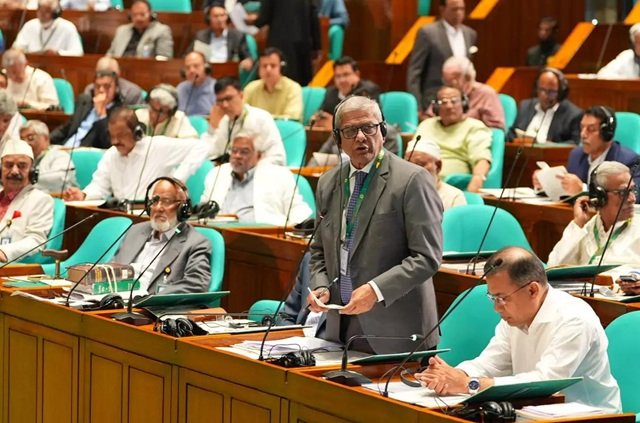
On September 10, 2026, the formation of 50 parliamentary standing committees of the 13th National Parliament was completed. Of these, only one person from the opposition party, Deputy leader of the Opposition and Deputy leader of Jamaat-e-Islami (JeI) Syed Abdullah Mohammed Taher, got the chairmanship of one committee, i.e., the Committee on Public Accounts. The opposition expressed anger over the non-distribution of parliamentary committee posts as per the proposal of the July National Charter. There is a total of 50 standing committees in the National Assembly, including 39 ministry-related and 11 subject-based committees.
On September 8, 2026, the National Assembly formed five ministry-related parliamentary standing committees.
On September 6, 2026, 10 parliamentary standing committees of the 13th Jatiya Sangsad were formed, with opposition Members of Parliament (MPs) excluded from chairing the bodies despite an agreement on 26 per cent of the chairmanships.
On September 2, 2026, lawmakers from JeI left the chamber in protest against the exclusion of opposition MPs from chairmanships of standing committees in the 13th Parliament, as 10 new committees were formed, all chaired by Bangladesh Nationalist Party (BNP) lawmakers. Taher argued that the treasury bench cannot hold all chairmanships, adding, “The will of the majority party has become the law, the decision of Parliament. That is dictatorship.”
On July 13, 2026, Parliament formed a 12-member special committee on constitutional amendment, chaired by Home Minister Salahuddin Ahmed. The opposition was asked to nominate five members, but it rejected the committee outright.
On March 15, 2026, the government appointed new administrators in 42 Zilla Parishads (District Councils) across Bangladesh. Of the total appointments, 11 administrators were central-level BNP leaders, while 31 were district-level party leaders.
After the national elections were conducted in Bangladesh, which resulted in the landslide victory of the BNP, everyone expected a clear timeline for local elections. However, the Election Commission (EC) has not yet clarified the timeline for local government elections. With this delay, the opposition is questioning the intent of the ruling party, as the government has already appointed political figures as administrators of City Corporations and District Councils. Due to these developments, BNP has faced criticism of partisanship.
Significantly, Transparency International Bangladesh (TIB) Executive Director Iftekharuzzaman criticised BNP, asserting that the appointments breach the BNP’s commitments under its 31-point agenda and election manifesto. Notably, the 31- point pledge states that administrators will be appointed only when an elected representative is removed due to death or by court order. Iftekharuzzaman asserted, “Since the government took power, the way appointments have been made to top positions in institutions of public interest – including the governor of Bangladesh Bank, vice-chancellors of various universities, and administrators of local government institutions – echoes the old ‘winner-takes-all’ culture of partisan monopolisation of the politico-governance ecosystem.”
On July 23, 2026, the government appointed BNP leaders to lead 11 state entities and also appointed a former BNP committee member to the Election Commission Secretariat. All 12 appointments were made on one-year contracts. These appointments contradicted the BNP’s election manifesto for the February 12, 2026, elections, in which it pledged:
The BNP will ensure the effectiveness and accountability of the state administration, police, and other institutions by relying solely on integrity, competence, merit, qualifications, patriotism, and experience, without considering an individual’s beliefs or disbelief, or party loyalty.
According to an analytical report published on August 13, 2026, BNP leaders had been appointed as administrators of 63 District Councils and 11 city corporations. Additionally, at least 11 party leaders have been appointed to head various state-run organisations, including:
- Abdul Bari – Chairman, Bangladesh Inland Water Transport Corporation (BIWTC)
- Zakir Hossan – Chairman, Bangladesh Handloom Board
- Kazi Rawnaqul Islam – Managing Director, Bangladesh Climate Change Trust Fund (BCCT)
- Benazir Ahmed – Chairman, Bangladesh Small and Cottage Industries Corporation (BSCIC)
- Mamun Hasan – Chairman, Bangladesh Jute Corporation (BJC)
- Mosaddek Hossain Bulbul – Chairman, Bangladesh Forest Industries Development Corporation
- Salahuddin Sarker – Director General, Bangladesh Labour Welfare Foundation
- Mohammad Rashedul Haque – Managing Director, Bangladesh Overseas Employment and Services Limited (BOESL)
- Mohammad Kamruzzaman – Executive Secretary, National Council for Social Welfare
- Abdul Khalek – Chairman, Bangladesh Steel and Engineering Corporation
- Shamsuzzaman – Chairman, Bangladesh Sugar and Food Industries Corporation
This has raised concerns in the opposition that local government could become an extension of the ruling party’s organisational network, rather than a politically neutral administrative institution. On September 5, 2026, Jamaat-e-Islami (JeI) Chief and opposition leader Shafiqur Rahman accused the government of violating its election pledges by appointing party loyalists as administrators across state institutions.
The opposition parties issued separate statements protesting the appointments of administrators at city corporations and district councils.
In its statements, Jamaat-e-Islamist (JeI) Secretary General Mia Golam Porwar declared that the move was part of a “deep conspiracy” to delay local elections and could be an early step towards staging another manipulated vote. Since the elections, JeI has repeatedly alleged rigging.
National Citizen Party (NCP) spokesperson Asif Mahmud Shojib Bhuyain also criticised the move in a Facebook post titled ‘Not votes, but control: BNP’s misuse of power over local government.’ Asif added that the tendency to take control of administrative structures before holding elections could not be dismissed as a temporary measure.
The presidential election also produced a constitutional controversy surrounding Article 70. Chief Whip of the National Assembly and BNP MP Nurul Islam stated that parliamentarians will not be able to vote for candidates outside their own party in the presidential election and added that Article 70 of the Constitution is in effect. As a result, if someone voted outside the party’s decision, their parliamentary membership would be revoked. In the presidential election, out of all 343 valid votes, BNP candidate Mirza Fakhrul Islam Alamgir secured 255, while Oli Ahmad, a contender from the 11-party opposition alliance led by JeI, got 88. This became a controversy, as the July Charter 2025 proposed reforms to the Article, but since the July Charter was never fully accepted or implemented, the criticism gained momentum. Senior Supreme Court Appellate Division Lawyer Advocate Manzil Morshed, stated, “The July Charter has proposed changes to the presidential election system. The BNP’s 31-point reform plan also addresses this issue. Before the election, the BNP said that changes would be made to Article 70. Except on matters concerning a change of government and money bills, MPs would be allowed to vote independently on other issues.”
These recent developments suggest a pattern of institutional consolidation by the BNP across multiple levels of governance, including all but one Parliamentary Committee. BNP-linked figures have been appointed to leadership positions in district and local bodies before the actual local elections. They have also been appointed to apex posts in various state-run organisations. The constitutional ambiguity and broken promises on reform have triggered a response from the opposition, calling the ruling party a partisan government, even as some allege a trajectory towards authoritarianism. The two parliamentary walkouts by the opposition, on July 13, 2026, and September 2, 2026, are measures of growing tensions within Parliament. Overall, the concentration of the BNP leadership and influence across local bodies, state institutions, the presidency and Parliament, raises concerns about the deepening institutionalisation of party influence in breach of electoral assurances.