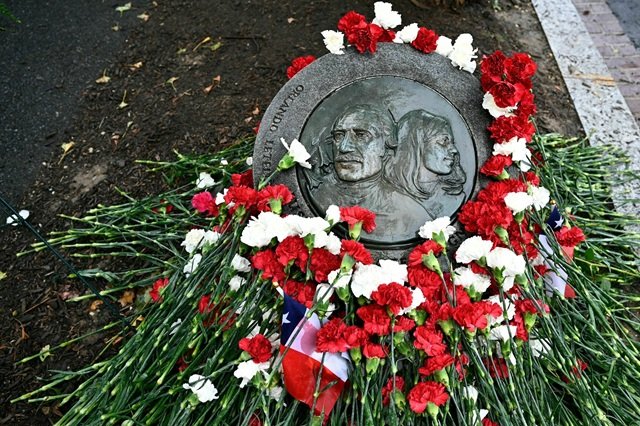
Fifty years after a car bomb killed former Chilean ambassador Orlando Letelier and his young colleague Ronni Karpen Moffitt on a Washington street, newly declassified FBI records are bringing renewed attention to one of the most consequential unresolved questions surrounding the attack: the role of General Augusto Pinochet.
The records, released by the National Security Archive, reveal the extraordinary extent to which US investigators pursued evidence concerning Pinochet, including a formal FBI interview with former US secretary of state Henry Kissinger in 2000. They also document a renewed investigation authorised by Attorney General Janet Reno in 1999, years after intelligence assessments had already pointed towards Pinochet’s involvement and an alleged cover-up by his government.
Yet the most significant evidence gathered by that investigation remains classified.
Letelier and Moffitt were killed on the morning of September 21, 1976, when a bomb planted under the chassis of Letelier’s car exploded as they travelled to work along Massachusetts Avenue, in the Washington area known as Embassy Row. Letelier had served as President Salvador Allende’s ambassador to Washington and minister of defence before the coup and had become the most prominent international voice opposing the Pinochet regime. Moffitt, 25, was a fundraiser at the Institute for Policy Studies, where both worked. Her husband, Michael Moffitt, Letelier’s research assistant, survived the bombing.
Within seven days, FBI attaché Robert Scherrer in Buenos Aires had identified a significant intelligence lead: Operation Condor, the collaboration between secret police agencies of Southern Cone governments to pursue opponents across the region and internationally. In a September 28, 1976 intelligence cable, Scherrer wrote that Chile was the centre for Operation Condor and that it was “not beyond the realm of possibility” that Letelier’s assassination had been carried out as a third-phase Condor action.
Despite that early warning, it took almost two years for the FBI to identify Chile’s secret police, DINA, as responsible for the bombing. The investigation advanced after photographs of two Chilean operatives who had sought false visas in Paraguay for a mission to the United States were published in a Washington, D.C., newspaper. They were identified as DINA agents Michael Townley and Major Armando Fernandez Larios.
Townley, an American citizen, was eventually transferred to US custody after the Carter administration demanded his extradition and months of delay by the Pinochet government. His detailed confessions concerning DINA’s responsibility for the bombing led the US Department of Justice to indict DINA director Col. Manuel Contreras and his deputy, Pedro Espinoza, alongside Fernandez Larios. Chile was formally asked to extradite them.
The case then moved beyond the identification of the operatives towards the question of who had authorised the assassination.
CIA intelligence reports later described an effort by Pinochet to “stonewall” the investigation and protect Contreras from prosecution. A June 1978 CIA report stated that Contreras had “admitted his culpability” to the official Chilean military investigator but threatened to say that he had acted on Pinochet’s orders if prosecuted. According to the CIA report, Contreras claimed to possess documentation supporting that threat. “This blackmail threat worked,” the report stated. “Thus, the coverup began.”
The question of Pinochet’s personal responsibility gained renewed prominence in 1987 after Fernandez Larios defected. In January that year, a small US team secretly debriefed him in Santiago for ten hours. According to the newly released debriefing records, Fernandez Larios implicated Pinochet in ordering the assassination and described efforts by the former dictator to prevent him from leaving the military and going to the United States.
Fernandez Larios also related information concerning Contreras. According to the debriefing documents, Contreras had told military investigator Hector Orozco that he had “given the order” to kill Letelier. When asked who had issued the order, Contreras reportedly directed Orozco to “ask the chief”. Since Contreras reported directly to Pinochet, the debriefing concluded that the reference was reasonably clear.
The evidence became public when Fernandez Larios appeared in Washington District Court on February 4, 1987, and pleaded guilty to “being an accessory after the fact” to Letelier’s murder. Although his legal proffer was regarded as having low evidentiary value, it generated international headlines and prompted renewed debate within the Reagan administration over US policy towards Pinochet’s regime.
Secretary of State George Shultz subsequently asked the CIA to conduct a comprehensive review of its intelligence on the assassination. On May 1, 1987, the CIA produced what the National Security Archive describes as one of the most consequential declassified documents in the case. Its assessment stated that a review of the agency’s files had produced what it regarded as “convincing evidence that President Pinochet personally ordered his intelligence chief to carry out the murder.”
Shultz then presented the findings to President Ronald Reagan, arguing that the bombing represented direct involvement by a head of state in an act of terrorism in Washington. He also raised the possibility of indicting Pinochet, although the United States ultimately did not do so.
Instead, US policy concentrated on supporting Chile’s transition to democracy in 1990 and encouraging the new civilian government to prosecute senior DINA officials. Contreras and Espinoza were convicted in the early 1990s and sentenced to seven and six years respectively.
The question of prosecuting Pinochet returned after his arrest in London on October 16, 1998. Under pressure from the Letelier and Moffitt families and human rights advocates, the Clinton administration revisited the case. On February 8, 1999, Attorney General Janet Reno authorised a “major” investigation into whether sufficient admissible and credible evidence existed to establish the involvement of additional people, “up to and including General Augusto Pinochet”.
The investigation, codenamed “CHILBOM”, involved FBI and Justice Department investigators reviewing thousands of documents and travelling to Chile and Argentina. Between March 20 and April 20, 2000, a special delegation spent a month in Chile taking sworn testimony. The FBI reported that 38 of 46 requested witnesses had been deposed; five had died and two were fugitives on unrelated matters.
Among those interviewed was Manuel Contreras, then imprisoned at Punto Peuco. His deposition remains almost entirely redacted. According to one investigator, Contreras blamed the CIA for the bombing, repeating a cover story that had previously been used to absolve the Chilean regime.
The investigation also reached Henry Kissinger. On May 25, 2000, FBI agents interviewed him in New York about a private meeting with Pinochet in Santiago three months before the assassination. According to the FBI summary released by the National Security Archive, Kissinger recalled Pinochet raising Letelier’s name while discussing contacts between Christian Democrats and opponents of the Pinochet regime and members of the US Congress. Kissinger could not recall whether Pinochet had become angry when speaking about Letelier.
By August 2000, Justice Department lawyers investigating Pinochet had presented Attorney General Reno with evidence summaries and recommendations concerning possible prosecution. Reno deferred action to the incoming George W. Bush administration, which took office in January 2001. The investigation appears to have been shelved. As one US official later told Chilean journalist Pascale Bonnefoy in 2002, “The Letelier case disappeared down a black hole.”
That unresolved ending is now at the centre of the National Security Archive’s anniversary release. Fifty years after the bombing, the FBI evidentiary records and Justice Department recommendations concerning the CHILBOM investigation remain classified. An FBI memorandum dated December 2000 identified an “investigative summary of the CHILBOM investigation”, but that document was withheld from declassification.
The National Security Archive is now calling on the Department of Justice to release the remaining records and its conclusions. Peter Kornbluh, who directs the Archive’s Chile Documentation Project, said: “The verdict of history on General Pinochet’s role as an international terrorist awaits the declassification of these final documents.”
Half a century after the bomb exploded on Embassy Row, the historical record has therefore expanded without becoming complete. The newly released files reveal how repeatedly US investigators returned to the question of Pinochet’s role, from intelligence cables in the 1970s and the Fernandez Larios evidence in 1987 to the CHILBOM investigation and the FBI’s interview with Kissinger in 2000. But the documents that might show how investigators ultimately assessed that evidence remain out of public view.
The Letelier-Moffitt case has survived successive investigations, political transitions and decades of secrecy. The latest disclosures do not close the case. They make clear how much of its final chapter remains hidden.