


The Chittagong Hill Tracts (CHT), nestled in the southeast of Bangladesh, have long been the homeland of the Chakmas, Marmas, Tanchangya, Tripura, and other indigenous communities. These peoples have cultivated their ancestral lands, nurtured deep-rooted traditions of Buddhism and Hinduism, and maintained autonomous governance structures for over a millennium. This was a region of harmony and spiritual depth—one where monasteries and temples dotted the hills, and where Buddhist teachings coexisted peacefully with Hindu customs. Today, however, these communities face an existential crisis. A relentless campaign of demographic engineering, militarisation, land seizure, cultural erasure, and systemic violence has pushed these peoples to the brink of extinction—unfolding in full view of an international community that remains disturbingly silent or, worse, complicit.
The historical roots of these communities stretch far beyond the modern borders of Bangladesh. Archaeological and colonial records indicate that the CHT has been a predominantly Buddhist region since at least the 9th century CE. Hereditary rulers such as the Chakma Raja and Bohmong chiefs held authority, preserving their cultural and religious identities while resisting Mughal incursions and Islamic conversion attempts. The British colonial administration recognised this distinct identity. In 1787, the East India Company signed a treaty acknowledging Chakma sovereignty. Later, the 1900 Chittagong Hill Tracts Regulation Act forbade non-indigenous settlement in the region, and the 1935 Government of India Act designated the area as “Excluded” to protect its unique character.
However, in 1947, Britain disregarded the wishes and identity of the 98% Buddhist-majority population and handed the CHT to Muslim-majority Pakistan. This colonial betrayal laid the foundation for the violence and marginalisation that continues to this day. Upon the creation of Bangladesh in 1971, the new state refused to acknowledge the indigenous identity of the region’s peoples, instead labelling them as “tribals” or “upajati.” This denial of identity was accompanied by the denial of land rights, cultural autonomy, and representation.
The most devastating blow came between 1979 and 1983, when the Bangladesh government carried out a large-scale resettlement program. Over 400,000 Bengali Muslims were relocated to the CHT, altering the region’s demographic composition. This was done in phases—first with 25,000 settlers, then 100,000, and finally 250,000. Backed by the military, this demographic shift was not just a population policy—it was an act of cultural erasure and Islamisation. Entire villages were razed, land was seized, and indigenous people were driven into exile or coerced into conversion. The Chakma, Marma, and other communities saw their ancestral lands transformed into outposts of Bengali Muslim expansion. The state refused to recognise the CHT’s traditional governance systems and treated its people as outsiders in their own homeland.
The numbers tell a chilling story. In 1964, indigenous Buddhists comprised roughly 75% of the CHT’s population. By 1991, they had declined to 48.5%. As of 2022, they account for just over 41%. These figures are not the result of natural demographic changes but of systematic state policies, often enforced by violence. In the name of “development” and “security,” the Bangladeshi military established camps throughout the CHT, creating a landscape of occupation where indigenous communities live under surveillance and fear.
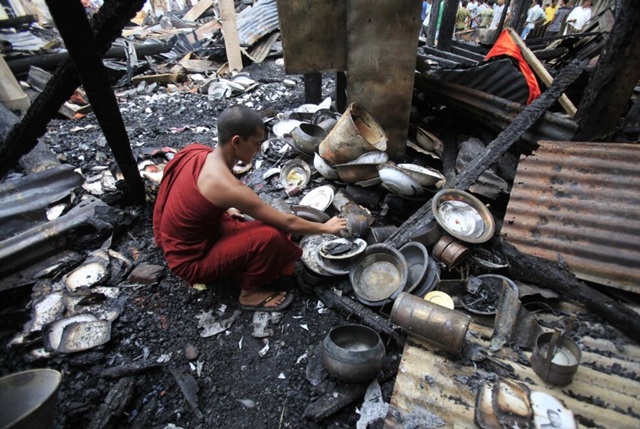
The violence is not confined to land grabs and settlements. It has taken horrific forms: massacres, arson, rape, and destruction of sacred sites. In 1980, over 300 Chakmas were killed in Barkal by security forces. In 1984, more than 500 were massacred in Bhushanchara. In 1989 and 1992, entire Buddhist villages were burned in Longadu and Logang. In 2010, over 500 homes and a Buddhist pagoda were torched in Baghaihat, and in 2017, hundreds of houses and monasteries were destroyed in Rangamati. A brutal attack in 2021 on Buddhist monk Agrojyoti Bhante in Khagrachhari exposed the vulnerability of even religious figures. In 2024, after the political fall of Prime Minister Sheikh Hasina, communal violence erupted. Bengali settlers, following the death of a fellow settler, launched reprisal attacks on indigenous homes, businesses, and places of worship—leaving death, displacement, and destruction in their wake.
The use of rape as a weapon of war has further traumatised indigenous communities. Women are systematically targeted to sow terror, destabilise families, and destroy social cohesion. This tactic falls squarely under the UN’s definition of genocide, which includes “causing serious bodily or mental harm” and “forcibly transferring children of the group to another group.” Yet, there has been no prosecution, no international inquiry, and no justice.
Education, too, has been weaponised. Over 70 indigenous schools have been closed or occupied by settlers or the military. Thousands of children, particularly Chakma and Marma, have been denied the right to learn in their mother tongue. This is not simply the loss of education—it is the dismantling of identity, the erasure of language, and the stunting of cultural transmission.
The so-called 1997 Peace Accord promised autonomy, the withdrawal of military forces, and the restitution of land. Nearly three decades later, these promises remain unfulfilled. Military camps still dominate the region, Bengali Muslim settlements continue to expand, and the promised return of lands has not materialised. Instead of autonomy, the indigenous peoples live under occupation, their voices silenced, and their culture systematically dismantled. The accord, once a symbol of hope, has become a monument to broken promises.
This is not an internal matter confined to Bangladesh. The crisis in the CHT mirrors a broader historical pattern of Buddhist erasure across South Asia. Afghanistan’s Bamiyan Valley, once a thriving Buddhist centre, was obliterated. Pakistan’s Gandhara civilisation lies in ruins, its once-vibrant Buddhist culture extinguished. The Maldives was forcibly converted in the 12th century. In India, centuries of conquest and coercion reduced Buddhism to a marginalised faith. The CHT is simply the latest chapter in this long story of cultural genocide—a continuation of a deliberate campaign to extinguish Theravāda Buddhist civilisation from the subcontinent.
The silence of the international community is not neutrality—it is complicity. The UN, the UNHRC, Amnesty International, Human Rights Watch, and Western governments have all failed to act. Scattered reports and polite condemnations do nothing to halt genocide. Bangladesh is a recipient of international aid, a strategic partner, and a geopolitical buffer. These alliances have come at the cost of the lives, lands, and heritage of indigenous peoples. Britain, too, cannot escape responsibility. It was colonial decisions that set the wheels of this destruction in motion by ignoring the CHT’s Buddhist identity in 1947. Historical accountability must be recognised.
The legal and moral imperatives are clear. Under the UN Genocide Convention and international law, the world is obligated to prevent, punish, and respond to acts of genocide. Bangladesh has systematically altered the demography of the CHT, targeted communities with rape and killing, destroyed places of worship, and forcibly displaced thousands. These are not isolated incidents—they form a coherent, sustained campaign of ethnic cleansing.
Immediate action is needed. A UN Special Rapporteur must be appointed to investigate these crimes. All state-sponsored settlements and military occupations in the CHT must cease. Lands and properties must be returned to their rightful owners. Protection for indigenous women must be prioritised. The 1997 Peace Accord must be enforced under international supervision. And the people of the CHT must be recognised as indigenous nations with full ancestral rights.
A proposal is therefore made for a Council of Buddhist Nations for the CHT, under the sponsorship of Theravāda Buddhist-majority countries—Sri Lanka, Myanmar, Thailand, Laos, Cambodia, and Bhutan. The council would comprise respected Buddhist leaders, not politicians, and operate on fixed terms, rotating leadership and collective decision-making. Its mandate would be to protect the CHT’s indigenous peoples, preserve cultural and religious heritage, prevent forced assimilation, and maintain transparency and accountability. This model could be extended to other threatened Buddhist communities in South and Southeast Asia.
The survival of the CHT’s peoples is not merely a regional concern. It is the preservation of an ancient civilisation that links us to Asia’s Buddhist past—a civilisation now under siege. The pattern is unmistakable, the crimes well-documented, and the consequences devastating. What remains is the courage to act.
History will not forget those who stood idle. The UN, the West, and former colonial powers can no longer claim ignorance or neutrality. Their inaction enables ongoing genocide.
Justice delayed is genocide continued.










