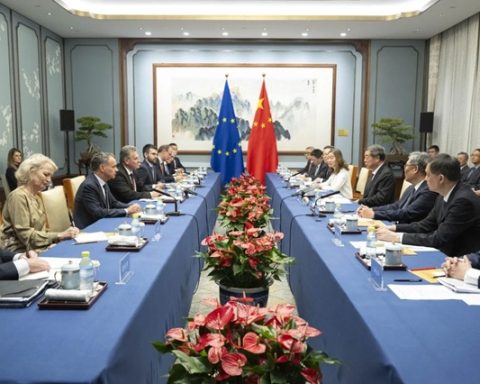
Taiwan’s Foreign Minister Lin Chia-lung accused China on Wednesday of reneging on a written promise to ensure “equal participation” for Taiwan at next year’s Asia-Pacific Economic Cooperation (APEC) summit, which will be held in the southern Chinese city of Shenzhen. Lin said that Beijing, which won hosting rights during last year’s APEC meeting in Peru, had pledged to respect Taiwan’s status and guarantee the safety of its delegation but has since “added a lot of conditions” to restrict participation.
The Asia-Pacific Economic Cooperation forum remains one of the few international organizations in which Taiwan, officially known as “Chinese Taipei,” is a member. However, the island’s involvement is increasingly fraught as Beijing intensifies military and diplomatic pressure, seeking to assert its claim of sovereignty over Taiwan. The 2025 summit comes amid some of the lowest cross-strait tensions in years, with China repeatedly warning countries not to support what it calls separatist moves by Taipei.
Lin told reporters at Taiwan’s parliament that Beijing’s shift represents a clear breach of its earlier commitments. “During last year’s APEC meeting in Peru, when China was vying for next year’s hosting rights, it made a written commitment to support Taiwan’s equal participation, particularly regarding the safety of attendees,” he said. “China has now imposed numerous conditions on our participation in next year’s APEC summit in Shenzhen, which violates that prior commitment. We will defend our rights and coordinate with like-minded nations to counter these actions.”
In Beijing, Zhang Han, spokesperson for China’s Taiwan Affairs Office, responded that Taiwan’s participation will be handled “in accordance with the one China principle and provisions and practices of relevant APEC memorandums of understanding.” The principle, which Beijing views as non-negotiable, asserts that both sides of the Taiwan Strait belong to one China. Taiwan’s government, however, firmly rejects that interpretation, insisting that the People’s Republic of China has no right to represent the island in international affairs.
Taiwan’s leaders have long been cautious about their role at APEC meetings. The island does not send its president to summits to avoid political tension, and no APEC member maintains formal diplomatic ties with Taipei. The last time China hosted an APEC summit in 2014, cross-strait relations were far warmer under then-President Ma Ying-jeou, who signed historic trade and tourism deals with Beijing. But the mood has since soured. In 2001, Taiwan even boycotted the APEC summit in China over disagreements about who could represent it.
Now, with China tightening its political grip over international forums and refusing to engage with Taiwan’s current president, Lai Ching-te, whom it brands a “separatist,” the latest dispute over APEC participation highlights the deepening chasm between Beijing and Taipei—and the mounting geopolitical strain across the Asia-Pacific.