


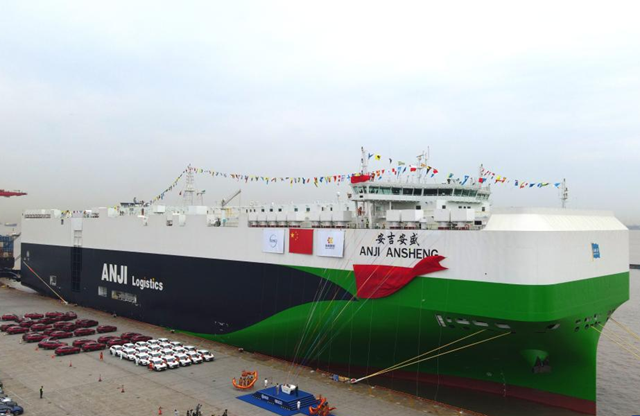
Marking a major milestone for China’s maritime and automotive industries, Anji Ansheng, the world’s largest ocean-going car carrier by capacity, embarked on its maiden voyage to Europe on Thursday evening. Departing from the Shanghai Haitong International Automotive Terminal, the vessel carries approximately 7,000 domestically produced vehicles, symbolizing the rapid ascent of China’s export and manufacturing power.
Built by China Merchants Industry Holdings and operated by SAIC Anji Logistics Co., Ltd., Anji Ansheng boasts an impressive 228-meter length and 37.8-meter width, with a maximum carrying capacity of 9,500 standard vehicles. It surpasses the previous record set just weeks ago by BYD Shenzhen, a domestically constructed carrier from electric vehicle giant BYD.
“The fact that this record has been broken again in less than a month reflects the rapid rise of China’s mid-to-high-end manufacturing sector, and the resilience and vitality of the country’s foreign trade despite complex global conditions,” said Gao Yuning, deputy director of the School of Public Policy and Management at Tsinghua University.
The vessel incorporates cutting-edge energy-saving technologies, intelligent low-carbon systems, and is equipped for future methanol refueling—demonstrating a commitment to sustainable maritime transport and paving the way toward carbon neutrality.
“China’s large-scale construction and delivery of vehicle carriers are propelling the country’s ocean-going auto transport capacity to new heights,” said Zheng Hehui, deputy general manager of China Merchants Industry Holdings.
The launch of Anji Ansheng coincides with booming demand for Chinese-made automobiles abroad. According to SAIC, the company has delivered over 5.5 million vehicles internationally as of the end of 2024, maintaining over 1 million units in annual overseas sales for three consecutive years.
Nationally, China’s automobile exports exceeded 6.4 million units in 2024, securing the top global position for the second year running. Between January and April 2025, over 1.93 million vehicles were exported, reflecting a 6% year-on-year growth.
Shanghai’s Haitong Terminal, the vessel’s departure point, handled 740,000 vehicle exports in the same period—up 25.1% year-on-year—highlighting the resilience of China’s auto export infrastructure amid global trade uncertainties.
“This momentum reflects not only the rising competitiveness of Chinese brands but also the strong capabilities of China’s auto industry,” said Cui Dongshu, secretary general of the China Passenger Car Association.
China’s growing automotive clout was also on display at the 2025 Shanghai Auto Show, which welcomed more than 12,000 international dealers. “China is doing a great job in terms of technology, and the cars are very reliable,” said Agustin Garcia, CEO of Spain’s Sarmovil Auto Group. “People see Chinese cars as offering a good balance between price and quality.”
Looking ahead, SAIC Anji Logistics plans to expand its ocean-going fleet to 22 vessels by 2026, with routes spanning Western Europe, Mexico, Southeast Asia, and the Middle East.
“For automakers, owning a fleet ensures stable export operations, reduces transportation costs, and guarantees timely delivery of products to overseas customers,” said Xie Xiaowen of the China Communications and Transportation Association.











