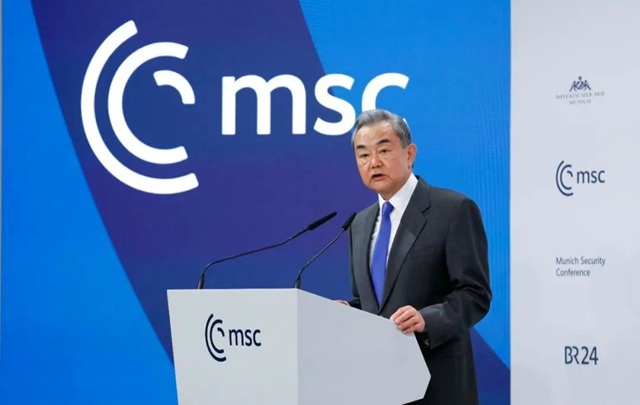
At the 61st Munich Security Conference (MSC) on Friday, Chinese Foreign Minister Wang Yi reaffirmed China’s consistent approach toward its relationship with the United States, emphasizing the country’s strategic resolve and the credibility expected of a major power. Wang, who is also a member of the Political Bureau of the Communist Party of China Central Committee, underscored that China’s policy toward the US is firm and stable, and will not change easily. He explained that this policy is anchored in three guiding principles proposed by President Xi Jinping: mutual respect, peaceful coexistence, and win-win cooperation.
Wang elaborated on these principles, explaining that the differences in the social systems of China and the US reflect the choices made by their respective peoples, and that it is unrealistic to try to transform or overturn each other’s systems. He emphasized that mutual respect is the foundation for meaningful interactions between the two nations. Peaceful coexistence, he continued, is crucial, as any conflict between the US and China would have far-reaching consequences for the world. Win-win cooperation is necessary, Wang stated, because both countries must collaborate to tackle global challenges, which is also their international responsibility.
China, according to Wang, is committed to building a stable, healthy, and sustainable bilateral relationship with the US based on these principles. However, he added a firm note of caution, declaring that if the US insists on suppressing China, Beijing would stand its ground without compromise. Wang stressed China’s commitment to defending its national sovereignty, dignity, and development rights, which he said also serves to uphold international fairness and justice, and maintain the basic norms of international relations.
Further, Wang drew on Chinese cultural references to highlight the resilience and determination of the Chinese people. He quoted traditional sayings about the strength and perseverance of individuals in the face of challenges, symbolizing the enduring character of the Chinese nation. Wang conveyed China’s confidence in both the future of the world and China-US relations, expressing hope that both countries would work toward the three principles that reflect the international community’s expectations.
Lü Xiang, a researcher at the Chinese Academy of Social Sciences, remarked to the Global Times that Wang’s speech was an affirmation of China’s longstanding position on China-US relations. Lü noted that while it remains uncertain how the new US administration will formulate its China policy, Wang’s remarks help promote a better understanding of China’s stance and lay the groundwork for future high-level interactions between the two nations.
In the context of the MSC, US Vice President JD Vance controversially stated that the biggest threat to European security comes not from China or Russia but from within. This remark has sparked further discussion on global security dynamics, with Chinese scholars like Li Haidong, a professor at China Foreign Affairs University, suggesting that the ongoing reshaping of US foreign policy might present an opportunity for China and the US to explore potential cooperation.
Wang’s keynote address also discussed the broader global challenges facing the international community, particularly regarding multilateralism and economic cooperation. He emphasized the importance of equal treatment, the respect of international law, and the need for open, cooperative global relations. He criticized protectionism, tariffs, and decoupling, warning that such measures would ultimately harm all parties involved and undermine global opportunities. He advocated for a multipolar world where nations collaborate based on the principles of equality and inclusiveness.
During a meeting with Harvard University professor Graham Allison, Wang outlined China’s approach to managing its own affairs, promoting Chinese modernization, and taking on the responsibilities of a major power. He highlighted China’s role in upholding the basic principles of international relations based on the United Nations Charter and advancing the democratization of global relations. Wang reiterated China’s position that its policies regarding US relations would remain stable, with a focus on fostering a healthy, stable, and cooperative relationship.
In addition to addressing US-China relations, Wang also discussed the ongoing Ukraine crisis. He expressed China’s commitment to peace, noting that the ultimate resolution of any conflict must come through dialogue and negotiation. Wang reiterated China’s four-point proposal on the Ukraine crisis, which calls for respect for sovereignty and territorial integrity, adherence to the UN Charter, consideration of the legitimate security concerns of all parties, and support for peace efforts. He emphasized that Europe must play a leading role in peace talks to address the root causes of the crisis and work toward a balanced and sustainable security framework for long-term peace in the region.
On the matter of China’s trade relations with Russia, particularly in the oil and gas sector, Wang defended China’s position by explaining that China and Russia, as major neighboring countries, have developed a comprehensive strategic partnership. This partnership, Wang stressed, is non-alliance, non-confrontational, and not aimed at third parties. He pointed out that China’s trade with Russia is necessary to meet the energy needs of its 1.4 billion people, underscoring that the trade relations are normal and consistent with China’s national interests.