Turkey’s opposition is betting that voters will reject what it describes as government coercion and politically motivated legal action against its leaders, despite a series of setbacks that have weakened its position since its strong performance in the March 2024 local elections.
The opposition had viewed its gains in the municipal elections as a potential route to challenging President Tayyip Erdogan, who has held power as prime minister and president for 23 years. More than two years later, however, its leading presidential challenger is in prison, its main political party has been divided by a court ruling, and several elected mayors have defected to Erdogan’s ruling AK Party.
Opposition leaders maintain that democratic elections remain the way to challenge the government and believe voters will eventually reject what they regard as a campaign of political pressure. The government denies that legal proceedings against opposition figures are politically motivated and maintains that the judiciary operates independently.
The immediate challenge for the opposition is to sustain public dissatisfaction until the next national elections, scheduled for 2028. Seren Selvin Korkmaz, co-founder and co-director of the Istanbul-based IstanPol Institute, said public anger remained significant but warned that it could dissipate without effective political organisation.
“I do not believe this anger has disappeared,” Korkmaz said. “However, unless this anger is channelled into political energy or organisational energy, it will fade away. It may evolve into disappointment, hopelessness or apathy.”
The difficulties facing the opposition are particularly evident in Izmir, western Turkey’s major coastal city and a traditional stronghold of secular and social democratic politics. The city, which has approximately 4.5 million residents, has never been won by Erdogan’s AK Party in an election.
However, Mayor Cemil Tugay, elected on an opposition ticket in 2024, defected to the governing party in October, delivering a symbolic setback to the opposition in one of its most important electoral strongholds.
Tugay defended his decision, saying it was in the best interests of Izmir. Erdogan rejected opposition allegations that the mayor had switched allegiance under pressure.
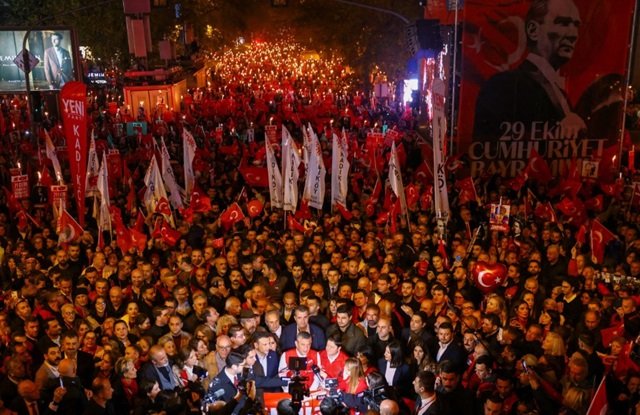
Cagatay Guc, the New Party’s head in Izmir, said the government was mistaken if it believed that political pressure and defections would determine how residents voted. The New Party, led nationally by Ozgur Ozel, has organised protests against the government’s actions and expects voters to oppose Tugay’s decision at the next national elections.
Interviews conducted by Reuters in Izmir revealed widespread criticism of the mayor’s defection, although some residents supported his argument that joining the governing party could help secure additional municipal services.
“It was Tugay who joined the AK Party, not the people of Izmir,” said a 50-year-old resident identified only as Koray, who feared possible repercussions. Another resident, 67-year-old Halide, said she would support Ozel in the next election.
However, a 46-year-old resident identified as Isa said he hoped the city’s industrial and commercial importance would translate into better municipal services through government support. Another resident, 53-year-old Alpay, suggested Tugay had little alternative, saying he would otherwise risk imprisonment. He referred to Silivri prison, west of Istanbul, where several opposition figures are being held.
Among them is Istanbul Mayor Ekrem Imamoglu, regarded as Erdogan’s principal political rival. Imamoglu won a second term in the 2024 municipal elections, when the Republican People’s Party (CHP) secured 37.8 per cent of the vote and retained control of Istanbul, Ankara, Izmir and several other major cities.
The results encouraged the opposition to view its control of major urban centres as a platform for a national political challenge. However, dozens of mayors and hundreds of municipal officials are now in prison. Imamoglu is awaiting trial on corruption charges, which he denies.
The CHP has also been divided following a court ruling that removed Ozel as party leader and reinstated former leader Kemal Kilicdaroglu. Ozel, an ally of Imamoglu, subsequently launched the New Party in an effort to maintain opposition mobilisation.
Tanju Tosun, a political science professor at Ege University in Izmir, warned that prolonged political setbacks could undermine voter confidence. “If voters lose faith that change is possible, why would they bother to vote?” he said, adding that turnout among opposition supporters could decline slightly.
Turkey’s presidential and parliamentary elections are scheduled for May 2028, although a presidential adviser said in October that voting would probably take place slightly earlier. An earlier election would allow Erdogan to circumvent constitutional limits on his eligibility and seek another term.