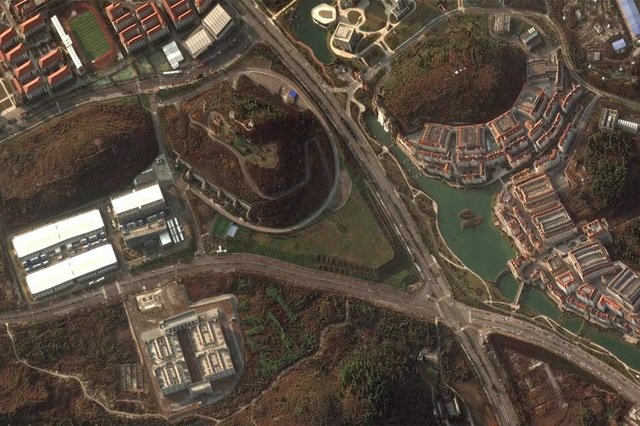
In the windswept northern region of Inner Mongolia, a landscape once defined by nomadic settlements is being reshaped into one of the most strategically important technology zones in the world. The area known as Horinger, whose name historically referred to “20 yurts” in Mongolian tradition, has become a focal point of China’s artificial intelligence ambitions, where the country’s leading tech firms and state-backed institutions are converging to build what are effectively industrial-scale AI computing hubs.
Rather than preserving its pastoral origins, Horinger now hosts a growing cluster of infrastructure designed to train and deploy large-scale AI systems. Companies such as Huawei, Tencent, and Alibaba are establishing operations alongside state-linked telecom giants including China Telecom, China Mobile, and China Unicom. Financial institutions such as the Agricultural Bank of China also form part of the expanding ecosystem, reflecting the scale of coordination behind the initiative.
At the center of this transformation is a policy objective laid out in China’s latest five-year plan: to position the country as the world’s leading artificial intelligence power. The strategy is not limited to software development or consumer applications. It extends to the physical architecture of computing itself, with entire regions in Inner Mongolia and other sparsely populated provinces being reorganized into high-density data center zones designed for AI training and inference at industrial scale.
These developments are part of a broader geographic and industrial strategy that links eastern urban technology hubs with western energy-rich regions. Known in policy terms as “Eastern Data, Western Compute,” the model relies on storing and processing vast datasets in provinces such as Guizhou, Ningxia, Xinjiang, and Gansu, where cooler climates and abundant renewable energy reduce operational costs. In these regions, data centers benefit from low electricity prices and natural cooling advantages, significantly lowering the cost of large-scale AI computation.
In places like Ulanqab and Ningxia, entire clusters of data infrastructure are emerging near solar farms and wind energy installations. Electricity costs in some areas are reported to fall to just a few cents per kilowatt-hour, with additional state subsidies further reducing expenses for operators using domestic AI chips. This economic model is designed to offset technological constraints in China’s semiconductor sector, particularly restrictions limiting access to advanced chips from Nvidia.
Despite these constraints, China’s approach is not centered on matching the most advanced foreign models in every technical dimension, but on scaling artificial intelligence into an accessible industrial commodity. Industry observers describe this as a “good enough” strategy, focused on affordability, deployment speed, and mass adoption rather than absolute technological leadership. The objective is to make AI widely usable across industries, from manufacturing and logistics to public administration and defense applications.
Within this framework, Chinese firms are rapidly expanding their AI capabilities. Companies such as DeepSeek have gained attention for offering large language models at significantly lower prices than Western competitors. According to industry comparisons, pricing for some AI services is reported to be more than 90 percent cheaper than equivalent offerings from leading US firms such as OpenAI and Anthropic. This pricing pressure is increasingly shaping both domestic and international demand, with some global companies beginning to integrate Chinese AI models into commercial offerings.
The expansion of China’s AI infrastructure is also closely tied to state industrial policy. Government directives encourage the use of domestically developed chips from companies such as Huawei, Baidu, and Alibaba, as well as emerging semiconductor firms including Cambricon. These policies aim to reduce reliance on foreign technology while accelerating the development of a self-sufficient AI ecosystem.
At the core of this system are China’s state-owned telecommunications companies, which provide both the physical and financial backbone of the data center expansion. Their control over fiber-optic networks and nationwide connectivity allows for centralized coordination of data flows between eastern cities and western computing hubs. This integration of infrastructure and policy is a defining feature of China’s approach, distinguishing it from the more decentralized, privately led model seen in the United States.
The scale of investment reflects long-term strategic planning. According to industry estimates cited in the report, China is preparing to invest hundreds of billions of euros over the coming years in a nationwide AI computing network. These investments are intended not only to support commercial AI applications but also to advance state priorities, including industrial modernization, demographic adjustment, and technological independence.
Beyond civilian applications, artificial intelligence is also being developed for defense-related use cases. The report notes that the People’s Liberation Army is exploring AI systems for decision support, autonomous systems, and battlefield coordination. Satellite networks and data processing infrastructure are being linked to real-time intelligence systems capable of supporting military operations, reflecting a broader concept of “civil-military fusion” in technology development.
In parallel, experimental AI ecosystems are forming around major technology campuses in cities such as Shenzhen, where developers, students, and industry professionals gather to test new AI agents and applications. These environments serve as testing grounds for rapid iteration, where new tools are deployed, evaluated, and refined in real time, reinforcing a culture of fast adaptation and continuous improvement.
While the United States continues to lead in frontier model development, with companies such as OpenAI, Anthropic, and major cloud providers driving large-scale innovation, China’s strategy is focused on infrastructure dominance and cost efficiency. The divergence between the two systems is increasingly defined not only by technological capability, but by economic structure, energy strategy, and state involvement.
Analysts cited in the report suggest that China’s advantage may lie in scale and cost rather than pure performance. The combination of cheap energy, centralized planning, and expanding domestic chip production creates conditions for rapid deployment, even if individual components remain less advanced than their Western counterparts. The expectation is that lower costs will drive higher usage, embedding AI more deeply into industrial and consumer systems.
The competition for artificial intelligence leadership is no longer confined to model performance alone. It now extends to infrastructure, energy, pricing, and the ability to industrialize intelligence at scale. As China continues to expand its AI data center network across its western and northern regions, the global balance of technological power is being reshaped not through a single breakthrough, but through the steady construction of an alternative computing ecosystem designed for long-term competition.