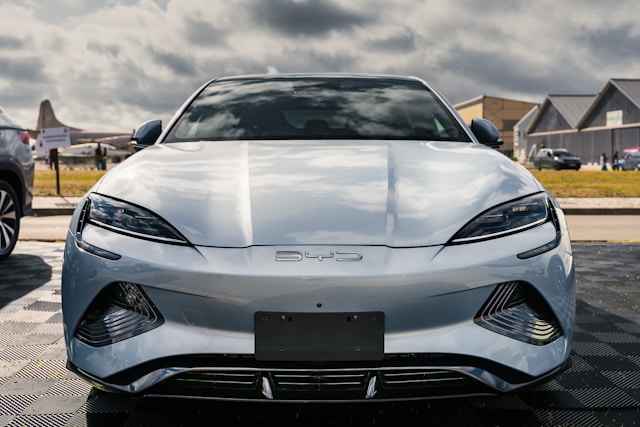
At the edge of Szeged in southern Hungary, a new industrial presence is taking shape. Dozens of Chinese construction workers walk or cycle towards a supermarket beside a sprawling construction site, where BYD, China’s largest carmaker and the world’s largest electric-vehicle manufacturer, is building its first European factory. The facility, costing around four billion euros, will include welding, pressing and painting facilities, offices and apartments across an area roughly the size of Berlin’s Tempelhofer Feld. It is designed to produce up to 300,000 vehicles a year, with production planned to begin by the end of 2026.
The arrival of BYD’s European production base represents a direct challenge to Germany’s automotive industry at a particularly vulnerable moment. Volkswagen, BMW and Porsche are already imposing major cost-cutting programmes as they attempt to compete with Chinese manufacturers. In China, BYD and other domestic brands have been taking market share from Volkswagen and other German manufacturers for years. In the United States, Donald Trump’s tariffs are squeezing their profits. Europe has remained the German manufacturers’ strongest remaining bastion, particularly in the premium segment. That position is now under pressure.
BYD sold 4.6 million vehicles worldwide in 2025, matching the combined sales of BMW and Mercedes. Its European sales increased by 150 per cent in a single year, reaching almost 175,000 passenger cars in the first half of 2026. Chinese-owned manufacturers collectively accounted for 11 per cent of newly registered passenger cars in Europe this year, rising to 12.1 per cent in June alone. Brands including Xpeng, Geely, Leapmotor and Jaecoo are becoming increasingly visible on European roads.
The challenge is not simply one of price. Chinese electric vehicles are increasingly competitive technologically. Xpeng’s G9, for example, is claimed to charge its battery from 10 to 80 per cent in 12 minutes under ideal conditions. Stefan Bratzel, head of the Center for Automotive Management in Bergisch Gladbach, named BYD the world’s most innovative car manufacturer this year, ahead of Volkswagen and Mercedes.
The cost gap is equally striking. Volkswagen chief executive Oliver Blume showed his supervisory board that assembling a car at a German Volkswagen, Audi or Porsche plant costs almost 6500 euros on average, compared with between 2000 and 2400 euros for a BYD vehicle in Hungary. BYD’s Seal 6 DM-i Touring plug-in hybrid starts at 42,990 euros, while a comparable Volkswagen Passat costs around 10,000 euros more. Once BYD begins European production, the advantages of avoiding shipping costs and tariffs will become even greater.
For Volkswagen, closing that gap could mean shrinking the company. Blume wants average factory costs reduced to 3000 euros and has put four German Volkswagen and Audi plants under consideration, while as many as 100,000 jobs could disappear worldwide in the coming years. His strategy has already triggered confrontation with IG Metall and growing distrust among workers. At Volkswagen’s Wolfsburg plant, works council chief Daniela Cavallo said confidence in the management board, particularly Blume, had been damaged.
The pressure extends beyond manufacturing. BYD has rapidly expanded its European sales network and is targeting customers with vehicles that are affordable without being perceived as cheap. Dealer Burkhard Weller has sold around 200 BYDs from one Osnabrück showroom alone and plans to establish a dedicated China House featuring BYD, Denza and MG. The company’s smaller Dolphin Surf starts at around 24,000 euros, a price point increasingly difficult for German manufacturers to match.
China’s expansion is being driven by problems at home as well. The Chinese automotive market has contracted by 20 per cent this year, while BYD’s domestic sales were down 36 per cent through July. Its exports, however, rose 81 per cent to almost one million vehicles. Europe has consequently become the most lucrative major market still open to Chinese manufacturers, offering an opportunity to compensate for collapsing margins at home.
The European Union is now considering tougher rules. The proposed Industrial Accelerator Act would from 2029 require manufacturers to build their vehicles and a large proportion of their components in Europe if they are to continue benefiting from subsidies such as Germany’s company-car privileges or purchase incentives. Chinese manufacturers are already responding by seeking European factories and partnerships, with Geely working with Ford in Spain, Dongfeng using a Stellantis plant in France and Chery occupying a former Nissan factory in Spain.
Yet the Chinese challenge is no longer confined to cheaper cars. Xpeng is targeting Europe’s premium market, while Volkswagen is considering selling electric vehicles developed in China in Europe. Opel plans to build an SUV from 2028 using technology supplied by its Chinese partner Leapmotor. German manufacturers that once defined automotive innovation are increasingly drawing on Chinese technology, particularly in software and artificial intelligence.
For European consumers, the transformation offers greater choice and potentially lower prices. For Germany, however, it presents a harsher dilemma. Buying a cheaper Chinese vehicle may save consumers thousands of euros while weakening demand for domestic production. At taxi specialist Transform GmbH in Nümbrecht, 80 BYD taxis have already been sold within weeks, with another 300 to 400 planned by the end of the year.
If that trend continues, Chinese cars will not merely be competing with German manufacturers in Germany. They will become part of the country’s everyday transport system. From the Brandenburg Gate and the Semperoper to Schloss Neuschwanstein, foreign visitors could soon take their first ride on the “German Autobahn” in a BYD.
For an industry that once dominated the global automobile, the symbolism is difficult to ignore.