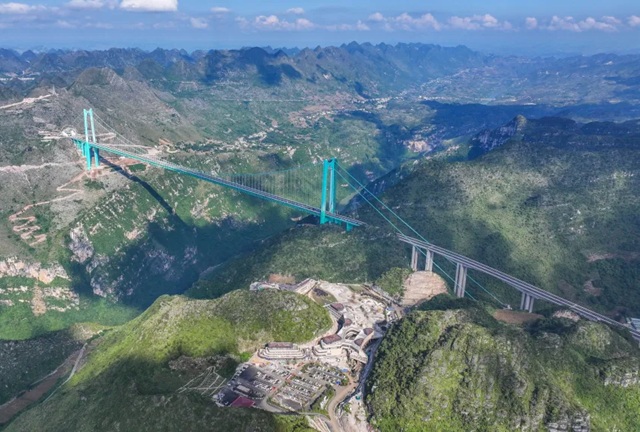
China is set to open the Huajiang Canyon Bridge in Guizhou province on Sunday, officially making it the highest bridge in the world. Suspended 625 metres above the river below, the turquoise pillars of the bridge carry a motorway across the vertiginous gorge, symbolizing yet another engineering triumph for China’s ambitious infrastructure program.
The opening ceremony will feature speeches from local officials eager to celebrate the landmark, yet behind the fanfare lies a growing economic concern. According to Times UK, the bridge — which cost approximately £200 million — is emblematic of the mounting debt burden faced by China’s inland provinces.
Guizhou, historically one of China’s poorest regions, has borrowed heavily to fund high-speed rail, motorways, and other infrastructure projects in an effort to spur economic growth. While these projects have facilitated faster travel and improved connectivity, they have done little to transform the local economy. Instead, eastern metropolises like Guangzhou and Shenzhen continue to attract the bulk of industrial investment, leaving Guizhou reliant on low-cost labor and tourism.
“This is a credit bubble of unprecedented proportions,” said Logan Wright, an analyst at the Rhodium Group, speaking to Times UK. “The story is less about crisis than about slow decay in growth, even as China continues to build record-breaking infrastructure.”
The fiscal strain comes amid slowing economic growth. According to a survey by Beijing’s Tsinghua University, the Chinese economy has stagnated in the first half of 2025, with local government debt outpacing fiscal capacity. President Xi Jinping’s low-tax policies have also limited government revenue, making it difficult to stimulate the economy without accumulating further debt.
Despite the challenges, the bridge has brought tangible benefits to locals. Residents like Niu Qiang, a used-car dealer, now enjoy significantly shorter travel times, while small business owners and tourist operators are hoping to capitalize on increased visitor numbers. Yet for many workers, the economic gains are modest. Casual laborers returning from prosperous eastern provinces often find low-paying work, highlighting the uneven distribution of wealth that has accompanied China’s infrastructure boom.
Times UK reports that the Huajiang Canyon Bridge is just one of 15 of the world’s 25 highest bridges located in southwestern China, a region now emblematic of the country’s debt-fueled growth model. Analysts warn that without structural economic reforms, China risks a slow decline similar to Japan’s post-“economic miracle” era, where infrastructure achievements outpaced sustainable economic development.
As China celebrates yet another engineering marvel, the Huajiang Canyon Bridge also serves as a stark reminder: monumental feats of construction may inspire awe, but the financial foundations supporting them are increasingly under strain.